
 Posted by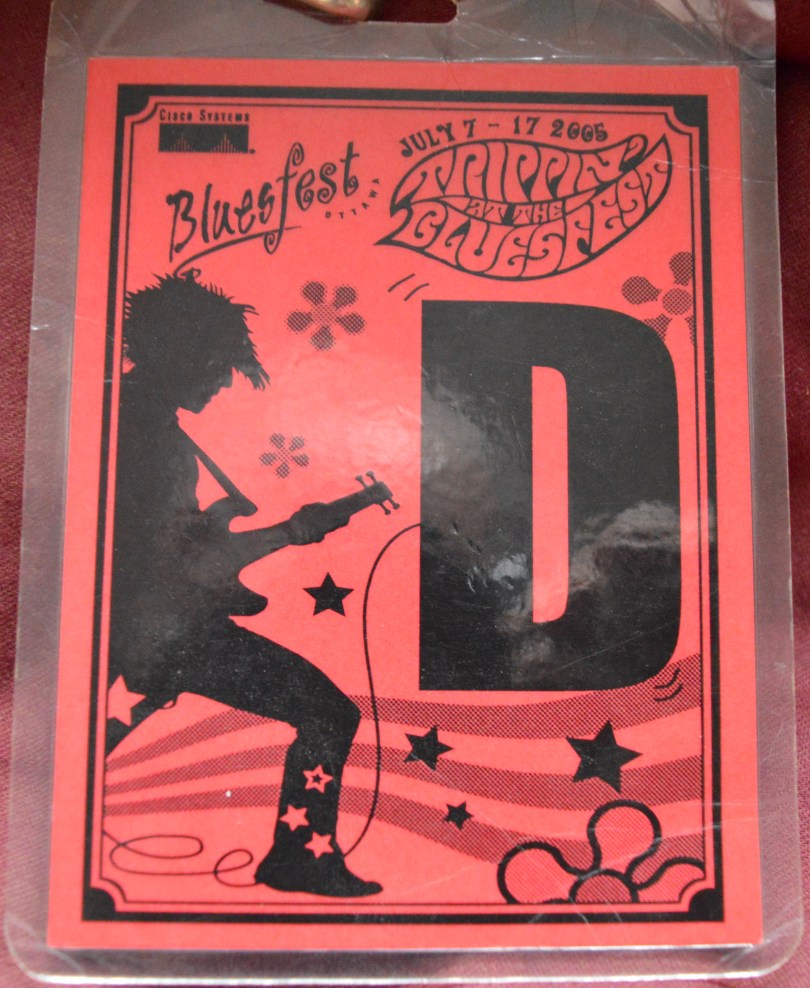
On July 16th, 2005 yet another beautiful day greeted the throngs of people out for the final weekend of the Ottawa Bluesfest. My day started early, with another of the many acts that the Bluesfest has presented that I had never heard of before, and once again I found someone new to be a fan of.
Kaki King stepped onto the main stage at 1:30pm and mesmerized me. About five feet nothin’ of singular instrumental talent, this young lady lap-steeled the audience into a lull of transcendence, and when she was finished she leaned over to the mic and gushed a “thank-you” that was so ferociously cute and timid that you could hear her blushing from a hundred feet away. The lady played her way through several different stringed instruments, showing off her comfort with the great tricks she’s picked up from players like Stanley Jordan, Don Ross, and maybe a tabla player or two. In addition to effortlessly careening around the fretboard, her strumming hand built relentless rhythms by hitting, rubbing, scratching, and tapping every part of the guitar she could get her fingers on. All in all it was a wonderfully surprising set from a player who clearly can’t take her hands off of music.
Thoroughly wowed, next I headed over to the Black Sheep stage for a Harry Manx set. Harry is a player I’d seen several times before (the first was at the Bluesfest years ago at an Ottawa Folklore Centre workshop), but he brought something new to the table this time. A few tunes into his set he brought out a tabla player and a song or two later they were joined by young Steve Mariner* (now of Monkeyjunk) on harmonica, which made for a darn fine set. For those unfamiliar, Harry Manx spent almost a decade studying music in India and upon his return he started playing raga-blues on a custom guitar outfitted with sympathetic droning strings. Hence, the addition of the quintessential Indian and blues instruments to Manx’s stellar guitar/sitar prowess was very appropriate and it worked great. And man, that Steve Mariner can really, really play.
Rain fell and postponed things a little, resulting in a truncated set by Bill Frisell. This was one of the performers I was anticipating the most of the entire festival and while the set was short, it did not disappoint. Frisell is one of the most unique and popular jazz players out there and one of the features that makes him stand out is his willingness to branch out into any direction he desires. No stranger to country music, the band he was touring with dictated a decidedly twang feel. There was an acoustic guitar/banjo player/vocalist, a lap steel player, and a fiddle player backing up Bill on his obligatory Fender Telecaster.
I’d like to say that his set was brilliant, with Frisell weaving his post-modern loops in and around old-timey country fiddle tunes and I’m sure it was, but when I think back to this day I can only see one thing: Being stuck behind a pair of bloody morons who sat in their lawnchairs dead-centre in the front row silently insulting the great Bill Frisell and his bandmates for the entire set.
Now, I’ve long been a fan of the Ottawa Bluesfest, you know that. They took a rather small festival with eclectic programming and quickly built it into Ottawa’s target event of the summer. But there was a huge issue looming over the Bluesfest back then, and it’s one the festival itself refused to address: those pesky lawnchairs.
(And to be honest this is but one of the many lawnchair events that stand out in my mind from that era of Bluesfest.)
I have been to countless concerts and festivals all over the world and I’ve never, ever seen lawnchairs become such a contentious issue as they did at the Ottawa Bluesfest. While most festivals only allow chairs in the back (leaving room for the more engaged fans to stand, dance and cheer nearest the stage) in absence of any official (or even de facto) policy the Bluesfest left the situation to police itself.
And so people set up their chairs as close to the stages as they could get them. When the festival grew to include multiple stages the masses began bringing multiple chairs. People would spend the opening ten minutes of each evening running around and setting up their chairs at every one of the stages, staking out all the best sight lines for later. And pity the poor music fan who found themselves standing between one of these chairs and one of the stages! “Hey buddy, I paid for this seat so sit down,” is another way of saying “I own this spot and all of the air between it and what I decide I want to look at.”
Which is, of course, ridiculous.
The festival ignored any and all complaints, explaining that the issue would work itself out and I suppose it did, but it sure took a long time and caused a lot of arguments along the way. Let’s just say it’s a good thing Canada doesn’t allow conceal & carry permits.
Back to the show at hand: Bill Frisell was on one of the side stages with that countrified band of great players behind him. He was touring his East/West album and I was excited to hear one of my favourite guitarists playing with his new band, even if I was stuck standing behind a samll sea of lawnchairs, many of them vacant.
Never mind the insult that one single lawnchair takes up the physical space of three dancing music fans – an indignity that pushes me and my music-loving brethren farther to the back – but what I saw at Frisell’s show that July afternoon made me feel nauseous.
There, sitting in the front row, dead centre was a man reading a newspaper. During Bill’s set. Not five feet away, the great Mr. Frisell had to buckle down and try to play brilliant music while staring at a completely disinterested hunk of meat sitting right in front of him. I mean playing to an empty room is one level of discouragement, but c’mon now, this was ridiculous. How someone could casually flip through a newspaper in full view of the artist and a thousand of his fans that are grumpily stuck standing behind them was beyond my comprehension.
And then I noticed the twisting of the knife: sitting in the lawnchair next to him his buddy was reading a grocery store flyer. What an insult.
Bill and his band played about forty-five minutes of gorgeous lay-on-the-lawn-and-put-off-contemplating-the-meaning-of-life music, and had I not been distracted by those lawnchair morons checking the sales in the damn Loblaws flyer the set might have been so intense as to have made the meaning of life scurry into a corner and cower in insignificance. Wobbly and perfect, Bill drenched the hillbilly bake with jazz syrup. When I managed to focus on the music it was like I was listening to pork chops and applesauce.
Next up was the New York Dolls. I stayed at their set just long enough to realize that punk rock and big screens don’t mix well, though admittedly I might have still been a bit miffed about the lawnchair dudes. I took a moment to explain to those gathered around me that the show wasn’t actually intended as parody and then I caught a cab home.
*I’ve probably mentioned this before, but Steve took lessons at the Folklore Centre for years. When his teacher died Steve was already accomplished enough to take on his students, and so at the ripe age of what, sixteen maybe? Steve started teaching at the Folklore Centre. And that young whipper-snapper took full advantage. Whenever he wasn’t teaching you’d find Steve roaming the store looking for some other teacher – any other teacher – who also had a break, and he’d always say the same thing: “Show me something!”
And so it was that young Steve Marriner snagged all the best tricks from all the best teachers in town and went from being a harmonica player to being a multi-instrumentalist who has toured the world and elsewhere playing the guitar, the bass, keyboards…you name it. Heck, it was the Folklore Centre so I wouldn’t be surprised if he couldn’t knock out a solo or two on the bodhrán and the aeolian pipes.
 Todd Man Out