
 Posted by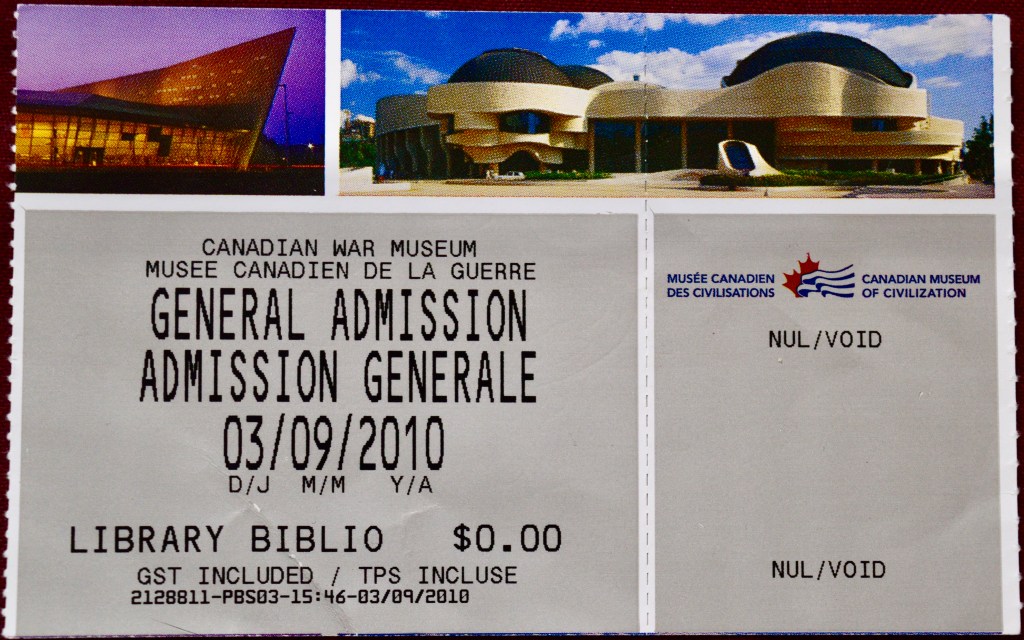
On September 3rd, 2010 m’lady and I went to Canada’s very respectful and equally respectable National War Museum here in Ottawa, an entity that I enjoy much more than the activity it memorializes. Which is to say: while I’m no fan of war nor the men who wage it* I quite appreciate the nobly curated collection and how poignantly it contextualizes both war’s role in the history of Canada and Canada’s role in the history of war.
Plus the museum is housed in just a straight-up cool clunk of architecture and I always appreciate an opportunity to careen my way through the building’s straight-edged girded caverns and angled concrete corridors. And amateur car-guy that I am I can always linger over the vast collection of military vehicles that goes well beyond the terrestrial trucks, jeeps, and tanks, reaching into the sky with towering aircraft hanging overhead and beneath the seas with a collection of very creepy early death-trap submarines that are lined along one wall.
But this time we were there specifically for an exhibit dedicated to the history of camouflage, which was a) pretty darn nifty, and b) likely the reason m’lady was along with me, camo fan that she is. And while the plethora of camouflaged uniforms were super-cool and shockingly fashionable I really dug the crazy patterns (called dazzle) that they used to paint on ships so they would be hard to identify from afar. And I’m not talking about just painting the thing blue and adding a couple of jumping dolphins on the side. No, I’m talking about bizarre off-kilter lines and grids designed to make the eyes dance in confusion so you couldn’t tell if you were looking at one ship or a half-dozen. Many of these designs were inspired by some of the biggest abstract artists of the day and as a matter of fact no less than Pablo Picasso bragged that it was his cubist art that “invented” dazzle camouflage. And being a fan of Picasso it’s no surprise that I was also a fan of this dazzle stuff.
Though I’m still not a fan of war, no matter how cool the paint job.
*I’m referring to the ringleaders here, not the actual boots on the ground.
 Todd Man Out