 Posted by
On March 21st, 2017 I experienced another of my countless visits to Canada’s National Gallery where I shelled out a dozen dollars to view my country’s wonderful art collection (which is a tiny bit offensive…shouldn’t Canadians gain admission to the gallery for free? Heck, everything in there is 1/38,000,000th mine after all). I was there for one of the featured exhibits (as I always am), this time it was the work of Alex Janvier (1935-2024).
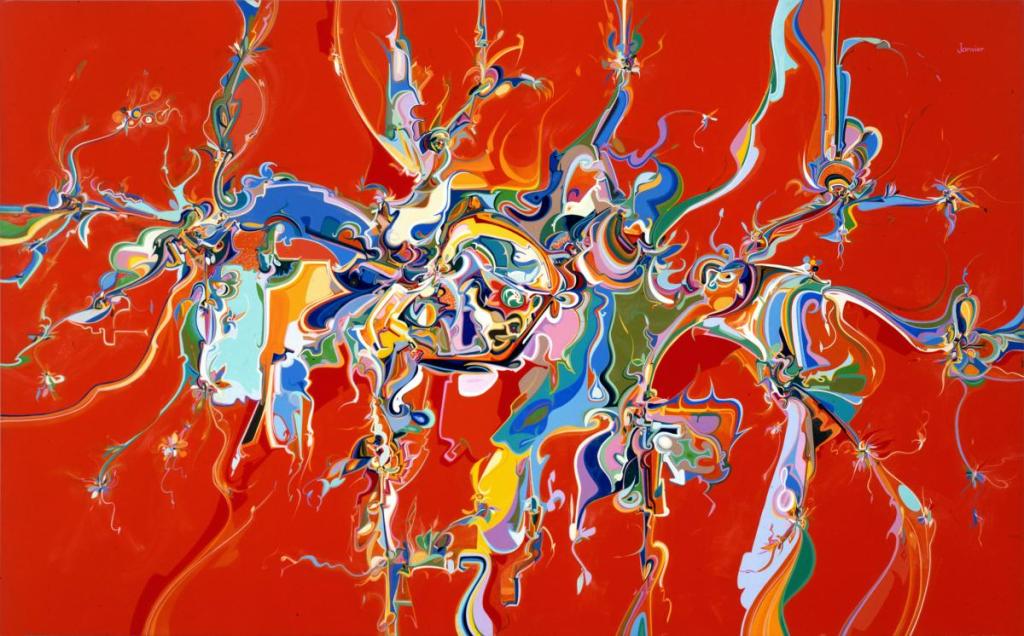
Janvier was a Canadian Aboriginal artist, but you might not realize that by looking at his work. When one thinks of Canadian indigenous art they generally picture Woodland Art, those many wonderful Norval Morriseau et al works depicting thickly outlined and multi-coloured profiles of naive native animals-within-animals encapsulating one another and staring ghostly and wide-eyed off of the canvas. Not Alex Janvier though. While his work was just as colourful as Morrisseau’s (if not more, if that’s even possible), that’s about where the similarities end. Janvier was Canada’s first Aboriginal abstract artist and his work had much more in common with the likes of Jackson Pollock and Wassily Kandinski than it did with the bulk of his shared ethnic artistic community.
You know, I’m really glad that I gained an educated appreciation of visual art. In addition to just blatantly adding to my daily enjoyment of life, my knowledge of visual art as a harbinger of all artistic mediums informs my knowledge and appreciation for the artistic medium that consumes my life: music. And this appreciation didn’t come by accident, oh no. In my first year of university my music history professor would always always always show slides of artwork when he was explaining a musical era. He was convinced that the arts were all connected and when visual art progressed in a society so did the music, and he convinced me too.
So in my second year I signed up for an art history class, but it went miserably. The first three-hour session had the lecturer present slide after slide of paintings of nuns, each one looking almost exactly like the last. I knew that I would one day be sitting in an exam room and I would be shown these same slides again, and not only would I have to identify the date and artist connected to each image, I would further be called on to expound on the differences between this particular nun painting and the next.
I don’t know what happened in the next three-hour art history class. I cut and ran; that is, I dropped the class like a hot potato before I got in too deep. Back then I was dumb as a truck – you didn’t have to be smart to get into university, you just had to be smart to get out the other end – and it didn’t really sink in that if I stuck with the class I might one day actually be able to expound freely on all things nun-related. So there went my opportunity for a traditional art-appreciation education.
But of course true education is acquired through osmosis rather than textbooks. If you surround yourself with something you’re going to learn about it, and in this case I surrounded myself with my friend and oft-roommate Eric, one of those rare individuals who did indeed arrive at university already smart. And one of the things he was smartest at was art history, which was both his university major and the profession of his single-parent father, the very eccentric and quite brilliant Hans.
Anyway, just being friends with Rico (the nickname that eventually settled upon him) taught me mile after mile about art and the people that made it. Add to that the beginning of the aforementioned countless number of visits to Canada’s national art gallery (and many, many others) to further bask in the educational osmosis of having my actual eyeballs landing on actual artwork and I tells ya, I can now expound freely. Not on nuns necessarily, but I can sure tell my Cubists from my Impressionists from my Van Gogh’s from my Gaugin’s from my Da Vinci’s from my Renoir’s from my Warhol’s from my Mueck’s.
And I can certainly tell my Janvier’s from my Morrisseau’s.
Anyway, the exhibit was great, just a blur of wonderful inky colours flowing easily in and out of each other in a seemingly random but quite un-so manner, piece after piece of simple, graceful beauty for beauty’s sake. Never splashy or spilled like Pollack but still encompassing the very similar feel of barely controlled colourful chaos, intricately thought out meaningless swirls meant to please rather than instil, and each one another blatant aesthetic pleasure.
To those that have absorbed the right osmos, that is.
 Todd Man Out