 Posted by
 - 110908 On My Way Home
- 111008 Welcome to the Jungle
- 111108 Unpacking Day One
- 111208 The Trip to Mopti
- 111308 Timbuktu
- 111408 A Big Day in the Desert (part one)
- 111408 A Big Day in the Desert (part two)
- 111508 Camels, Trucks, and Boats
- 111608 Niger River Beer Run
- 111708 Never Get Out of the Boat
- 111808 Enter the Dogon
- 111908 Sand Trek
- 112008 Life in the Valley
- 112108 The Party
- 112208 The Great Fall
- 112308 Music, Music, Music, Music!
- 112408 Collectif Soul
- 112508 Dit Weah and Djenné-Djenno
- 112608 The Long Road Back to Bamako
- 112708 No Problem
- 112808 Paris
- 112908 Fin, et Bonne Nuit
110908 On My Way Home
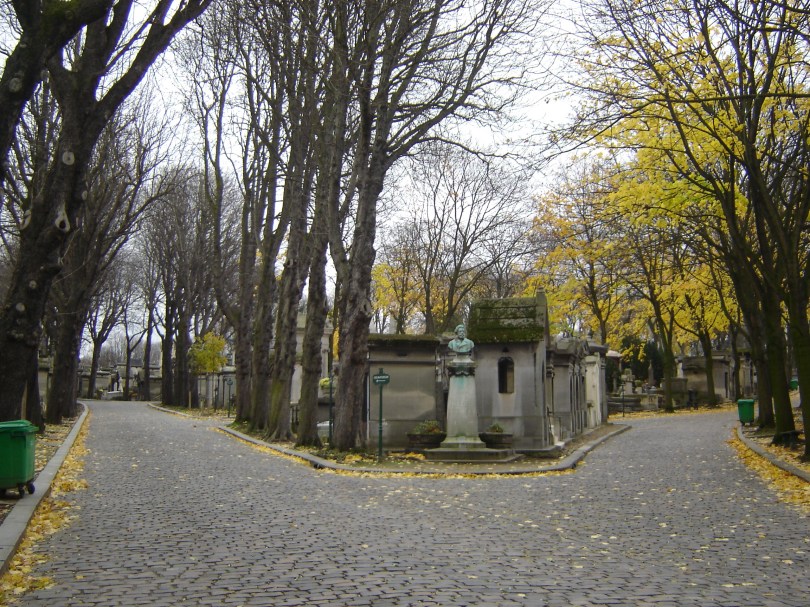
As I sat on the bus between Ottawa and the Montreal airport numbly gazing at the dark and starkly pretty Canadian landscape that fluttered by, it finally started to sink in: I was going home, back to the motherland of humanity.
For some reason I’d prepared for this, my first trip to Africa, differently than I had prepared for most of my journeys. Or, more accurately, not prepared. Usually by the time I embark on a trip I’ll have researched the destination so meticulously that I feel somewhat nonchalant about actually getting there. For this trip, however, I had done virtually no research whatsoever. So as I rested my forehead on the cold window and tried to concentrate on the blurry forest scenery outside, inside I was an anxious bundle of nerves barely concealed beneath a quiet silent surface.
I hoped a burger and a beer before takeoff would take the internal edge off. Or perhaps keeping the edge on was a better strategy? Regardless, I got my panicky bus-gazing mind set on a burger and a beer at the airport so I had one (and one).
Though I was on a budget. I hit the Burger King while m’lady made her way to the St. Hubert. We met up at a plastic table-and-chairs and wolfed down our quasi-meals before I rushed to find a bar, with just ten minutes to go before our plane started boarding. I ordered a Canadian and struck up a quick conversation with a guy at the bar who was heading the same way I was. He said he was in mining, a gold digger from British Columbia on his way to Mali for the third time. With all that experience he was clearly much more comfortable with missing planes than I because when I pounded the last of my beer and begged out of our conversation to run for the gate he just shrugged and sat there calmly toying with his cocktail.
I gotta tell you, I love Air France. The staff are friendly, the inflight magazine is hefty, they serve the best meals in the sky, and most importantly they still dole out free drinks. The only beer option was Heineken, but who’s complaining? M’lady was resting when the garçon came by so I ordered her a small bottle of red wine too. I’ve been up front on Air France before but even back in regular class they offer a myriad of entertainment choices – I decided on The Dark Knight. The seats in the proletariat section are still small, but as I tossed and grunted the night away I placated myself with memories of the dijon-style sauté of beef accompanied by vegetables and Parisienne potatoes, with fresh baguette, gouda cheese, fruit, and chocolate raspberry cake for dessert. When grinding my kneecaps into the seat in front of me didn’t keep me awake, the drooling did.
Between Montreal and Paris one loses five hours so it was 9am (née 4am) when we arrived at Charles de Gaulle for a seven-hour layover, but rather than killing time at the airport we got our butts directly on the train into the city. This marked my first visit to Paris and two things were immediately apparent: there’s graffiti everywhere and everyone talks like Inspector Clouseau. We found a cafe and enjoyed a pair of $6 coffees; m’lady ordered an omelette. The waiter was just rude enough to remind us where we were without dampening our spirits as we soaked in the street scene, which included a fair share of graffiti’d vans.
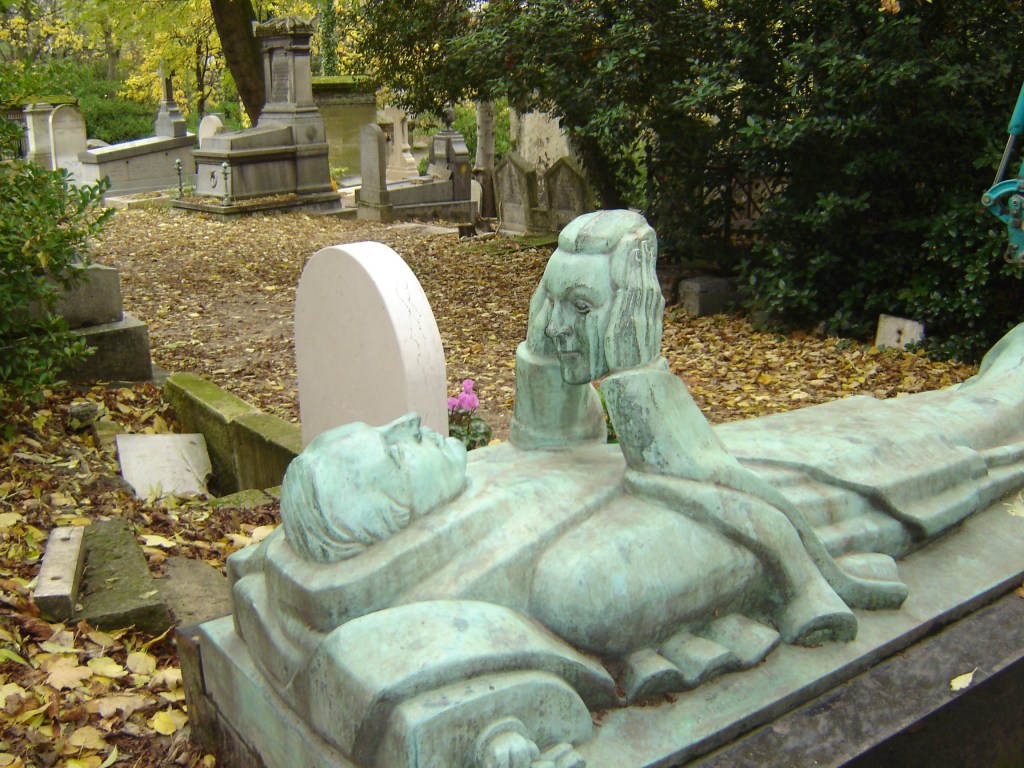
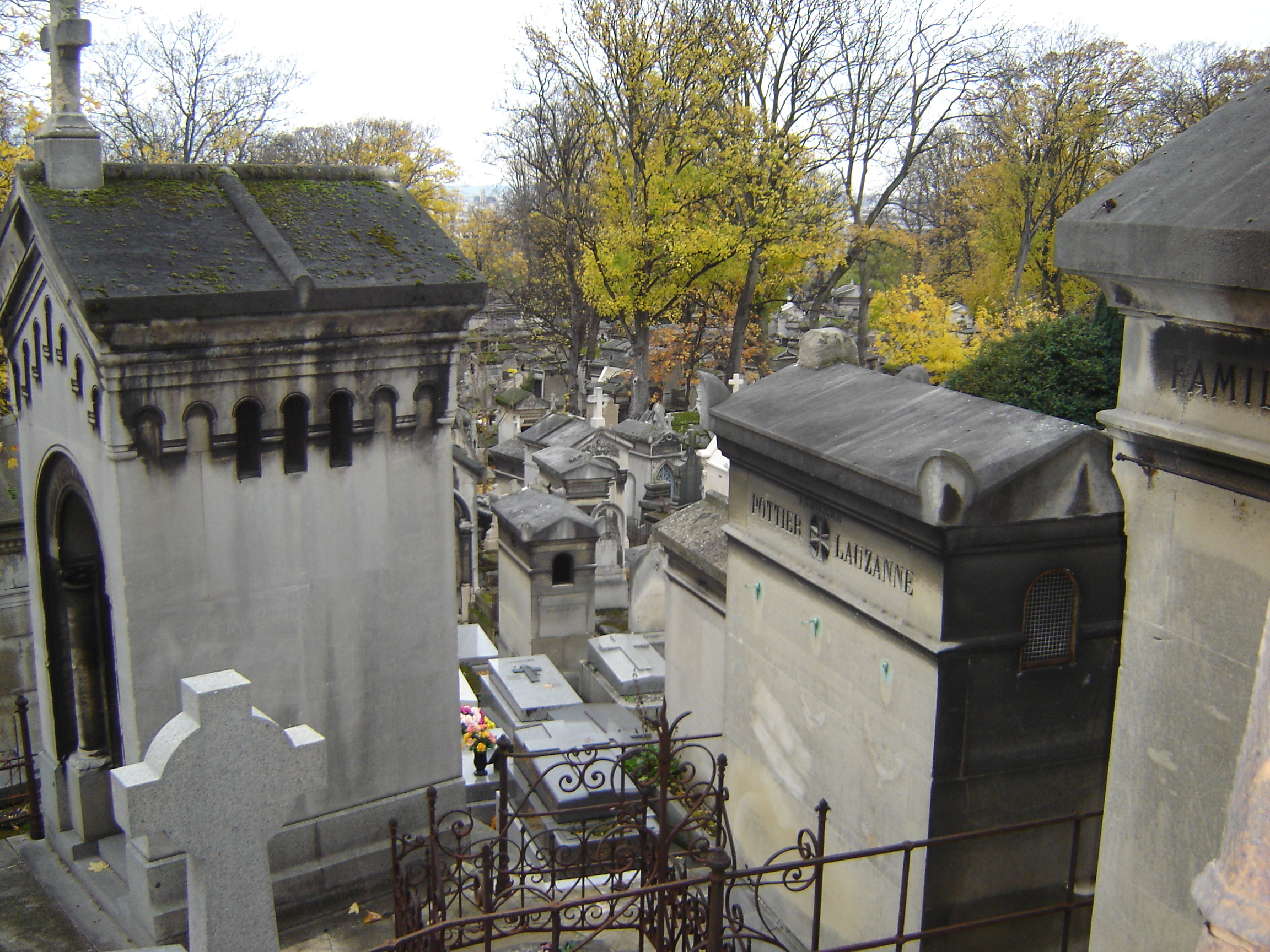
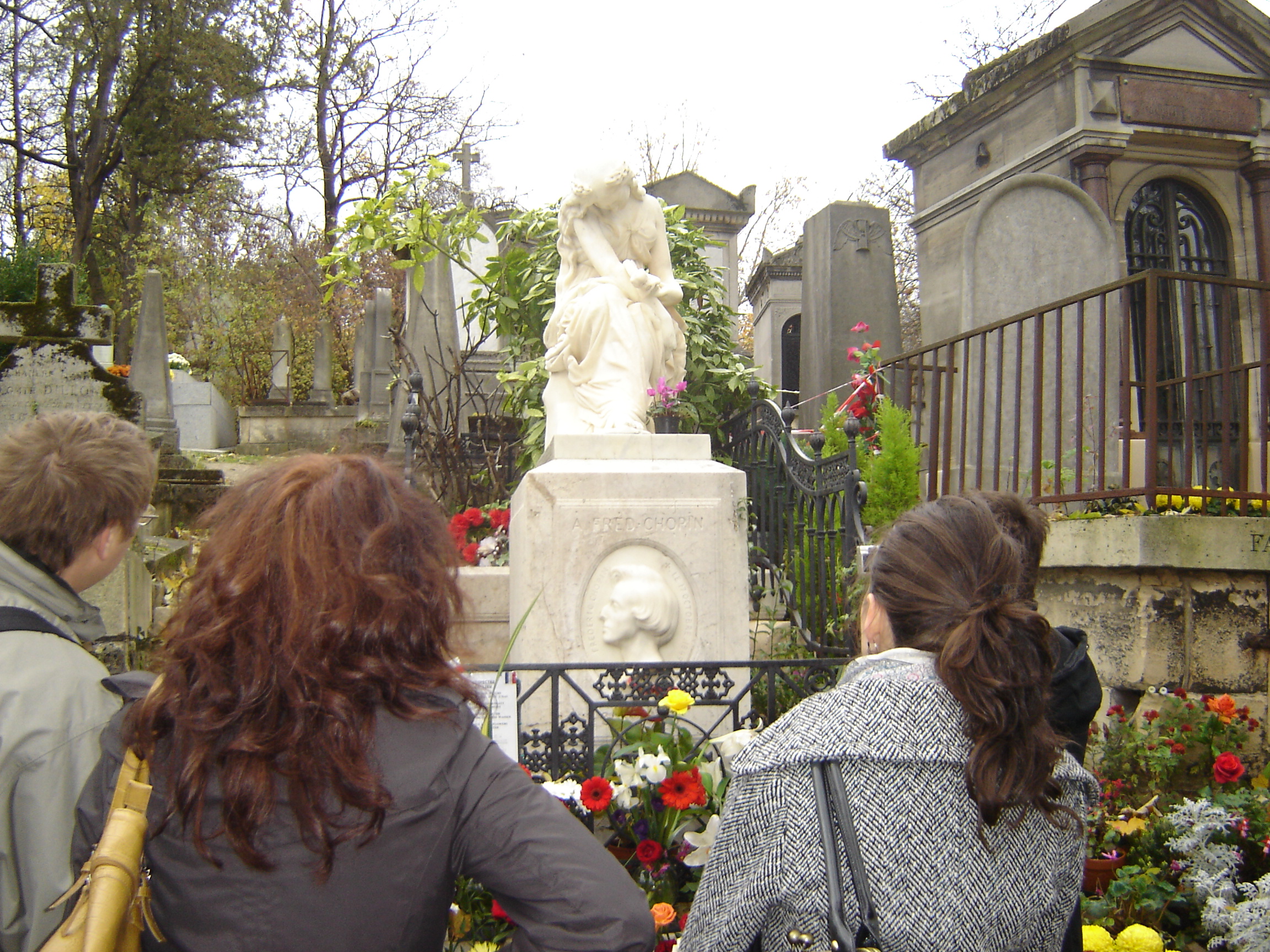
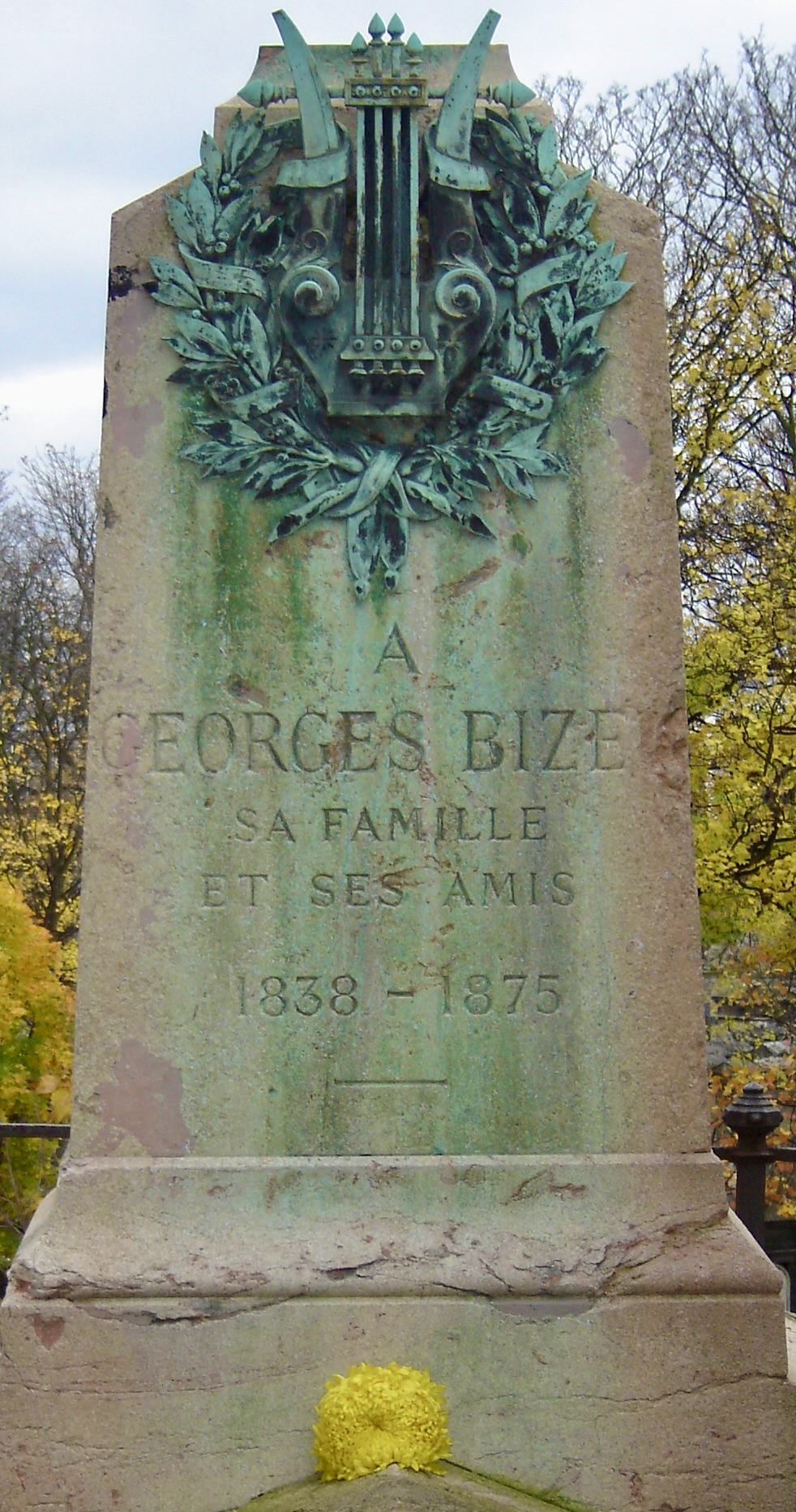
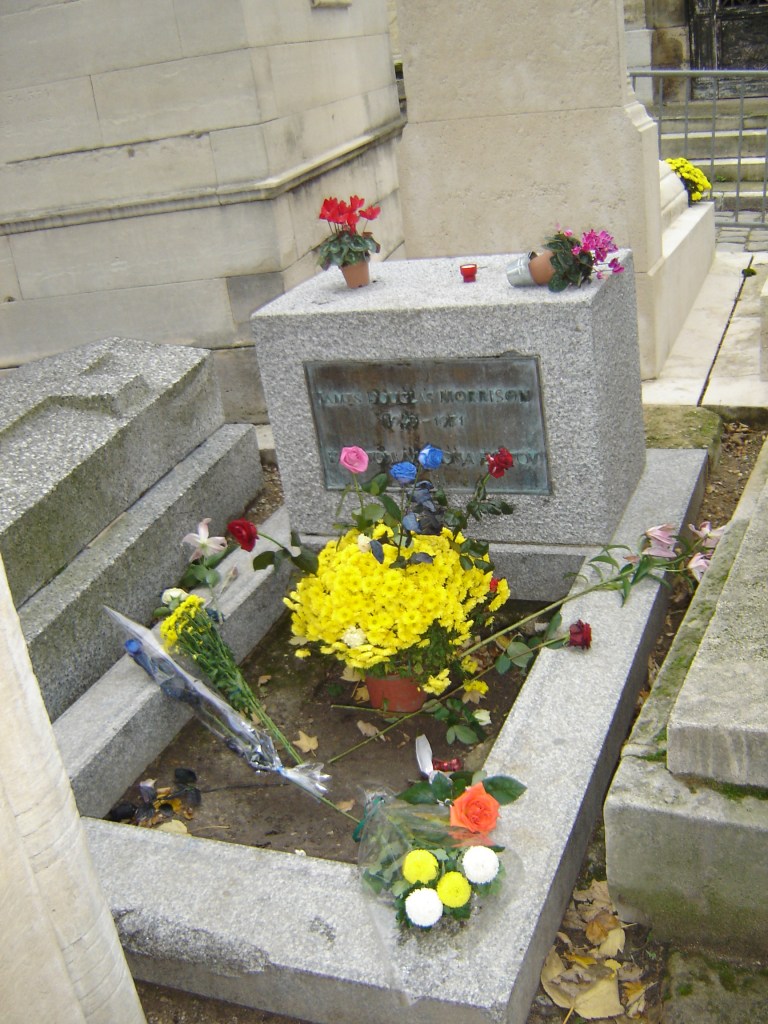
After our très petit dejeuner we visited the famed Cimetiere du Pere-Lachaise. We wandered amongst the gorgeous memorials, discovering the final resting places of Bizet, Chopin and many other note-writing notables. Popular culture* being what it is, of course the peak of the visit was the alleged final resting place of Mr. Mojo Risin: Jim Morrison. Cheesy yet necessary, the pilgrimage is complete.
Back on the metro we shared m’lady’s wee bottle of wine that we had smuggled off of the airplane and I tell you, we felt very Parisian in doing so. We arrived back at the airport with plenty of time to catch our connecting flight. The next leg of our journey was on the same airline. I eagerly hoped they were serving the same menu and made a point of staying awake to find out.
*I just noticed that the word “culture” includes the word “cult”. It makes sense I suppose, but I doubt many people associate their own culture with a cult. The cultures of others maybe, but not their own. Seems fitting though that I noticed this when typing about Jim Morrison. I’m not saying that The Doors were cult by any stretch, but Jim’s gravesite definitely looks suspiciously cult-like.
111008 Welcome to the Jungle
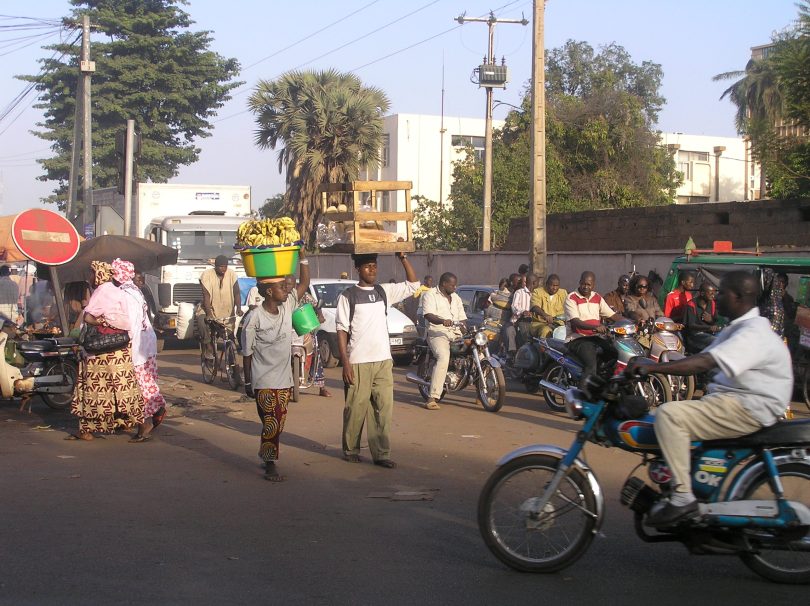
Generally when a plane gets close to landing one begins to see the lights of towns and cities below. As we descended towards the capital of Mali all I could see below us were scattered bonfires, otherwise I could see no light at all. We landed at Bamako’s Senou International Airport around 10pm and disembarked directly onto the runway in a sweltering night heat. As we followed the other passengers across the tarmac I was surprised to notice throngs of people spilling out of the building to greet us. I’m talking about maybe a hundred people or more, and they clearly weren’t airport employees. Once we squeezed our way inside the terminal it was clear that there was no semblance of security, sanity, or decorum anywhere. There were people everywhere I looked, and they all seemed to be yelling and waving and screaming and trying to get everyone else’s attention. The place was nuts; just complete and utter chaos.
Somehow through all the madness we found not only our luggage but also a man named Baba, who told us that he had a car waiting that would take m’lady and I to the hotel that we had pre-booked for our first night.
(Aside from this hotel our entire three-week stay in Mali was unbooked. At this point we hadn’t even looked into things like transportation, accommodations, excursions…nothing. We were the blind leading the blind straight into the Sahara Desert.)
The three of us made our way to the parking lot surrounded by a crowd of touts that kept busy trying to carry our bags and telling m’lady how beautiful she is. Baba ultimately directed us to a very beat-up Mercedes. We piled in and made our escape, headed towards Mali’s capital city.
I was immediately struck by how many open fires I saw burning alongside the road. Small garbage fires, big bonfires…there were fires everywhere. Combined with lumbering vehicles spewing clouds of black exhaust and who knows what other poisons, I can say without hyperbole that the air truly was thick. Every waft carried with it an olfactory adventure. That said, the traffic was relatively sensible, the main road was actually quite good, and there were gas stations all over the place, (the price was about a dollar per litre).
We eventually turned down, well, Baba called it a “street” but I hesitate to agree. Though I will concede that it was a somewhat level strip of potholes without any houses built on it, so close enough I guess. Regardless, the ailing car bungled along the indecipherable road and delivered us to our hotel. We were shown our room, for which we were given the choice of paying 15,000* (if we used the air-conditioning) or 7,000 (if we left the air-con turned off and agreed to only use the sad and lazy overhead fan that spun around just fast enough to make noise but not fast enough to actually create wind).
We opted for the latter (budget…remember?) and asked about drinks. The hotel guy offered to go buy us an armload of beers. He was back in a jiffy and m’lady and I dove in trying to convert our wide-eyed buzz of exhilaration and adventure into sleep-deprived alcohol-induced exhaustion. We eventually succeeded and turned in after twenty-eight hours of travel.
*At the time 1000 West African CFA francs was equal to $2.35 CDN
111108 Unpacking Day One
What can I say about my first day in Africa? It was so jam-packed with astonishment that I could easily pump out 10,000 words just on the first twenty-four hours.
(Fret not; I shan’t.)
In the morning (okay, the early afternoon) m’lady and I awoke in Mali to the first of what I suspect will be a series of hot, sunny days. In short order our de facto guide pulled up in yesterday’s beat-up Mercedes. We got in and Baba directed the driver to take us all to a hospital on the poorest side of town.
About a year earlier I had read a story in the Ottawa paper about a Canadian organization called Not Just Tourists that sends medical supplies to underprivileged countries via tourist’s unused luggage space. M’lady and I tend to travel lightly so we signed up (as a matter of fact, m’lady went on to volunteer for the organization for the next decade or more). We had brought two NJT suitcases along with us on this trip, containing between them a total of twenty-five kilos of medical supplies.
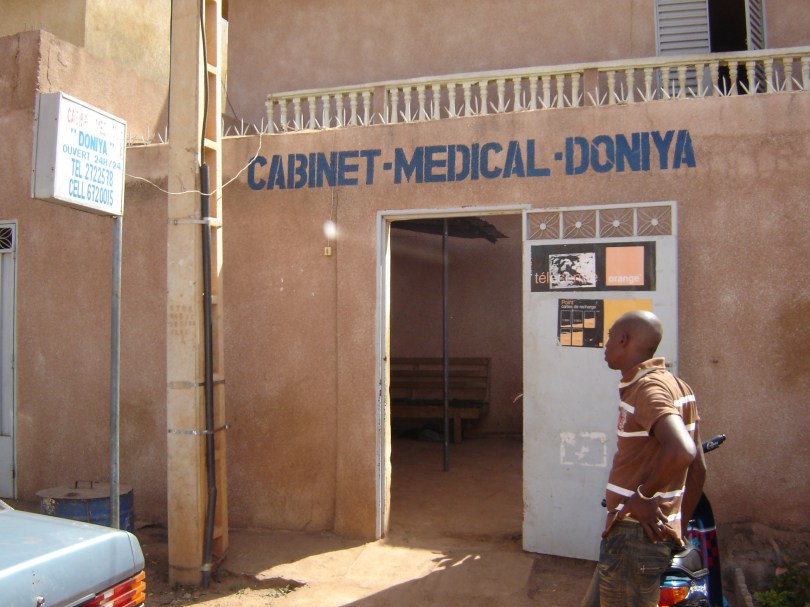
After a brief stint in the clinic’s busy waiting room we were shown in (I’ve heard it said that in the West we have clocks while in Africa they have time) and met by a doctor who quietly took the supplies off of our hands. I must admit that I felt a bit odd about the whole exchange, though I’d definitely do it again. It felt uncomfortable to sit across from a man who – against what odds and after who knows how much struggle – rose through the ranks to become a doctor in such an impoverished country and watch him swallow his pride while he accepted random, unscheduled charity of cast offs and out-of-date materials from a guy whose biggest accomplishment had been being born white in North America. Though I should stress that the doctor did not make it uncomfortable by his own actions or attitude. For his part he merely surveyed the contents of the suitcases and accepted them with shrug and a mute nod. The tension was all in my head. It was real, but it was self-imposed.
Our chore complete, m’lady and I our four guides piled back into the car and I asked them to take us to the best drum maker in the city.
When we’d decided to travel to Africa I knew immediately that I wanted to go to Mali, and it all goes back to my first two years studying music at Carleton University. Back then the mandatory Aural Training course included a weekly African drumming component and during my first two years (and for those two years only) the university had contracted a man named Yaya Diallo to lead three drumming sessions every Friday. Everyone enrolled in the Bachelor of Music program was required to attend one of the two-hour sessions each week; it wasn’t long before I asked and was granted permission to attend all three.
Yaya came on the bus from Montreal every week. He spoke French and his own native Malian language. I spoke neither and he didn’t speak English very well but I think we understood each other just fine. For example, I understood that Yaya had been born in a remote village in Western Africa and that he was raised to be a goat herder. I understood that he learned to play music from an elder in his village and that he learned to use music for healing from his mother, who had been a herbalist and traditional healer.
And most importantly I understood that Yaya Diallo was the most “pure” musician I had ever met. He made music fully, completely, and without distraction, and always with a near-sacred determination. He dispensed little praise and tolerated no excuses. Making music was Yaya’s entire reason for being and I found him enthralling. As a young, wide-eyed musician in the throes of idealized academia there was no way that I could avoid idolizing the man. I was thrilled to sit beside him (as I invariably did) for six hours every Friday.
Yaya didn’t talk very much. For his classes there were no papers, textbooks or exams (“Every time you play is a test”), and when he did speak it was usually a story about his life in the village. One day he told us how to go about purchasing a drum if we were ever in Mali. He said that when most musicians try out a new drum they will play their craziest rhythms and flail their arms around, making fools of themselves. Yaya assured us that the drum maker would only bring his poorest drums to such a person, for they knew that a showboat isn’t concerned about the sound of his instrument; for such a musician a drum is merely a soapbox to stand on.
With a smattering of English and some translating help from the French speakers in the class Yaya told us that to understand the quality of a djembe one only had to play the drum’s three sounds. A good musician will approach each drum by tilting it slightly (to allow the sound to escape from the bottom) and hitting it three times in quick succession: Boom Din Dun. The first beat tests the bass sound with an arched palm striking the centre of the skin, Boom! Second, one makes the drum’s main treble note sound with a curved hand hitting the drum’s similarly curved rim, Dun! Finally comes the high overtone that is achieved through a subtle, nearly imperceptible adjustment of the rim shot, Din!
Boom Dun Din. That’s all, and on to the next drum. When a drum maker sees you do this, the artisan will bring you his finest instruments.
As usual, I listened to Yaya in trance. At that point in my life I hadn’t been anywhere (aside from one trip to Disney as a kid) but I knew I would one day go to Mali and buy myself a djembe. I knew it. And here I was!
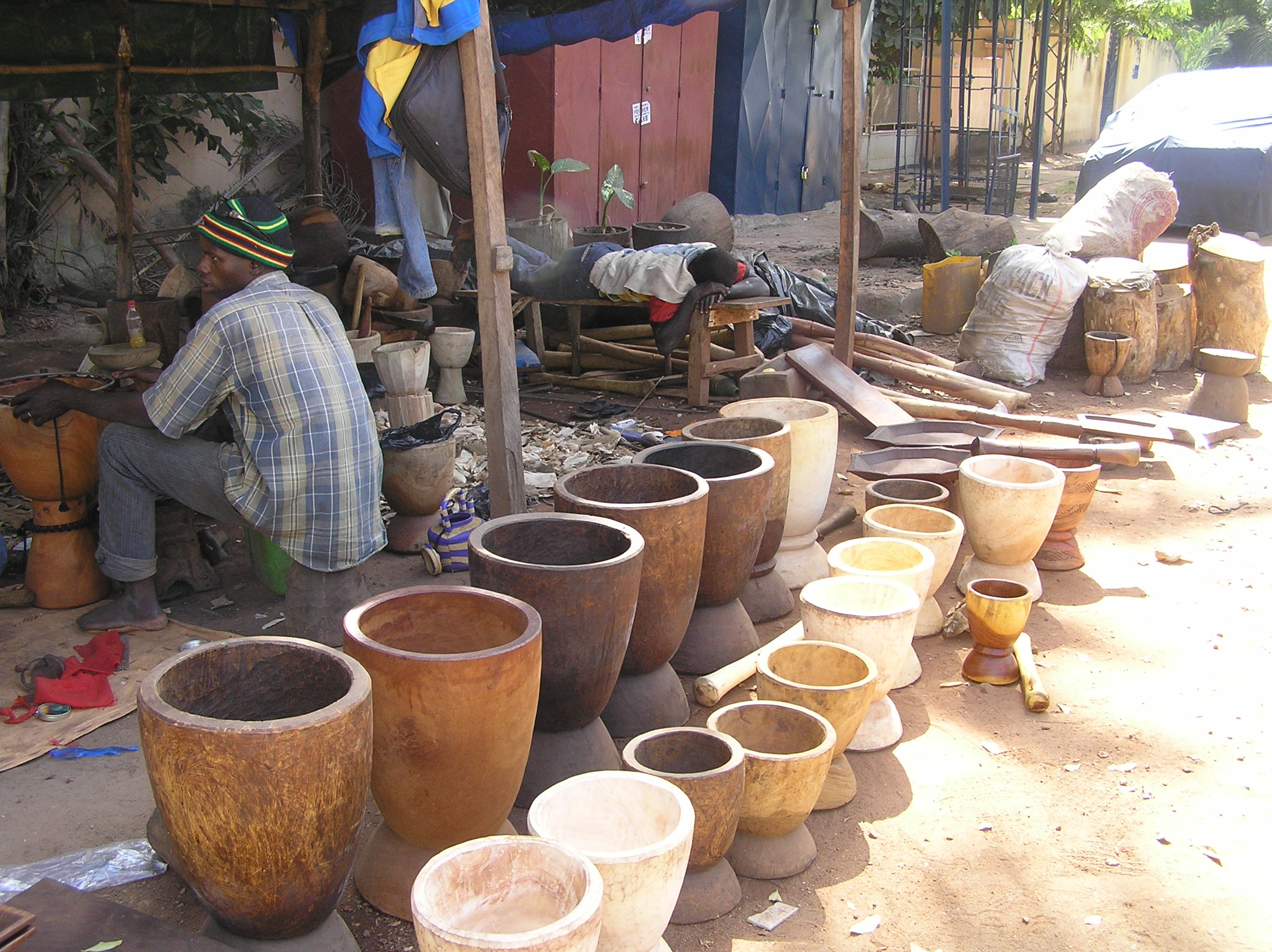
On the outskirts of the city the car pulled to the side of the dusty road where a few men busied themselves carving wood and stretching skins. Though I could see no shop per se, this (we were told) was the best “music store” in Bamako. As I approached the proprietors I was tingling with excitement.
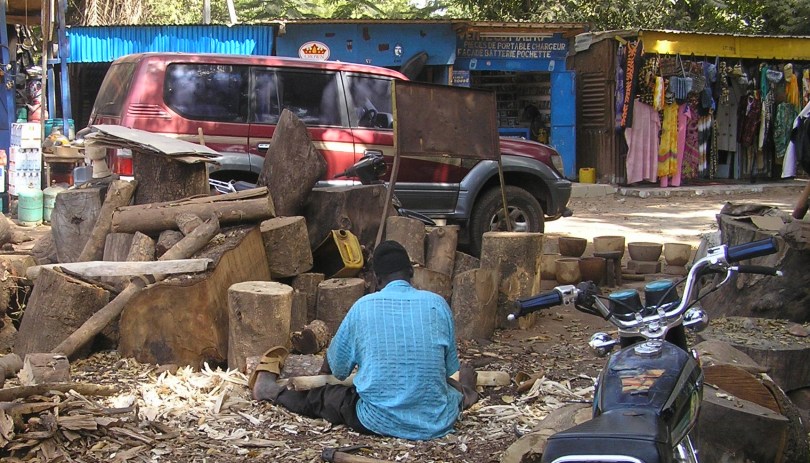
I greeted the drum makers and asked if I might try out their wares. I was told that they could make something custom for me but I told them no, I wanted to try out the djembes they had that were already made. I had to hear them.
The men hurriedly assembled a handful of drums that were scattered about and I went down the line: Boom Dun Din and on to the next. Boom Dun Din, Boom Dun Din…
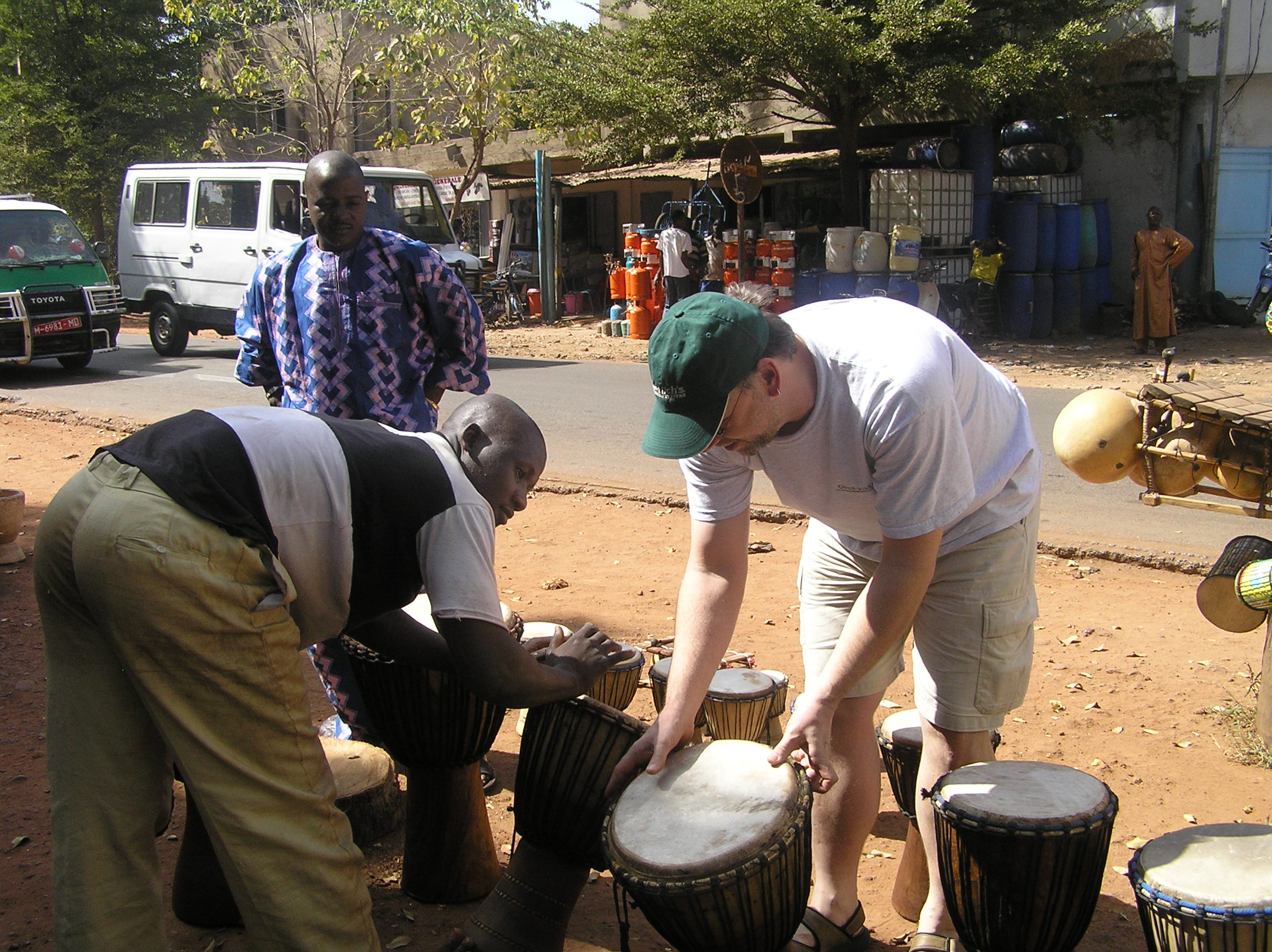
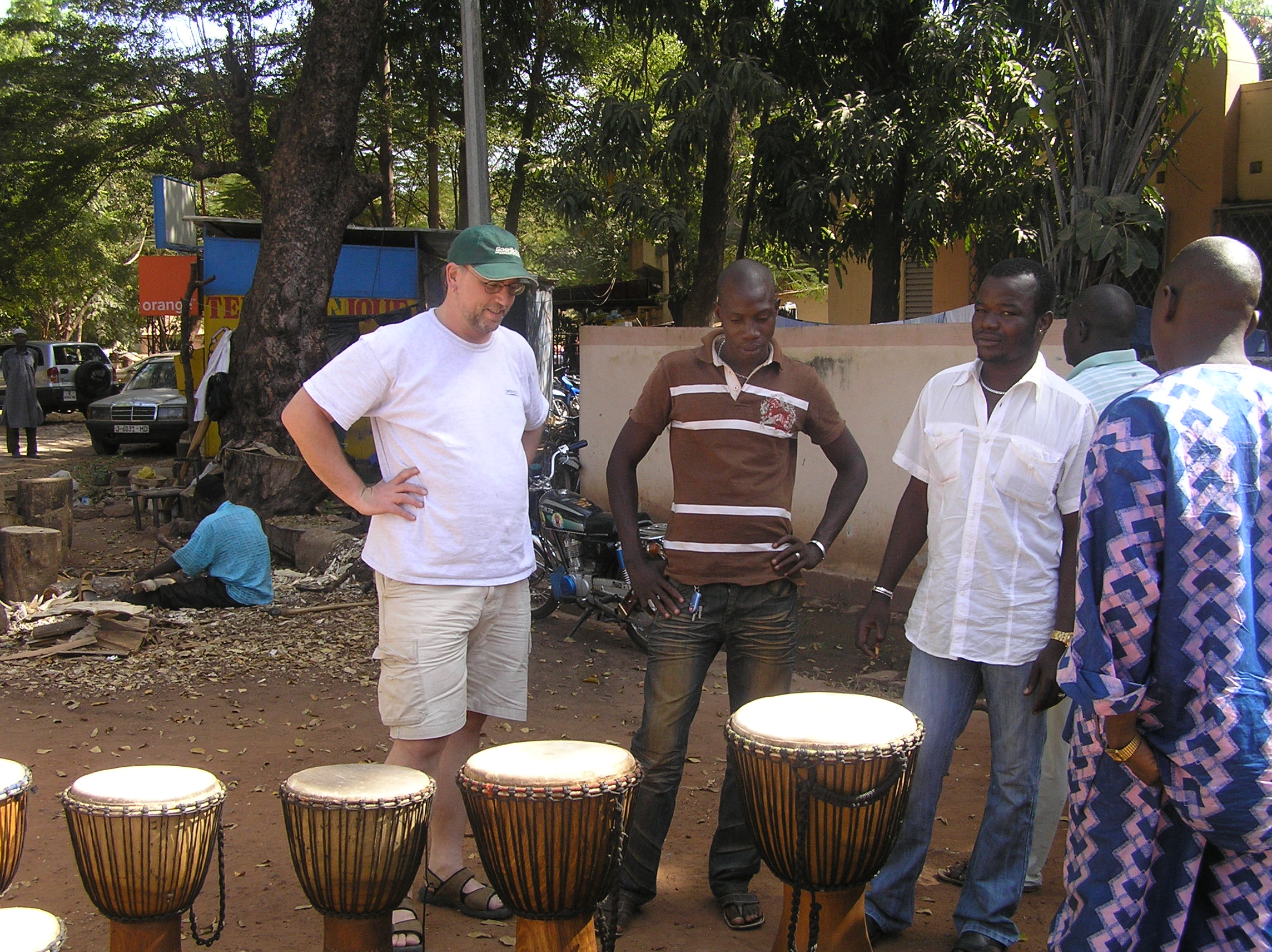
Finished, I stood there scrutinizing and scratching my chin when lo, from out of nowhere one of the craftsmen appeared with another drum which he set in front of me.
I tipped it slightly and brought my hand down three times…BOOM! DUN! DIN!
The damn thing sounded like thunder.
“I’ll take this one,” I gasped. After a brief negotiation I paid them $100US plus an additional $10 for a fabric carrying bag, which they would arrange to be made for me right away. I was concerned that the goatskin drum head might make it difficult to bring back to Canada but I decided to burn that bridge when I came to it. On Baba’s suggestion I decided to leave the drum with them and pick it up just before we departed the country. With my backpack and guitar I already had plenty to lug around.
By this time m’lady and I were beyond starving, so our next stop was for lunch at a nearby restaurant. It was dark inside as we took a booth and pored over the thin, photocopied menu. We both ordered rice that came topped with a delicious onion sauce but even my manic appetite couldn’t help me empty my bowl. As the lady took away my leftovers I heard childhood echoes of my mother admonishing me to finish my dinner because there were thousands of kids in Africa who would love to have it. I washed down my guilt with a large beer and then we headed to the market.
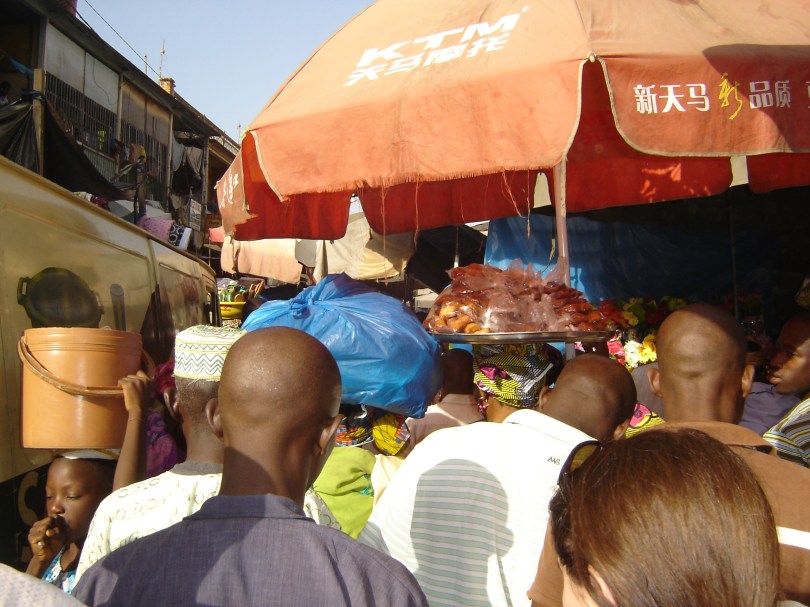
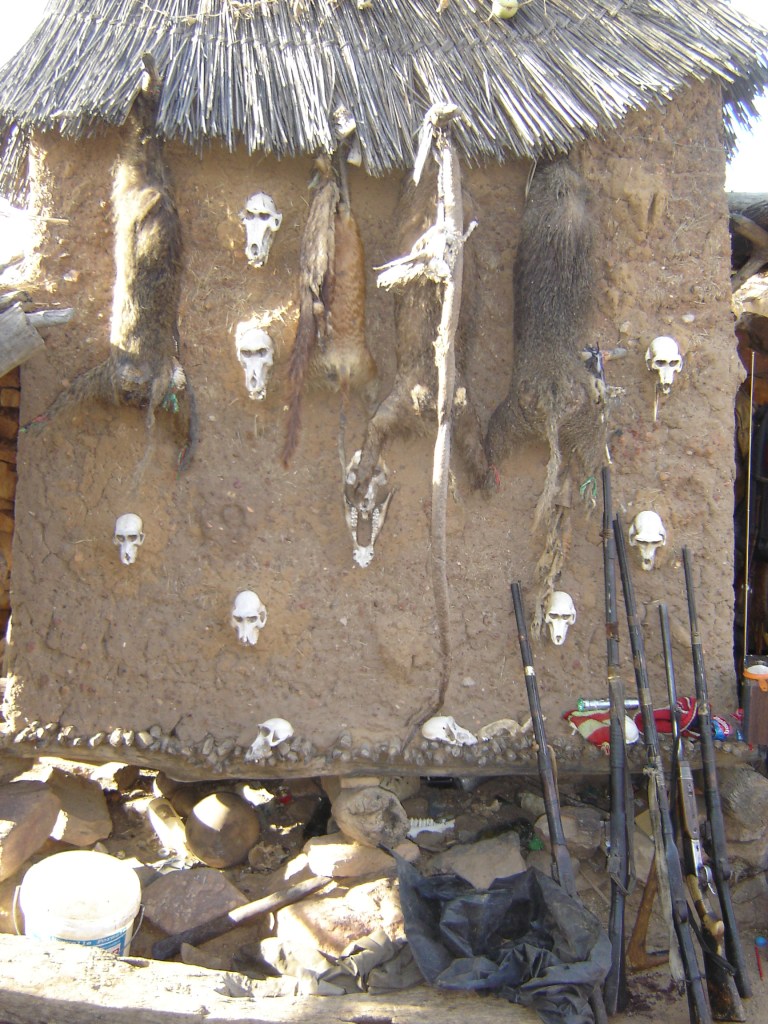
Bamako has a population of approximately two million and I’d swear they were all at the market. The place was nothing short of chaotic. We crushed through throngs of people crowded around booths that were piled high with every product imaginable. We weaved past ladies balancing overloaded baskets on their heads and around squawking piles of bound-up chickens while eager merchants tried to thrust random items directly into our hands. The atmosphere was so thick that it was impossible to tell when we were indoors or outside or where exactly we had entered or left buildings, as we did over and over. When we passed through the fetish market we saw dried monkey heads arranged in rows and baskets laden with colourful dead birds, along with anything else one might require to keep their spirit world appeased and at bay.
Eventually we ended up back at the same restaurant again, where we drank beers and haggled with our posse until nightfall. Against our better judgement and with some misgivings m’lady and I agreed to prebook a few things through Baba, but given the relatively short duration of our trip and the clear unreliability of local transport we felt it prudent to do so.
Back at the hotel we hammered out the final deal and handed half of all of our money to Baba, in an arrangement which should take care of much of what we hoped to get done during our stay in the country. Then to celebrate/commiserate m’lady and I went out and hit the little string of bars along our “street” for more beers and some dinner.
With bus tickets secured for the following morning and a subsequent alarm setting of 5:40am, we were just finishing up our “final” drinks before going back to the hotel when some young men sat at our booth. We got to talking and they told us of two live shows going on at that very moment, both of them for free. They said that one of the shows was within easy walking distance and they could take us there, so we finished our bottles and followed our new leaders.
Five minutes later we were at the Palais des Arts, a fairly large building that hosts concerts and theatre productions. Around the back was an outdoor area called the Cafe des Arts* where a band called Mondank was kicking it down before an audience of perhaps thirty people. The band consisted of electric guitar, bass, djembe, drum kit, gori (like a smaller kora**), and a vocalist. They played all-original music that just seeped that wonderful, unmistakeable West African sound that pleases my soul so much. As the band weaved thousands of hypnotically repeating notes around just one or two chords the vocalist overlaid ethereal, seemingly unconnected melodies through big, overdriven speakers that lent a cackling authenticity to the overall sound.
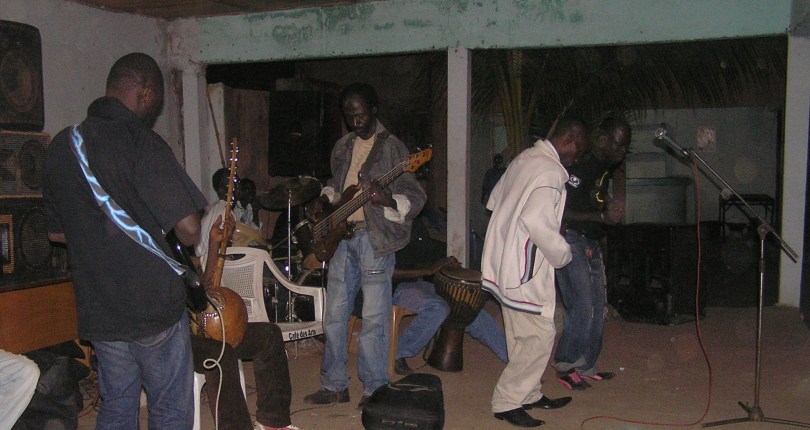
Several ladies were dancing when we walked in and soon three or four men joined the dancefloor. Without a word or any discernible signal they all started dancing in choreographed unison as if we were an audience to some well-rehearsed, low-budget music video. It was surprising and deeply entertaining.
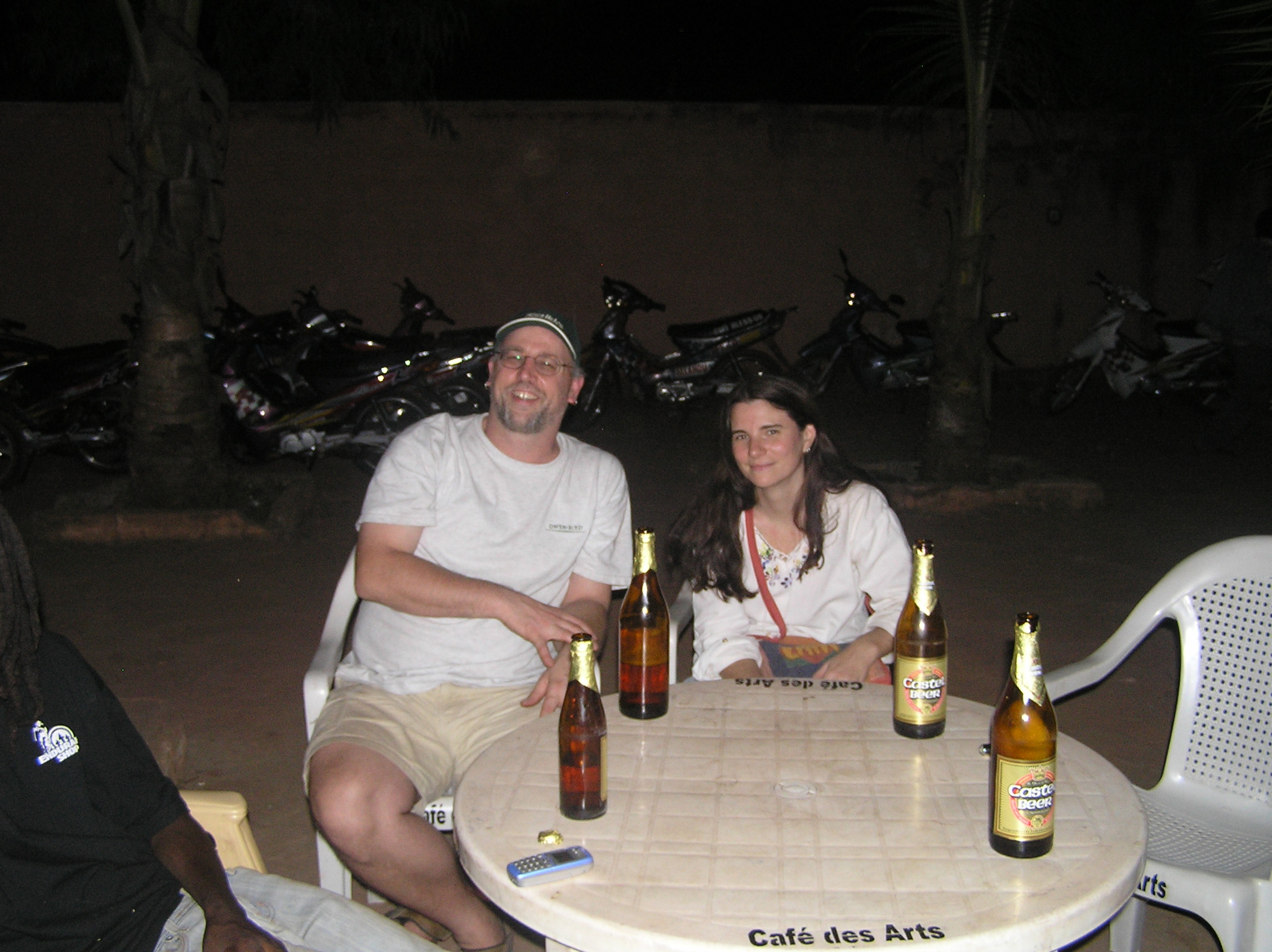
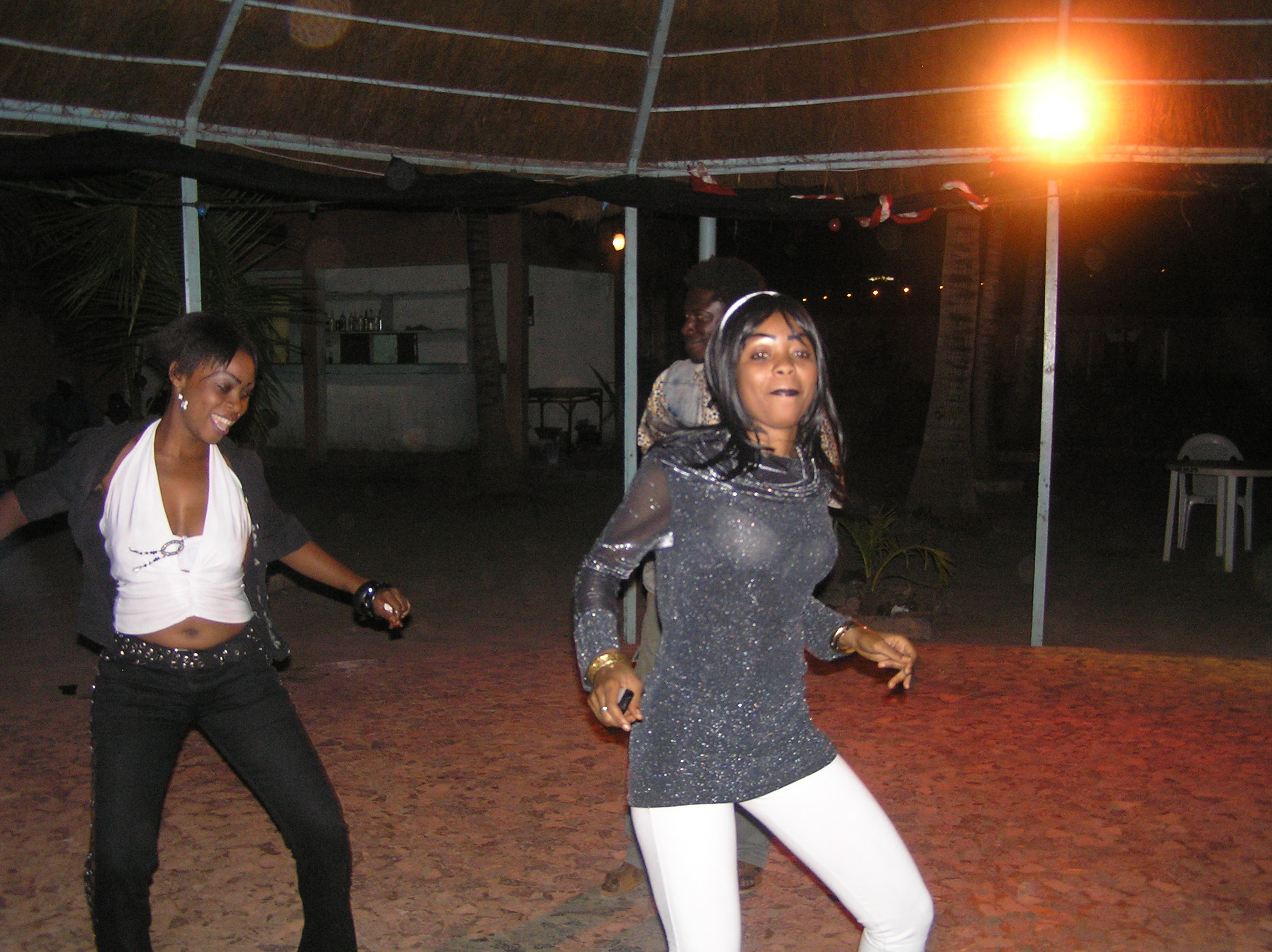
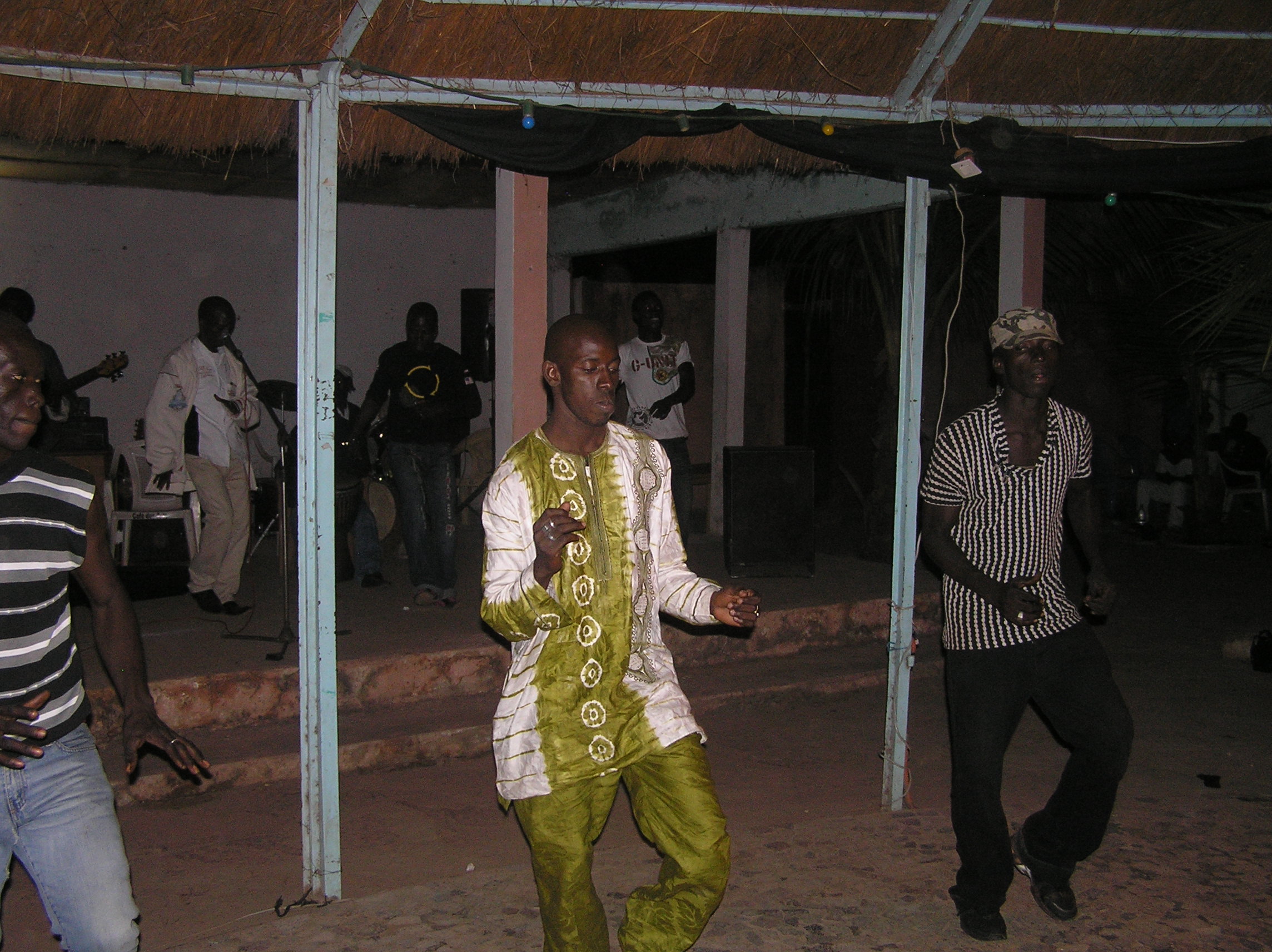
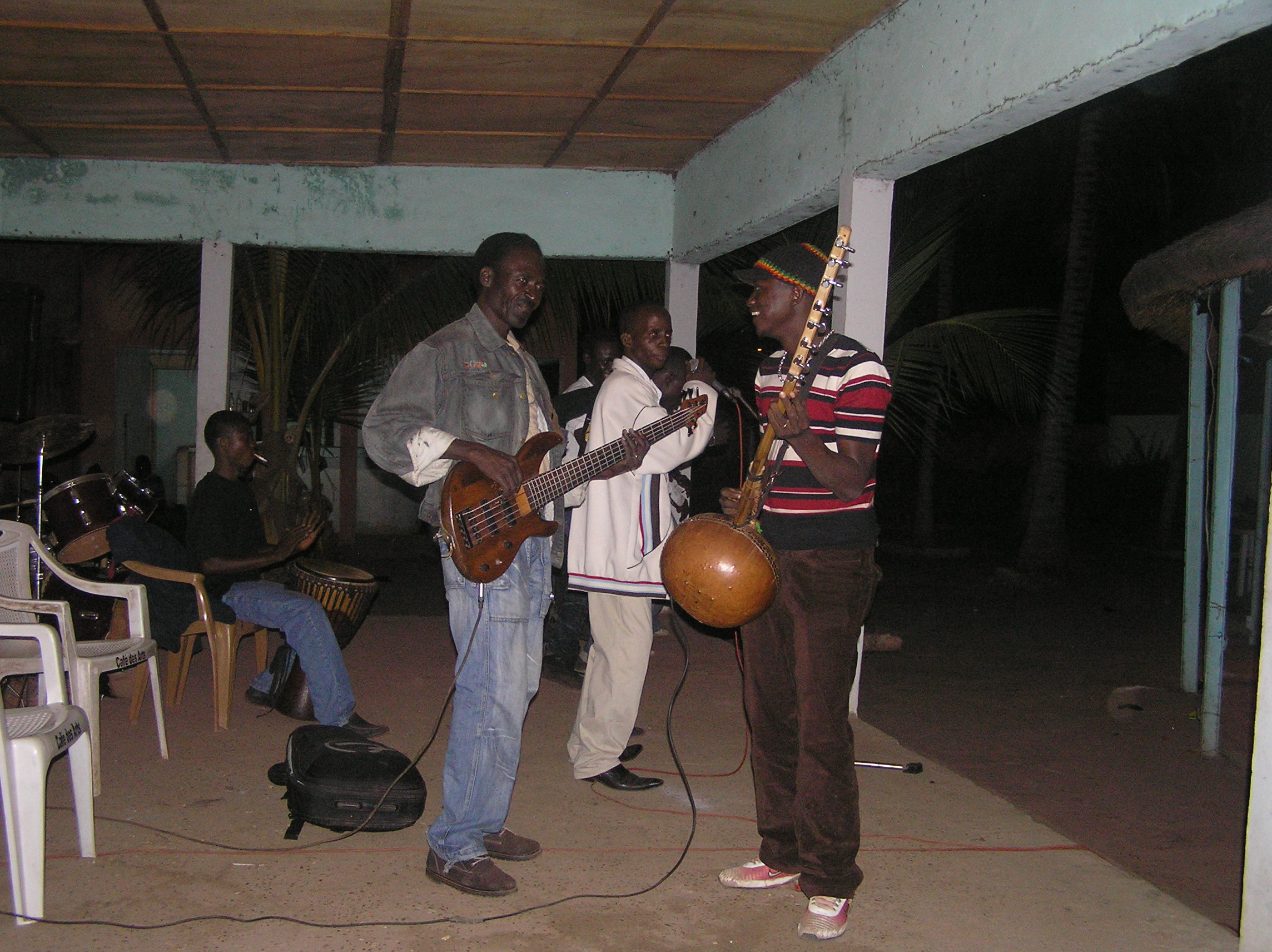
After a couple of hours and several rounds bought by yours truly our young hosts started trying to sell us things, and they quickly got aggressive. When they had asked what I did for a living back in Canada I’d lied and told them that I was a boxing instructor, which may or may not have encouraged them to back off when I stood up and gave one of the guys a loud, emphatic, chest-poking “NO!” We took this as our cue to get ourselves back to the hotel, which is exactly what we did. It was around 1am when we finally hit the sack in our positively sweltering room.
My goodness, there is so much I’m leaving out about the day, but one can only type so many words.
*At the entrance of the venue I noticed a poster advertising an upcoming concert featuring a band called Farty. I bet they stink.
**The kora is a West African harp-like instrument with a gourd and about thirty unfretted strings. The living master of the kora is Toumani Diabaté. Do yourself a favour and find him on youtube.
111208 The Trip to Mopti
When my alarm sounded well before 6am I was jarred from a deep dream while m’lady didn’t wake up at all; she hadn’t slept in the first place. Despite several nighttime showers the heat had kept her awake the entire night. That’s what we get for not paying to use the air-conditioner.
I dragged my carcass out from under the mosquito net and took a shower myself. Though by this time I had been showering exclusively in cold water for more than fifteen years, the frigid water was still quite shocking and painful. It’s probably because I was already sweating bullets, 80% due to the heat of the coming day and 20% due to all the alcohol I soaked up the previous night.
But we’re troupers: early as it was we were outside waiting for our ride right on time. I don’t know how long it took us to decide that our pre-arranged taxi wasn’t, but eventually we walked to the main road to flag a cab and we got ourselves to the bus station.
By 7am we were onboard our bus and settled in for a ten-hour journey to Mopti. It was certainly no Greyhound and it had no bathroom but it was surprisingly comfortable. I was expecting the bus to be a standing-room-only packed-to-the-roof scenario and I was pleasantly surprised to be surprised that it wasn’t. As we sat there waiting to depart our man Baba showed up as he said he would, stepping onto our bus and greeting us with a wide smile. He gave us several envelopes to deliver to his contact in Mopti and assured us that we would see him later. His arrival at the bus depot greatly eased my not-so-slight concern that we had been shafted out of half of our money the night before. Phew!
Our bus left when it became full. Aside from us there were four other foreigners aboard. Unfortunately, in addition to being sleep-deprived m’lady was also feeling quite ill, so she spent the whole ride trying her best not to vomit. Not only did she succeed, she was characteristically very strong and stoic about it.
Like the bus, the road was in surprisingly good shape, and we progressed at an admiral clip. The view outside the window was reminiscent of a CARE infomercial. Scraggly trees and patches of grass grew out of the dirt dividing one mud-brick village from another. Whether driving cattle, herding goats, or sitting beside the road absent-mindedly swatting flies away from buckets of fruit for sale, everywhere I looked I saw people working hard to make their way through the sweltering day. The bus would stop periodically, each time setting off a flurry of women who clamoured towards the bus carrying baskets of food, drinks, and other things to sell to the passengers. During one such stop a man rode by on a bicycle with a live goat strapped to the back, a sight that seemed utterly unremarkable to everyone but us. I noticed one solar panel amongst the entirety of the seemingly otherwise unpowered villages, and that single panel was accompanied by a prominent sign advertising the agency that had supplied it.
Sporadically napping throughout the long, dusty journey, at one point I was lulled awake by a tiny tapping on my knee. I opened my eyes to find the cutest little girl staring up at me, no more than two years old. When she saw that she had gotten my attention she broke into a huge smile. I couldn’t help but to smile back. We made faces at each other and laughed for a minute or two until her father noticed that she was missing. He got up and walked down the aisle with a smile of his own, returning to his seat with his daughter and parking her on his lap. As I stared after them I was forced to recall a haunting statistic from an article I’d read on the plane: 50% of children born in Mali won’t live to see their fifth birthday. My sleepy grin disappeared and I turned my attention back to the window.
The terrain remained flat, prairie-flat, with baobab trees and termite mounds poking up from the horizon. It was dusty, arid, and very, very hot, with nary a cloud in the sky. I was forced to wonder how the trees could possibly appear so lush.
Again the bus stopped aside another village, again more women rushed to ply their wares. A couple of times throughout the day the men got off with their small mats and they all knelt in the shade of the bus to pray. Every element of the journey was fascinating and relatively comfortable; there’s no better way to see a country than travelling the same way the locals do.
After nine-and-a-half hours on the bus we finally arrived in Mopti (the fare cost 8,000 each, which was less than $20CDN). Somewhere along the way m’lady had started feeling better and otherwise the ride had been relatively painless, but when we stepped off that bus and into the mayhem that accompanies arriving busses in these parts we were hot, tired and hungry. Especially “hot”.
So we were very happy to immediately meet our contact and climb into his 4×4 for a relaxed, worry-free ride to our hotel. As we checked in we were happy to find a nicely decorated, clean lobby and equally pleased with our room for just 13,000. When the proprietor showed us the hotel swimming pool I bolted towards the water, fully clothed. The hotel guy reached out and casually held me back, cartoon-style, as if this sort of thing happens all the time. Good thing too: I was still wearing my backpack.
Okay, that might not be entirely true but this is: It took less than two minutes for me to get suited up and dive into that pool, and it was absolutely glorious. Numb with joy and blissful appeasement I ordered a couple of poolside beers and made small talk with a few other travellers. After a bit of asking around I was consoled to learn that we seemed to have bargained an excellent price on the stuff that we had pre-booked with Baba. That called for another round! By 7pm m’lady and I mustered our final stores of energy to climb up to the hotel’s rooftop restaurant where we really, really enjoyed our first and only meal of the day beneath a monstrously large full moon.
The extreme heat and the lingering dregs of jet-lag settled into the magically foreign surroundings and forced a backdrop of surrealism to the evening. The fact that we spent dinner discussing our pending camel-trek to Timbuktu made it even more so.
111308 Timbuktu
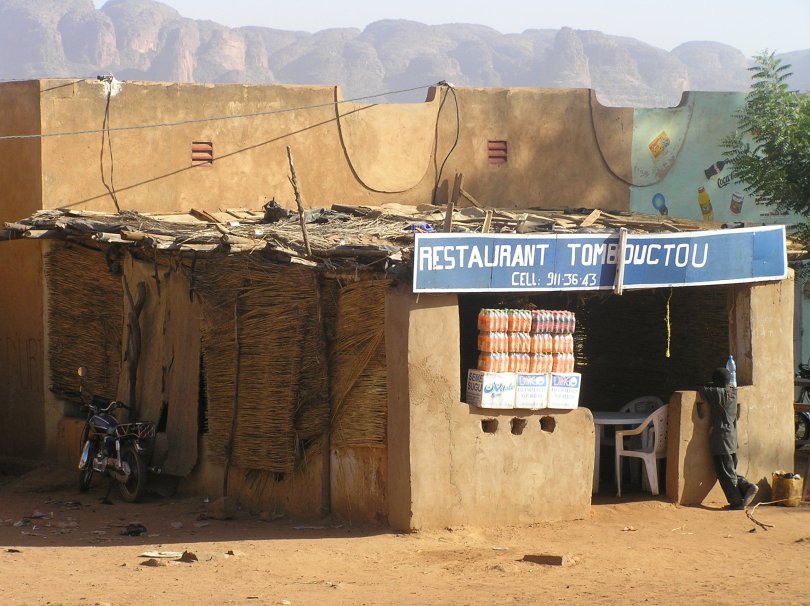
M’lady had more sleep to catch up on than I did, so while she headed to our room right after dinner the previous night for some well-needed shuteye, I kept myself busy drinking beers and playing guitar on the terrace. I quickly discovered that my only common ground with the locals seemed to be Bob Marley, so I played every Marley song I could think of until they closed the bar at the ridiculously early hour of 11pm. Even still, it felt like my alarm clock’s morning interruption at 5:45am came much, much too soon. Again. This was becoming an unfortunate habit.
At 6am we were outside, squinting under the unimpeded sun. In short order were joined by another yawning, stretching, squinting tourist, a stocky Englishman about my age with a round face and a thin smile. British Steve was another client of our man Baba, and he would be joining us for our coming adventure. After the briefest of small talk our driver arrived. Handshakes and introductions all around, we tossed our gear in the back of his 4×4 and the four of us set off for a long day of driving.
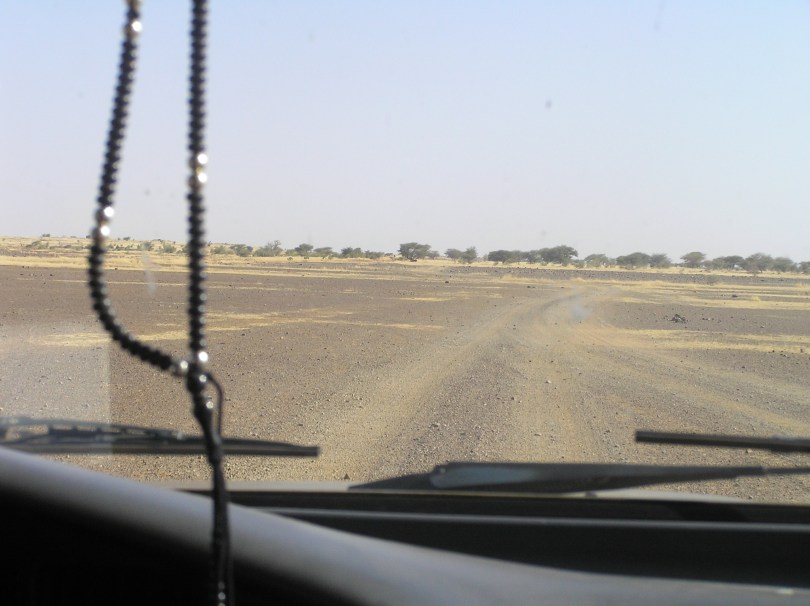
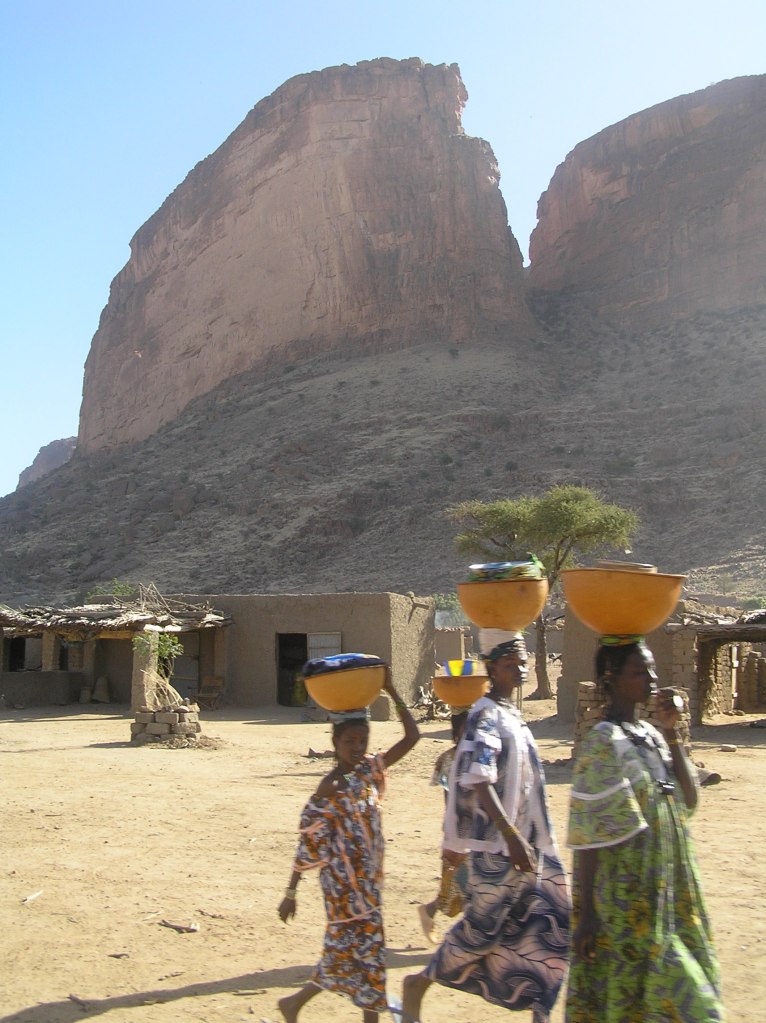
As we left Mopti our non-Jeep jeep remained on a smooth ribbon of asphalt that became increasingly encompassed on both sides by an infinity of near-emptiness. After an hour the road started to morph into a rough dirt track and eventually it vanished altogether, swallowed up by the encroaching desert. After that it was mostly just straight-up bush driving. The ride was fast, long, jarring, and simply unbelievable. The main purpose of wearing the seatbelt seemed to be to keep our heads from repeatedly bouncing off the roof of the jeep. Despite this I almost chipped a tooth a few times.
We drove past village after village, ageless pockets of life where herding goats and pestling grain seemed to be the chief concerns. In the ever-widening landscapes between the villages camels driven by Tuareg nomads dressed in blue robes and turbans became commonplace. The scenery was constantly sublime and the experience unforgettable.
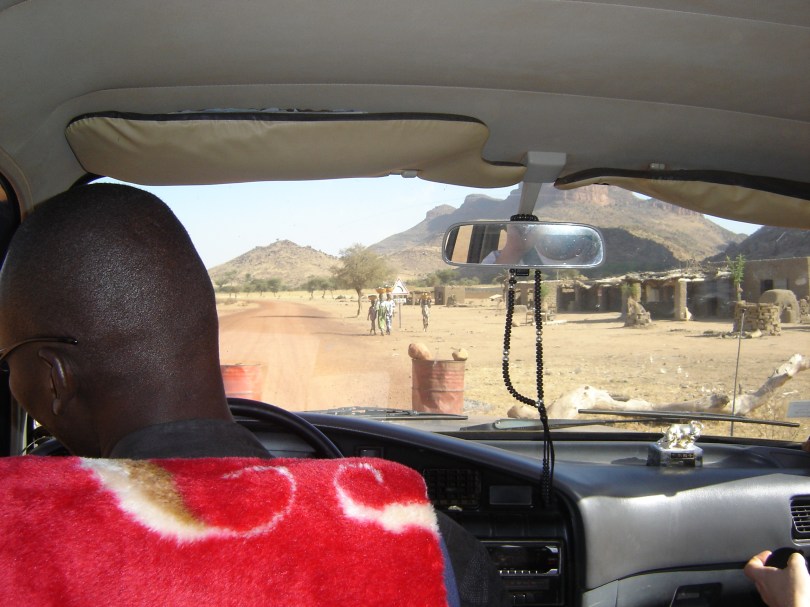
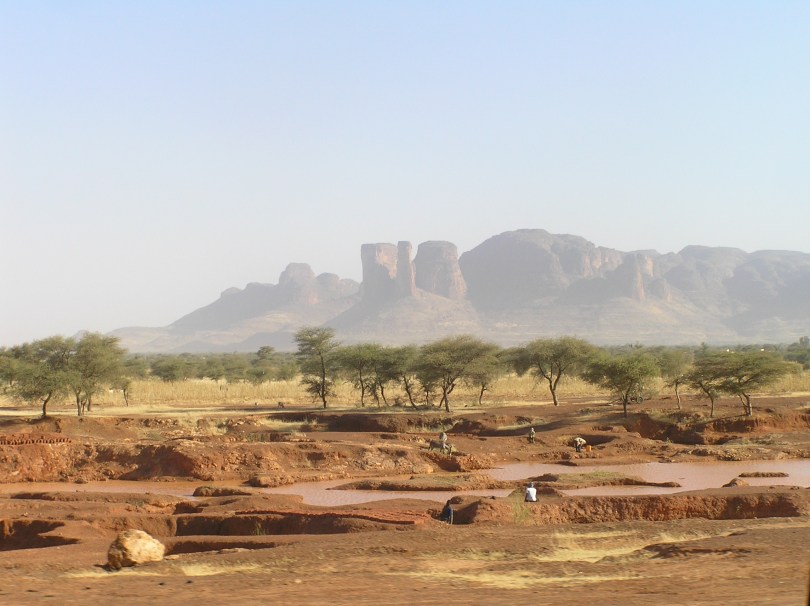
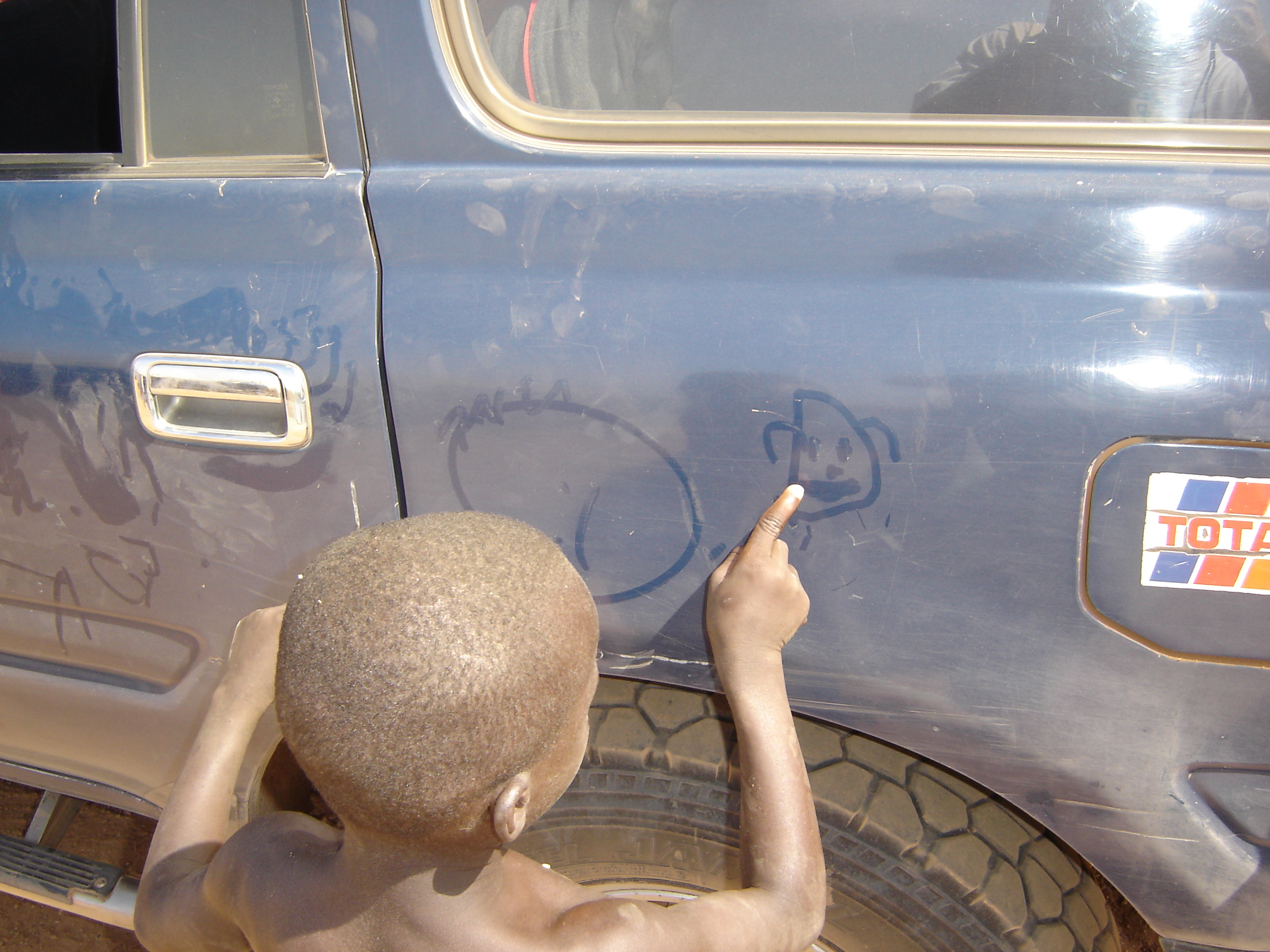
After seven hours we arrived at the shores of the Niger River. While we waited for the ferry I played with a group of children that surrounded the dock. We amused ourselves by finger-painting portraits of one another into the dust-caked body of the 4×4. Meanwhile an impromptu game of hacky-sack broke out, but of course nobody actually had a hacky-sack. The game began with some sort of unidentified fruit peel in place of a real ball before upgrading to an empty cigarette pack.
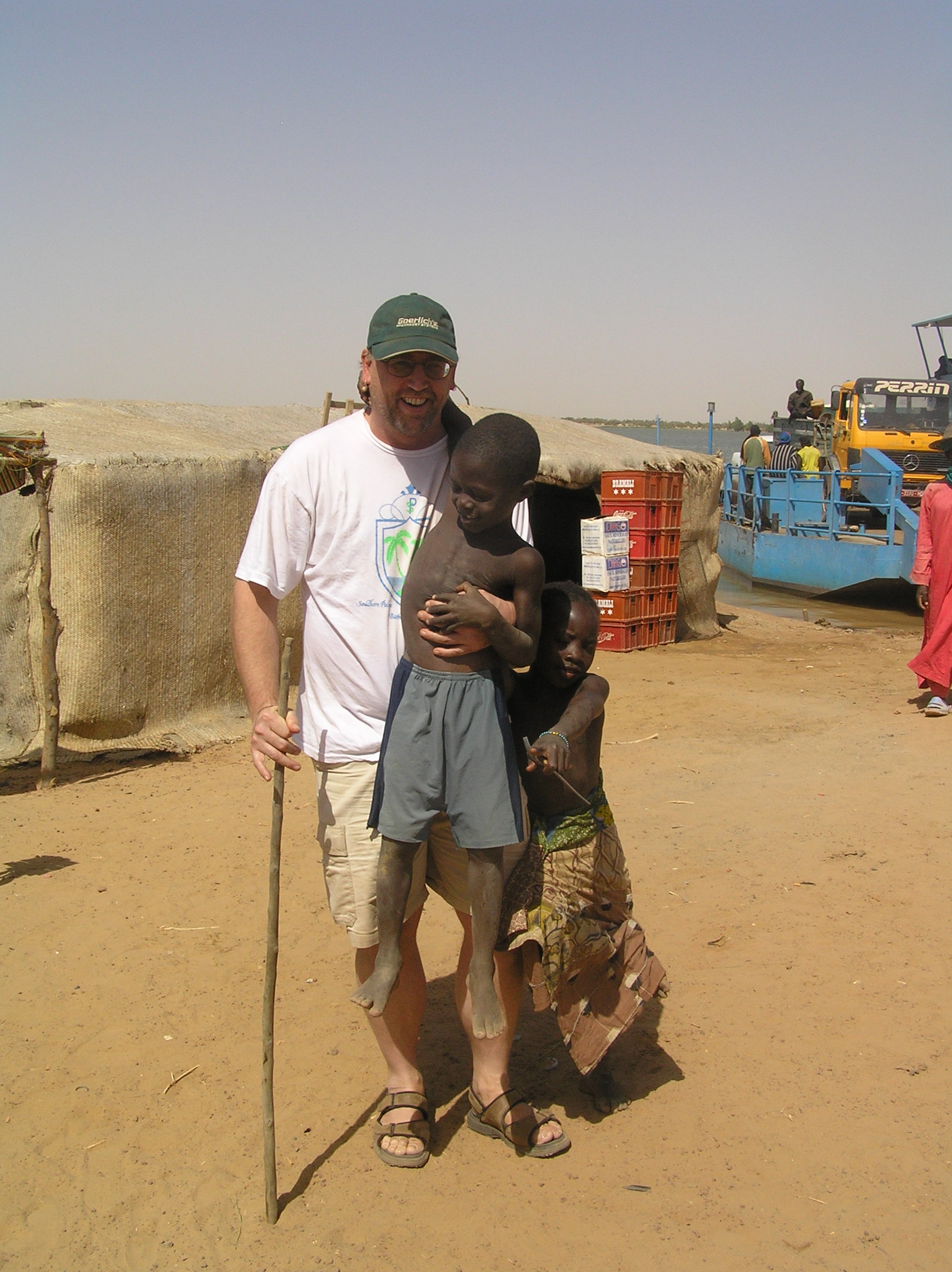
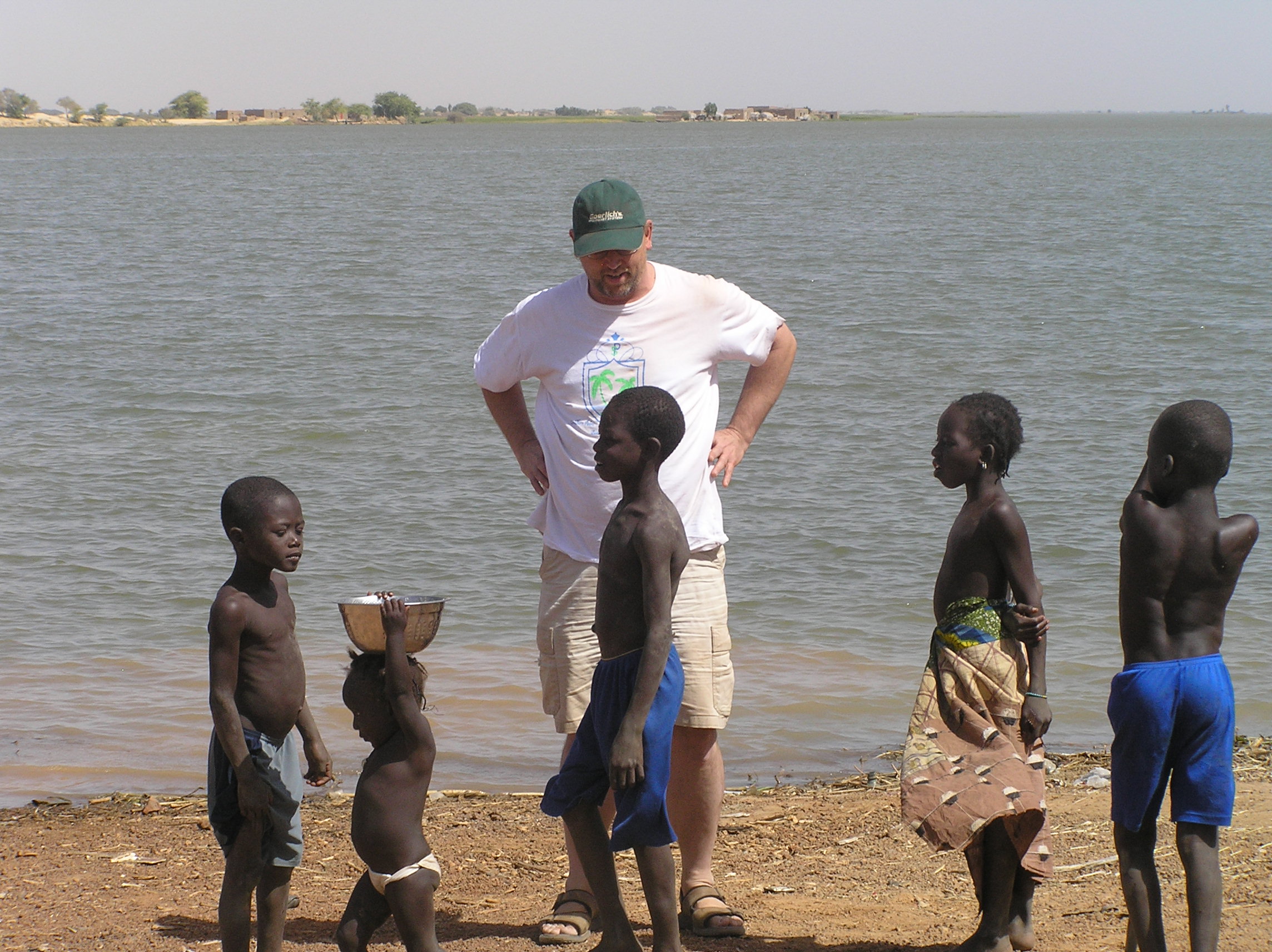
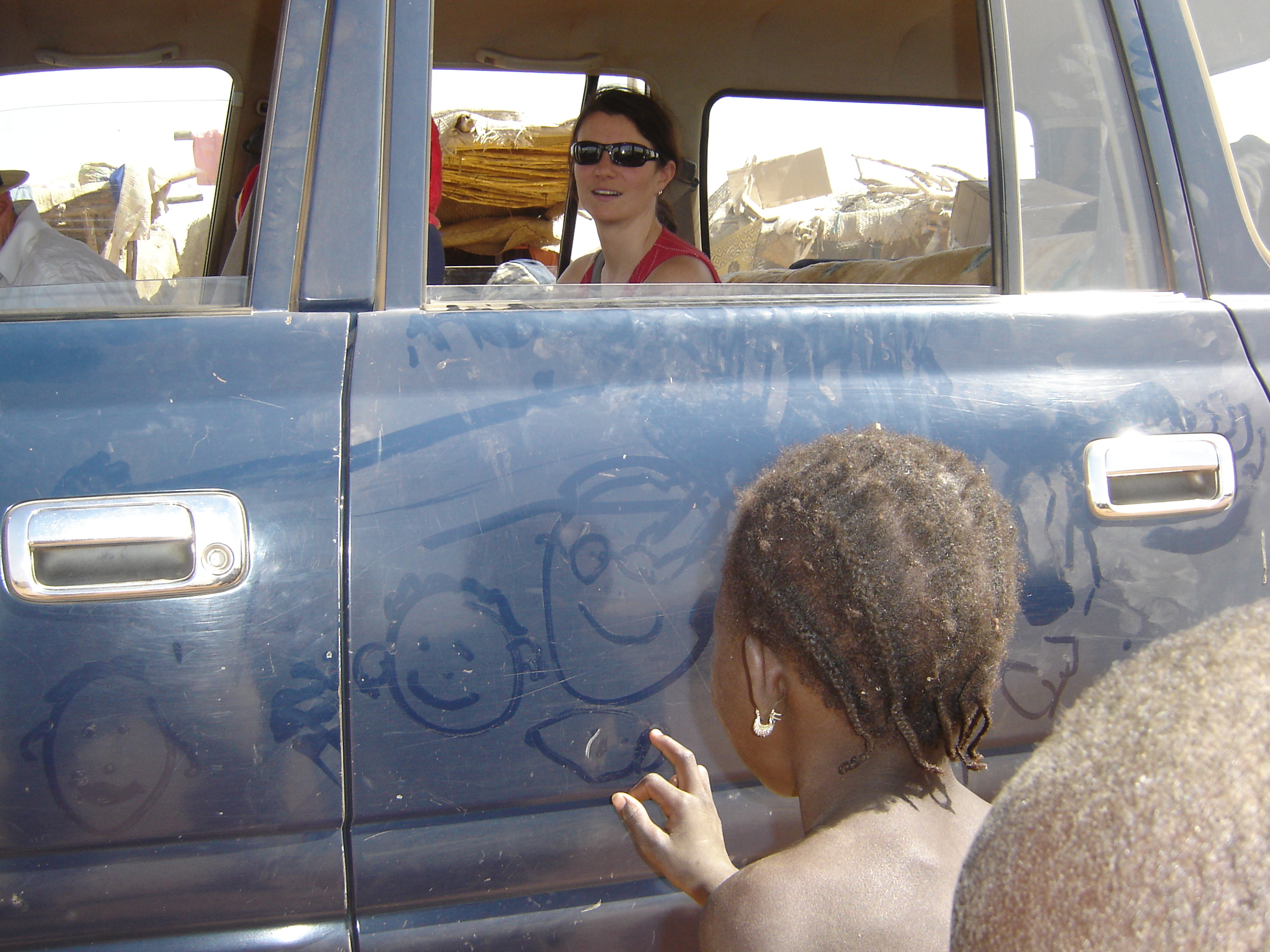
When the ferry arrived it filled up immediately with the three waiting vehicles, a dozen people, one cow, two goats, and countless chickens. And with a swarming goodbye wave from the kids we were off. When we landed on the other side we were in Timbuktu county. Twenty kilometres later we entered the fabled but quite real city of Timbuktu. We checked into our Baba-booked hotel and headed out for a walkabout and hopefully to find some lunch.
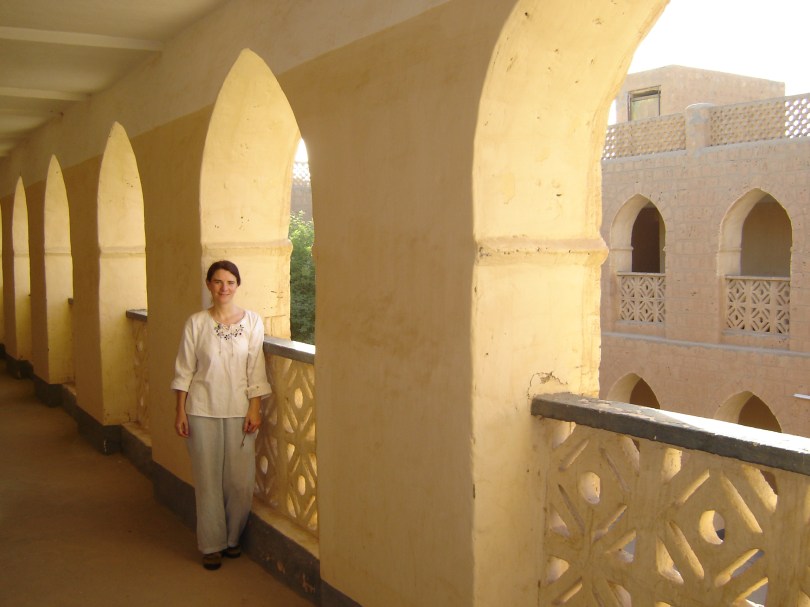
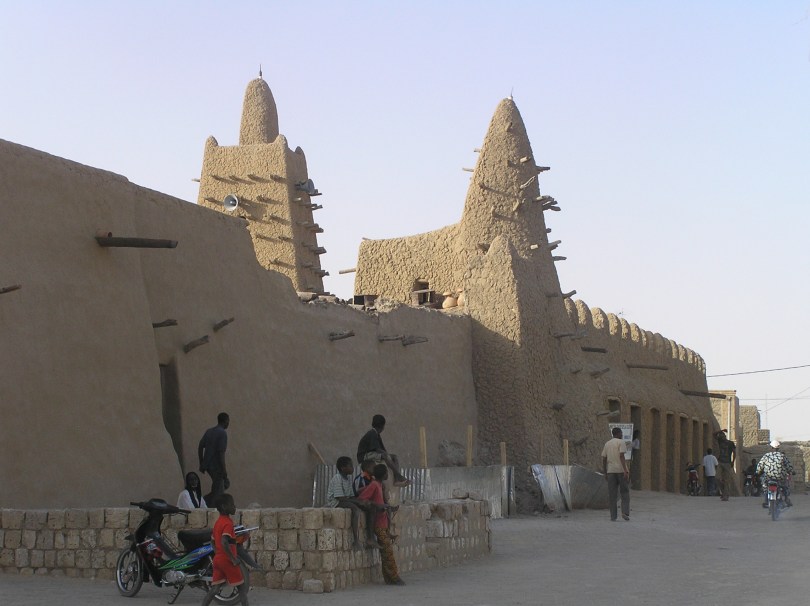
Timbuktu was established approximately a thousand years ago by the desert-dwelling Tuareg people. The city changed hands several times as it grew to become a major trading centre. Due to its location on the fringe of the Sahara Desert and proximity to the Niger River the city became a hotbed of the salt trade, which it still is. And you remember that old saying about something being “worth its salt,” right? Well, that came about because salt used to be an extremely valuable resource. Throw in a little bit of gold, ivory, and slave trading and the desert metropolis of Timbuktu quickly grew to legendary status. A major university was founded there, as was one of the world’s great libraries.
Where there is wealth there is bound to be strife, and for a multitude of reasons Timbuktu eventually skid into decline. At one point the city was burned to the ground, library and all, and after a quick walk along the dusty streets I must admit that it appears that Timbuktu didn’t bother to do much rebuilding after the fire. Little seems to remain that is worthy of attracting weary travellers from the world over, aside from the city’s wonderfully exotic name, of course. Well, that and the flinching awareness that one has reached a locale that many explorers lost their lives trying to get to not so much as a hundred years ago.
As a pair of conspicuously white tourists, m’lady and I attracted quite a bit of attention during our stroll. We were never not being greeted, followed, and fawned upon. After an obstacle-laden wander through the market and a few pictures of the big, beautiful mud mosque in the middle of the city m’lady tired of the nonstop interaction and decided she was ready to go back to the hotel. On the way we passed a radio station and I poked my head in for a quick peek. The primitive equipment gave the station a range of only about a hundred kilometres, but for the people within that radius the station provided an indispensable source of information and connection.
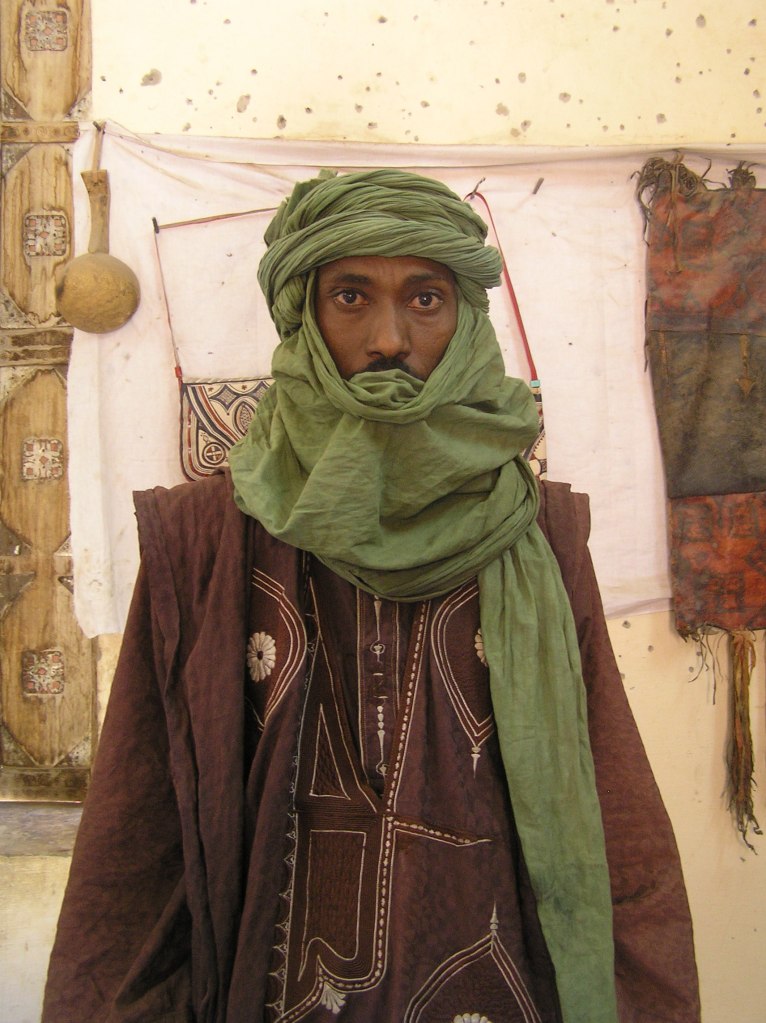
Back at the room I grabbed my guitar and went outside to continue exploring on my own. I emerged from our dwelling with the guitar strapped to my back Springsteen-style and made it about two feet before a Tuareg man insisted that I follow him, as his father was the greatest Tuareg musician in all of the Sahara. A short walk back through the market brought us to his family’s house. Or rather, the tent that they had temporarily pitched in the front yard of someone else’s house. Nomads, remember?
It turned out that the guy’s father wasn’t home so with a shrug he pulled a satchel of jewelry out from beneath his robe and started trying to sell me stuff. I had only been in the city for a few hours but I already knew that the Tuareg people were well known for both their fine silver jewelry and for their overly-aggressive sales pitches, so I immediately left.
A block away a group of Tuaregs asked me to play for them so I did. In no time we were surrounded by dozens of people, all of them clapping and dancing. Eventually I moved on but wherever I went I recreated the same scene. Perhaps it would be more accurate to say that wherever I went I caused a scene. Walking around Timbuktu with a guitar made me feel like I was fifty feet tall.
One young man coaxed me to follow him to his family’s house. I explained that I’d be happy to but made it clear that I didn’t want to buy anything. He said it wouldn’t be a problem because he was not a jewelry maker like the rest of his tribe. He told me that he was a student and that instead of making jewelry he wanted to become a musician. I said “Okay,” and followed him home.
Along the way we were stopped by two goats who became engaged in a devastating head-butt fight. The street was immediately made unpassable as everyone gathered to watch, just like kids inevitably surround a schoolyard scuffle. And really, if a guy like me pounding out squawky Bob Marley covers counts as entertainment around these parts then of course a solid round or two of unhinged goat violence is going to pull a crowd.
Facing each other with their heads down, the goats would scratch the dirt in front of them like angry bulls before crashing headlong into one another with astounding speed, incredible strength, and brutal force. Whack!!! I was amazed that either creature could survive even one attack, and they went at each other at least ten, maybe a dozen times! Finally one of the goats faltered and staggered away and the street returned to its usual dusty bustle. My new friend and I continued on to his house.
When we arrived I discovered that, just like my last host, his family’s home consisted of a yurt that was set up in front of another family’s house. My new friend went inside and brought out a blanket to lay on the ground. We doffed our sandals, he grabbed his “guitar” and we sat down and played together.
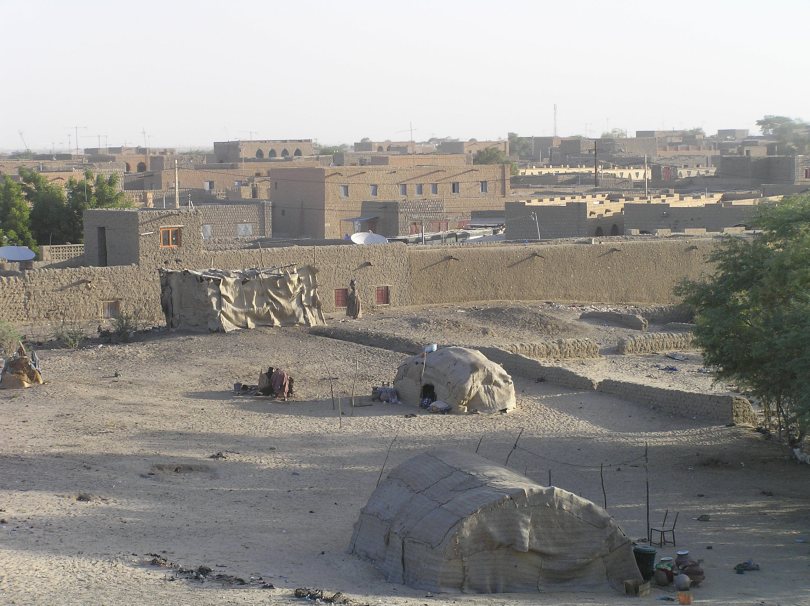
His was the traditional instrument of his people. I can’t remember what he called it but I suppose it could be described as a primitive mandolin or perhaps a small banjo. It had a small gourd-shaped body made of wood with a top of stretched animal skin and a fretless neck that was reminiscent of a sawed-off broomstick. The instruments’s three nylon strings were permanently fixed, there were no tuning pegs at all. I twisted my highest strings to approximate his and when I managed to copy some of his motifs he was thrilled.
With an instrument that was utterly untunable, the man’s playing focused on rhythm rather than tonality, something that was highlighted to me when we switched instruments. When he corrected my playing it was always about the rhythm. He ignored the notes I was playing altogether.
Eventually he handed back my guitar and asked me to play him some blues music. I did, making up the desert blues as I went along (“Got the desert blues/Got the sand in my shoes/Got the desert blues/And I’m stuck in Timbuktu”). His entire extended family suddenly emerged from the tent, dancing and clapping and obviously very pleased to have me there. I found the reaction kind of surprising because aside from Ali Farke Touré I had yet to hear anything like blues so far – only traditional Malian music and reggae – but it sure was great to see the whole family having so much fun. I was also surprised because I’d had no idea that there had been anyone inside the tent.
By this time the sun had gone down so I soon begged off and circled my way back to the hotel, where I found m’lady mercifully still asleep. I went to the restaurant and spiked a few Cokes with little airplane bottles of whiskey that I had brought from Canada. I whiled the time chatting with the only other patron in the joint – a British tourist who wasn’t Steve – the two of us repelling random Tuareg sales pitches the whole time. When I ran out of teensy Canadian Clubs I switched over to local beers. When I ran out of company I pulled out my little alphasmart word processor and did some typing. Eventually the lone barman closed the place and left me all alone.
Swatting drunkenly at malarial mosquitoes and staring up at the vast canopy of stars it occurred to me that along with the steady chirping of sand crickets I could hear drums beating in the distance. And while I should have been thinking about nothing but bed, I just had to find out where that music was coming from.
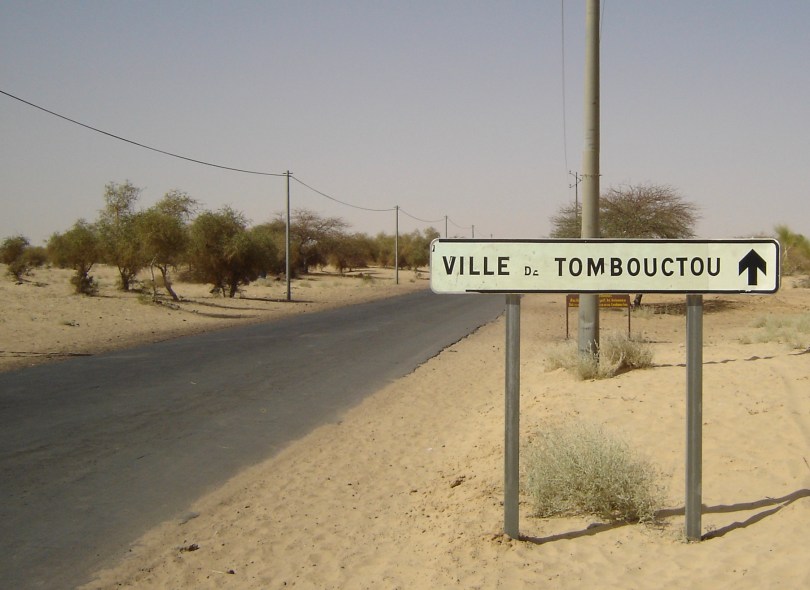
111408 A Big Day in the Desert
Before turning in I had staggered back and forth through the streets of Timbuktu following the sound of drums. The doppler effect created a musical mirage that tricked me into chasing the ricocheting rhythms as they bounced up one street and down another, until suddenly the drumming stopped. Before embarking on my sonic search I’d stopped into the hotel room and emptied my pockets of all valuables and money save enough to buy one beer (I may be crazy but I’m not stupid). Suddenly left with no music to wander towards I decided to find somewhere to have that last beer.
The streets of Timbuktu are surprisingly busy at night, but after stopping at a few establishments and finding no beers for sale I decided it was perhaps most prudent to get my drunken ass back to the hotel. I didn’t think that I was very tired but once I fell into bed I was asleep in seconds.
M’lady’s morning stirring roused me from my slumber and we decided to go for a walkabout before it got too hot outside. We aimed north, weaving slowly along the side streets watching Timbuktu’s morning unfold. It felt distinctly like strolling through Mos Isley, but without the Imperial Stormtroopers.
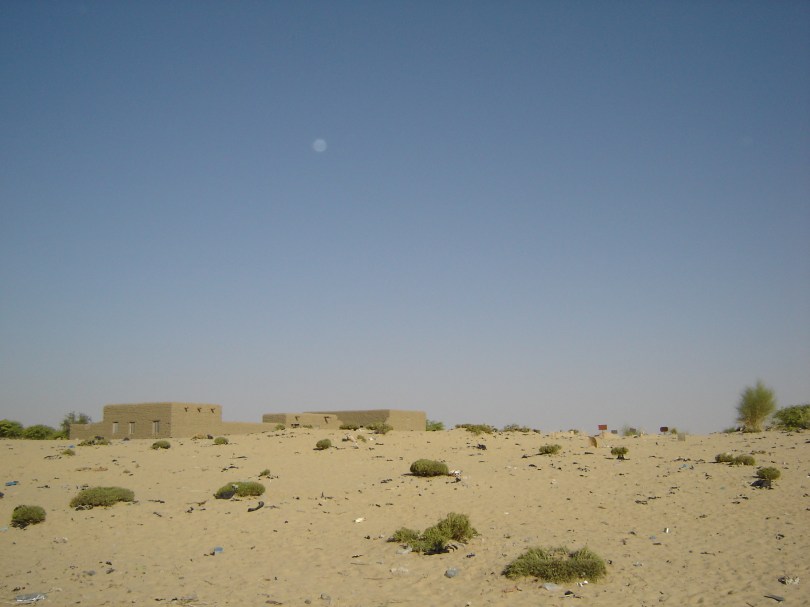
We eventually walked our way right out of town and found ourselves standing in the Sahara Desert. Turning around we zigzagged our way back through the city until we came across the Flame Of Peace Monument, where about a dozen children sat, seemingly waiting for us. “Shouldn’t you kids be in school?” I asked. En masse they pointed at just one member of their crew, “Yes, he’s supposed to be in school!”
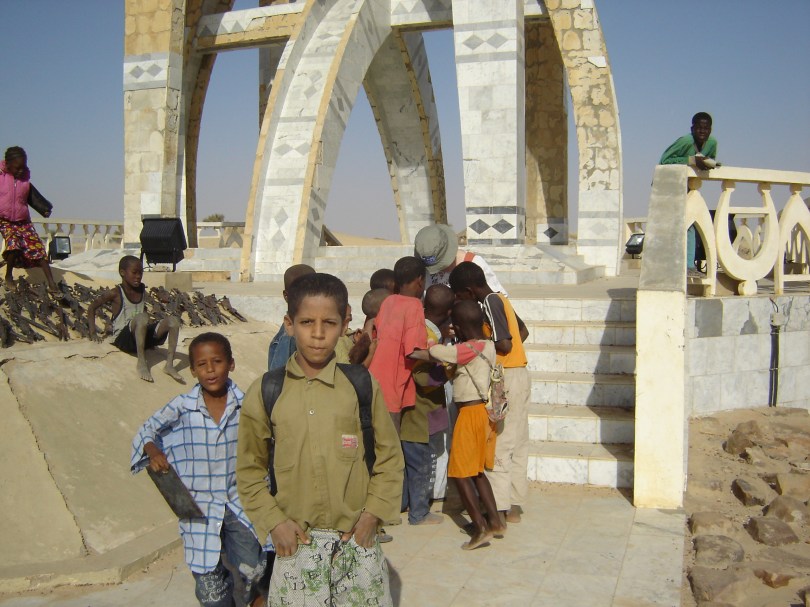
For centuries this area was the exclusive stomping grounds of the Tuareg people, nomads who wandered unfettered throughout the vast desert in pursuit of the lucrative salt trade. When nationhood grew out of the African independence movement of the 1960’s geopolitical boundaries suddenly appeared, disrupting historic trade routes and restricting the movements of the Tuareg people, who were exiled to neighbouring countries including Libya and Algeria. To the Tuareg these national borders were nothing more than imaginary lines drawn in the sand. They began to revolt, demanding a large swath of the Sahara that they could call their own.
After decades of fighting Malian president Amadou Toumani Touré brokered a peace deal (which did not include handing over any land to the Tuareg) and in 1996 ten thousand people gathered in Timbuktu – on the very spot where we were standing – and handed over their weapons to be destroyed. In total more than three thousand guns from both sides of the conflict were burned that day. To honour the agreement, a monument was built from the remains of the scorched and melted pile of firearms, and while the sculpture is relatively unremarkable in size the significance of what the memorial represents to the Saharan people is enormous.
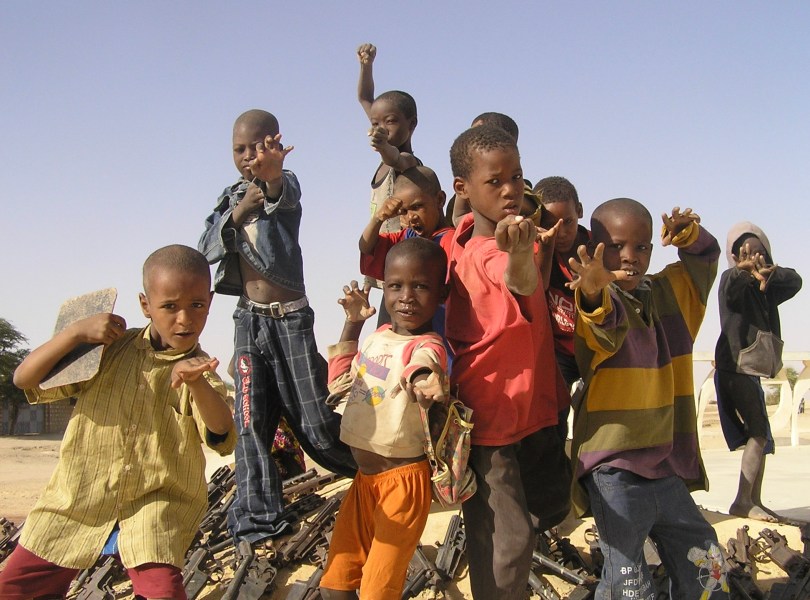
After a short visit m’lady and I decided to continue our stroll. leaving the kids to jump and play on the Flame Of Peace like it were a set of playground monkey bars. Along the way I heard some crazy music wailing out of a building and poked my head in. I was surprised to discover that the main instrument I heard was actually a recording, an electric guitar or something similar that was being beautifully distorted by squelching much too loudly out of a tiny speaker that was barely up to the job. Next to the speaker sat a man who drummed along on a gourd of some kind. It turned out I had interrupted a wedding rehearsal. The groom – dressed all in white and looking like a prince – greeted and welcomed me while the women invited me to join their dance. Of course I did, much to their amusement and mine.
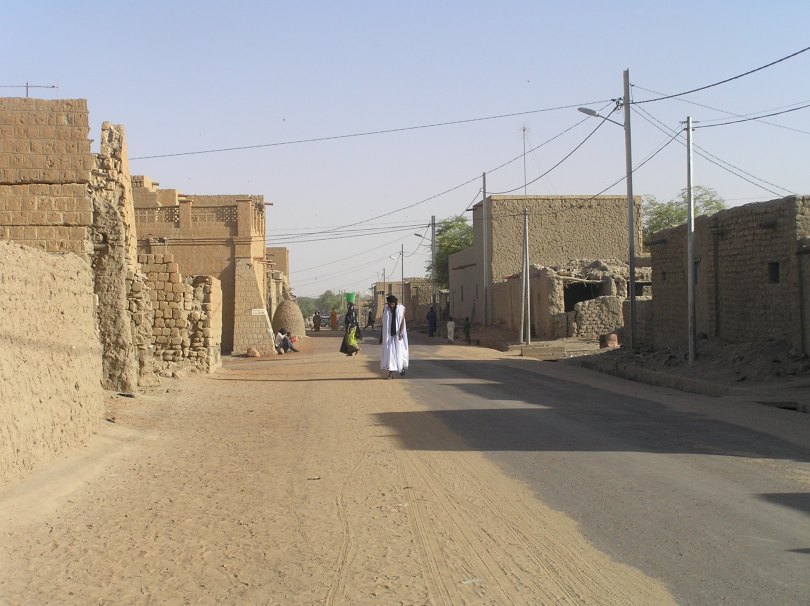
Back out on the sunny street m’lady and I decided that we were at least half-starved so we kept an eye out for somewhere that we could get some breakfast. We found an establishment that seemed up to the task and sat at one of their half-dozen tables, the only customers in the place. When we asked for a menu we were brought a weathered piece of paper with Arabic writing on it. We pointed at splotches of ink and were told what each item was. None of it sounded very breakfast-y but most of it sounded pretty good. By this time we were all-the-way starved and we might have said “yes” to a few more dishes than perhaps we needed to. Suffice to say, when we finished ordering I felt like we might have overdone it a little, like when you order a plate or two too many at a Chinese restaurant.
It took at least a half-hour for our first dish to arrive, and when it did I was flummoxed. The man brought out an enormous bowl full of millet and chicken and simply set it on our table. I mean this bowl was at least a good two, maybe two-and-a-half feet across. “What’s going on?” I wondered aloud. “This can’t all be for us…”
The man stood back with a smile, nodding and encouraging us to begin eating.
“Oh no! This means…”
And sure enough, when the beef and rice came out it was also enough to feed a dozen people. Same for the salad and the sides of vegetables. Our waiter soon pulled another table over to ours so he had room for everything. Our order of bread amounted to a full loaf. When all was said and done we had ordered enough food for twenty or more people. By the time we had eaten our fill we hadn’t put even the slightest noticeable dent in the massive spread.
Our bill still came to an absurdly low amount and by the time we settled up we remained the only customers in the restaurant. I gestured to the empty tables and asked the proprietor with a shrug why nobody else was there and he pointed to a small clock, indicating that 9:30 was too early for customers.
9:30? M’lady and I looked at each other in shock. “It’s only 9:30?!?!” We thought it was noon or 1pm at least! We had been in the restaurant for probably close to two hours, and before that was the kids and the wedding party, plus all that walking around. We just assumed that we had woken up around 7:00 or 7:30 but it turns out we had accidentally been out romping through the streets since well before 6:00am, probably closer to 5am. Here we were fed full to the elbows and it wasn’t yet ten o’clock. Talk about getting a jump on the day!
We walked off our “breakfast” by looking for and finding the post office, where I sent myself a couple of postcards. We paused beside a school and listened to a class that was being held outside in the school’s dusty courtyard. The students responded in unison to the teacher’s every question. The teacher started leading them through the English alphabet and I was pleased to hear that they ended with “zed” and not “zee”, just like we do in Canada. During their second recitation I stuck my head over the fence and joined in, which caused the young children to explode into riotous screaming and jumping around. I ducked away and left the teacher scrambling for order, then we booted it back to our hotel.
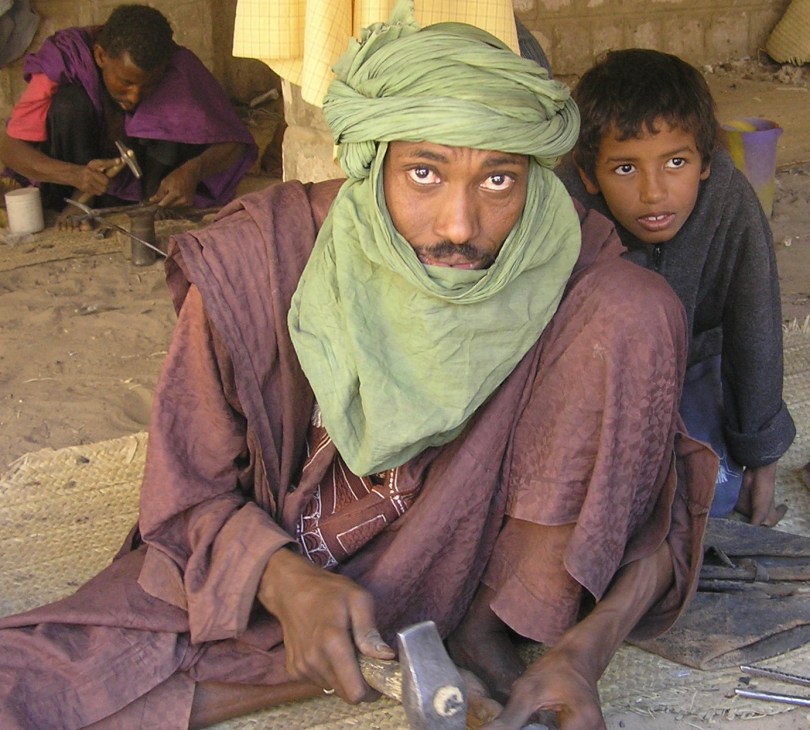
Along the way we passed a cemetery, just the second we’d seen in Mali so far. Both looked like little more than rubble-strewn patches of rough earth, each dotted with a number of small, hand-painted signs. The wooden markers were so simple and plainly written that one could easily mistake them for advertising a garage sale or something equally mundane rather than marking the final resting place of someone’s dearly departed.
I don’t know why I find graveyards so interesting, but I sure do.
Back at the hotel we relaxed in the open-air bar, sipping cool beers in the shade and watching the city around us roast. Despite the oppressive heat the locals still found it chilly, many of them walking under the noonday sun wearing multiple layers. Some walked by wearing winter jackets zipped all the way closed, just like Kenny in South Park.
To think that people even have winter jackets in Timbuktu. But then, what do I know about riding camels through the Sahara Desert and sleeping on the barren sand?
Not much, admittedly. But I was about to find out.
Now, if you’ve been keeping track you’ll notice that it’s not even lunchtime and m’lady and I are gearing up to ride camels into the desert to spend the evening with the nomads. And yet with a missive already this massive I feel it prudent, dear friends and readers, to pause for reflection before I continue with the adventure, lest the reading of this diatribe take up too much of your day. So let us suspend the action here and freeze on this moment in which m’lady and I lounge in the shade with drinks and watch the world go by.
Until next time.
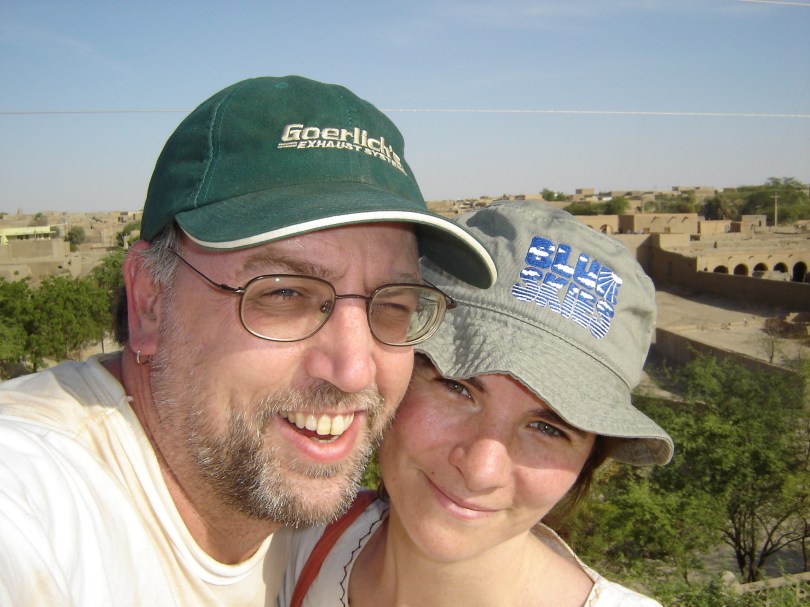
INTERMISSION
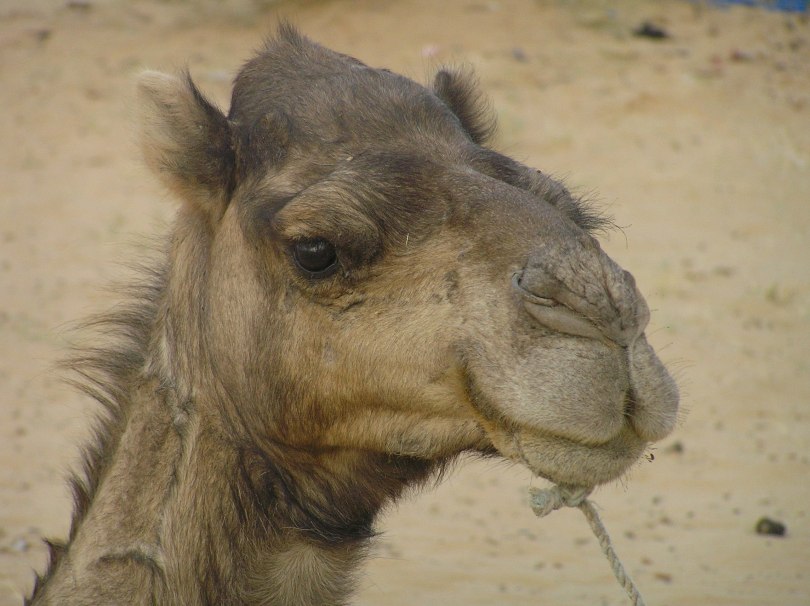
The interested reader may recall that before I calved the tale of this day in half m’lady and I had already spent 6+ hours exploring the glaring, blaring streets in and around Timbuktu before the hour had even struck noon. At last word we were resting easy in the hotel bar as the world unfolded around us. The remainder of our day had been preplanned and prebooked back in Bamako through our man Baba and all we had left to do was be ready. And so we readied ourselves with a steady stream of cool drinks and lazy relaxation.
It was late late afternoon by the time we were summoned. Behind the hotel we found British Steve, whom we’d met the day before when we shared a jeep from Mopti to Timbuktu, and together the three of us met our Tuareg guide Mama, his assistant, and their three camels.
When m’lady and I had haggled our bookings with Baba he’d recommended we take a camel journey into the Sahara and spend the night in a traditional a nomad encampment. We waffled while he insisted that this was a must-see if we were to be in Timbuktu, and we were. After a little more humming and hawing he dropped the price down so far that we felt we would probably spend more more money just sitting around doing nothing for a day. So we booked it.
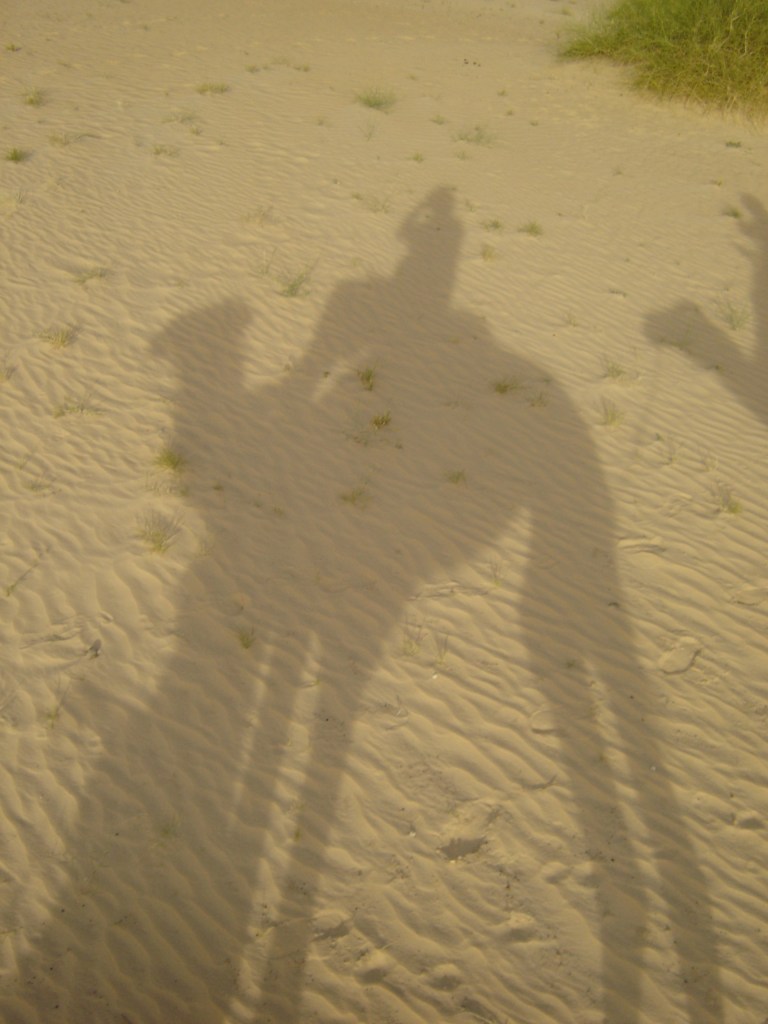
The three camels were for British Steve, m’lady and I to ride while Mama and his assistant would walk ahead, leading us. The men coaxed the camels to their knees and the three of us mounted our lumpy steeds. We rode on the camel’s hump in saddles that sported a tall wooden plank up front where a saddle horn would traditionally be. As my charge clamoured up to a standing position I hung on to that plank for dear life. M’lady and British Steve did the same.
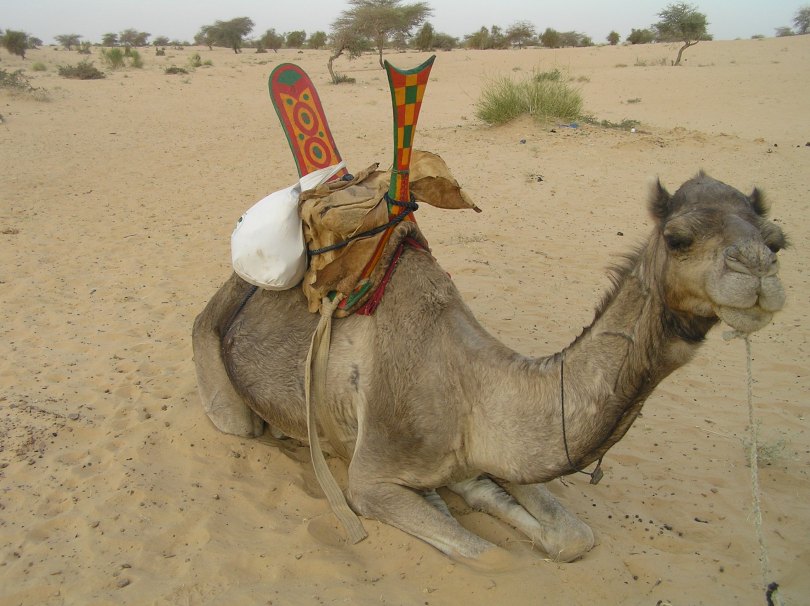
And then we rode our camels out of Timbuktu and into the vast Sahara. Crazy.
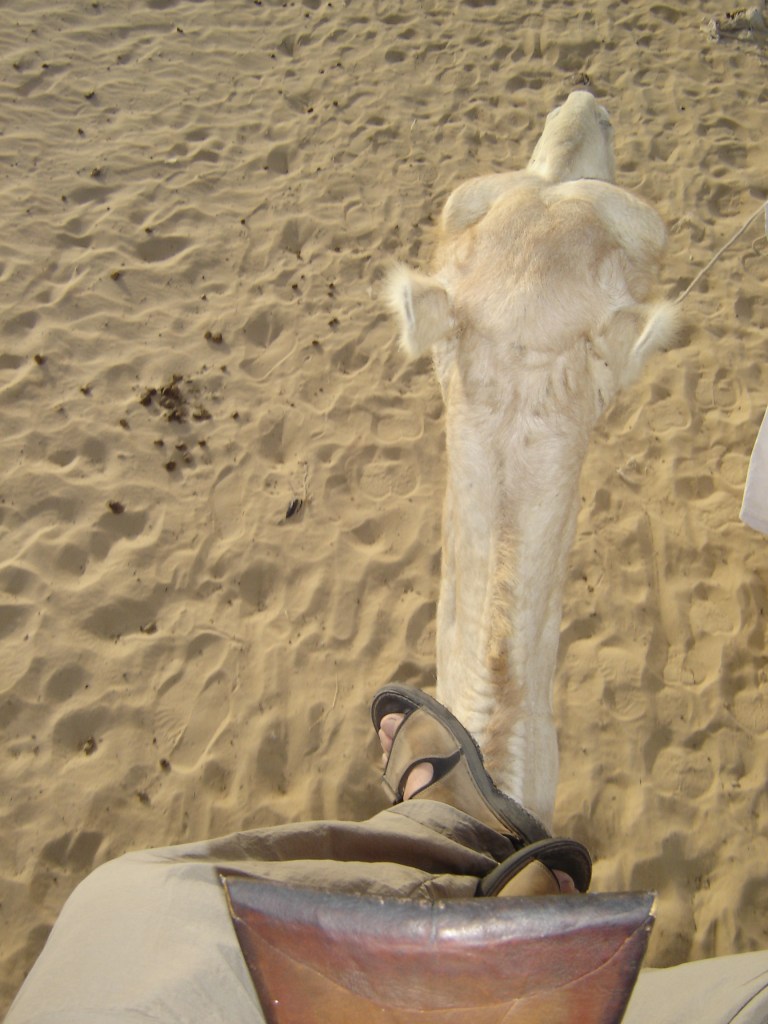
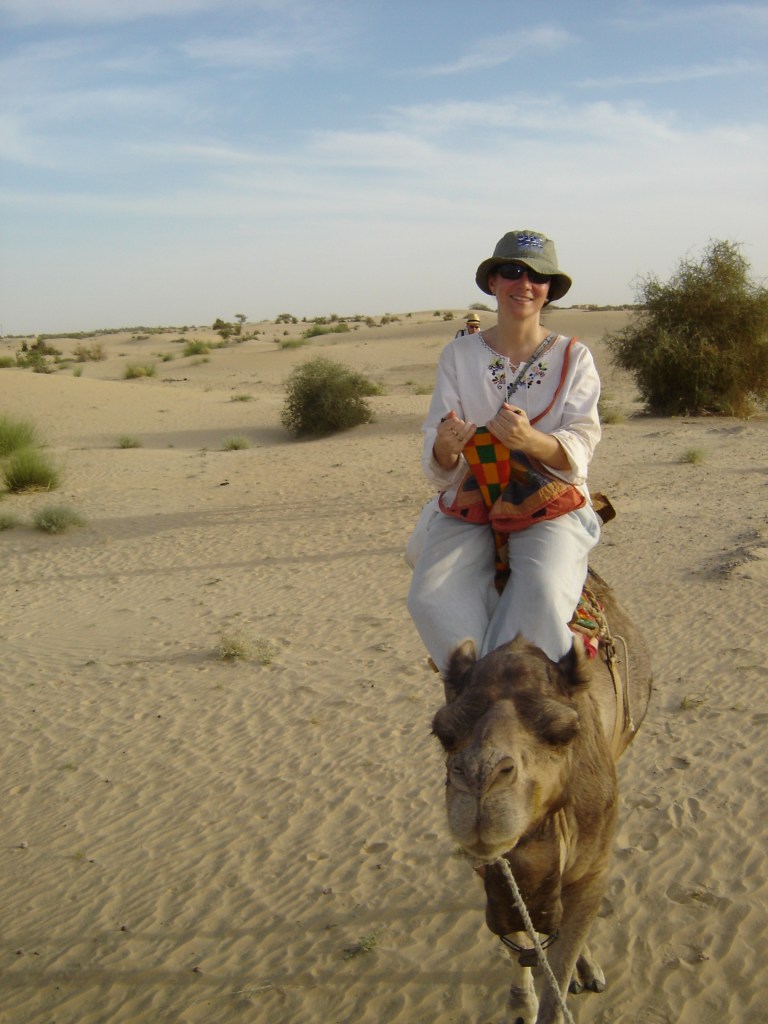
Mama and his buddy led us about six kilometres into the desert, both men holding a cellphone in one hand and a camel’s reins in the other. When I first saw these two robed and weathered desert nomads carrying their modern cellphones I was taken aback, but it quickly struck me: who needs a cellular telephone more than a nomad?
(Speaking of cellphones, partway through the afternoon ride British Steve had to dig into his backpack to answer his cellphone. It was a work call and he quickly begged off, explaining that he was actually a bit busy right now riding a camel through the Sahara Desert and could they please call back next week? I wondered if the person on the other end of the line could possibly have believed him.)
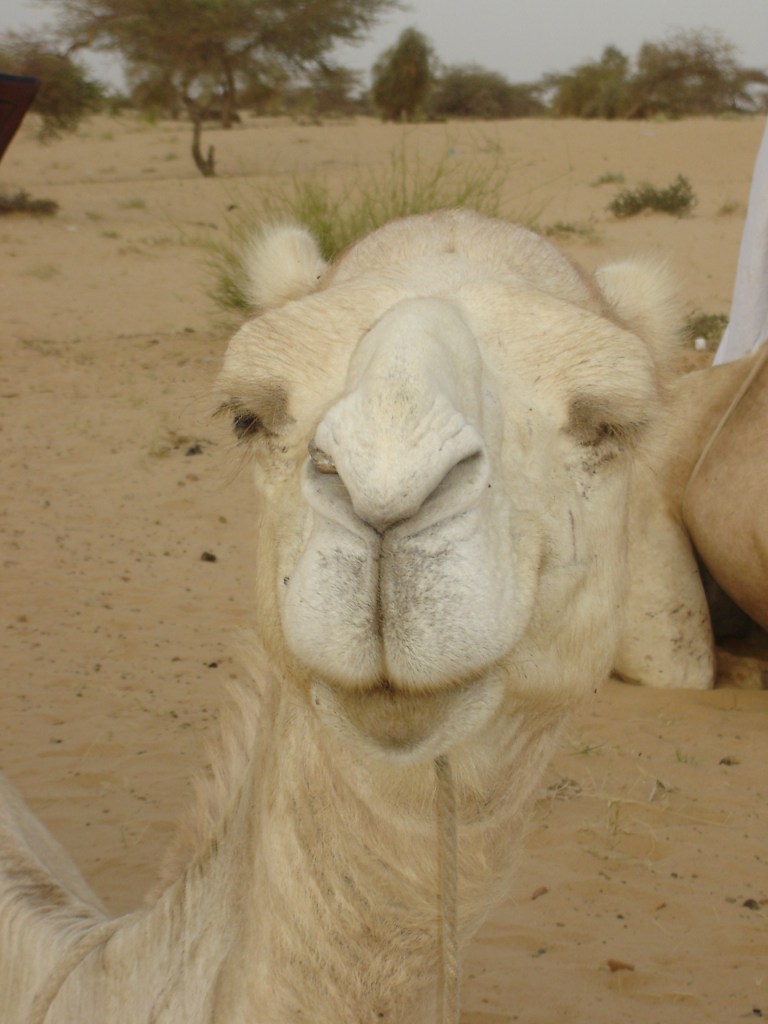
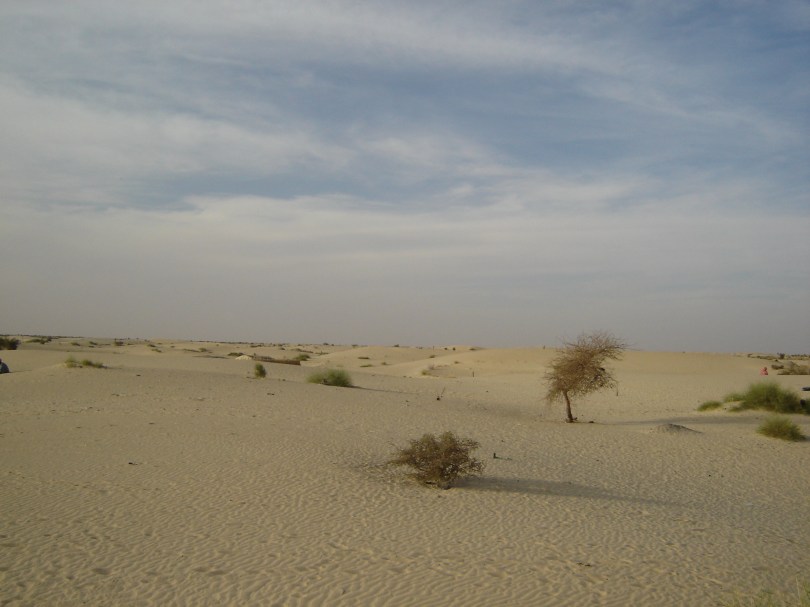
Though there was no mistaking the barren fact that we were in a desert, I was surprised how dotted the landscape was with vegetation, rough as it was. Rather than Tatooine-like hills of empty sand retreating into the horizon as Hollywood would have it, the endless dunes were scattered with scraggly trees and thorny bushes that looked like rooted tumbleweeds. Speaking of Tatooine, we passed quite a few wells along the way, round concrete structures that would fit right in on the Lars family homestead. When I inquired with Mama he invariably described each well by the nationality of the volunteers who built it. “That is a German well”, “This one is British”, “This one was made by the Dutch…”
The ride was somewhat uncomfortable but things could’ve been worse; at least I wasn’t the camel. Though to be honest, Mel didn’t seem to mind. And no wonder; camels are larger and heavier than horses and they have evolved themselves to be very well-adapted for slow, steady progress. (Yes, I named my camel “Mel”. I wasn’t about to go riding through the desert on an ungulate with no name. M’lady named hers “Cammie”.)
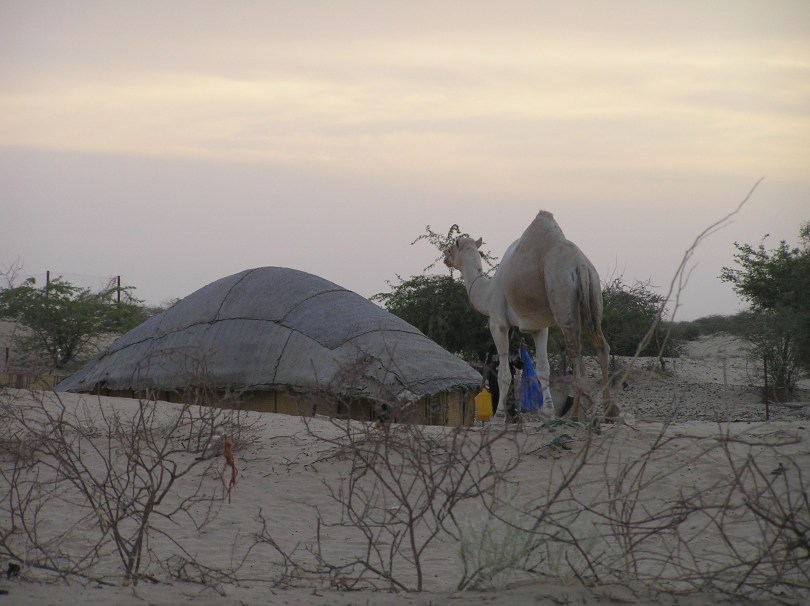
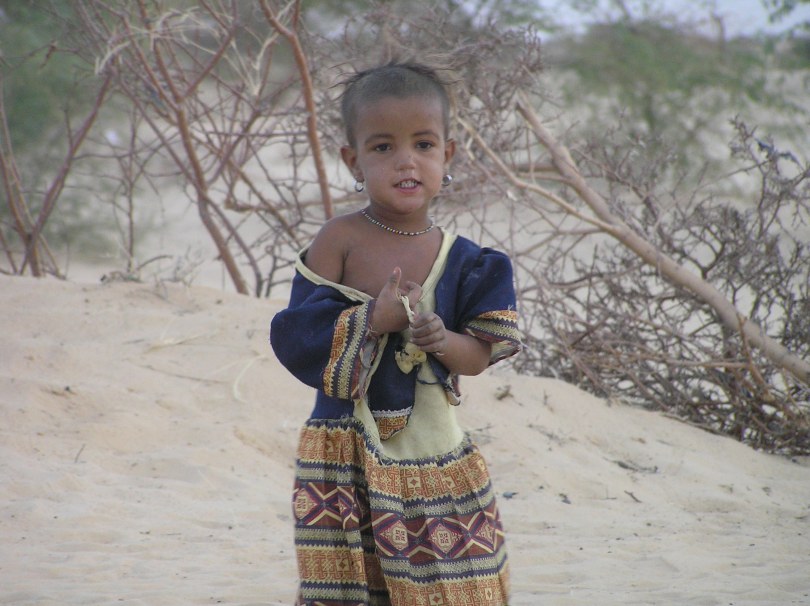
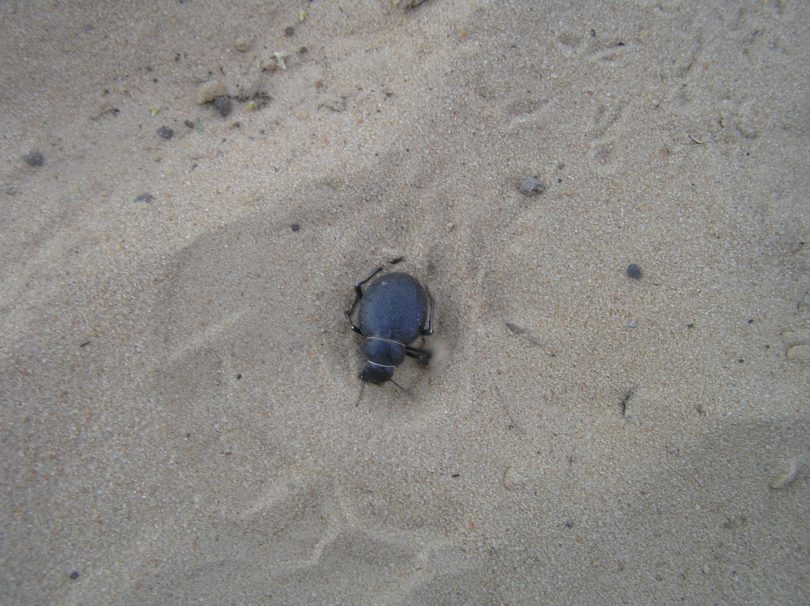
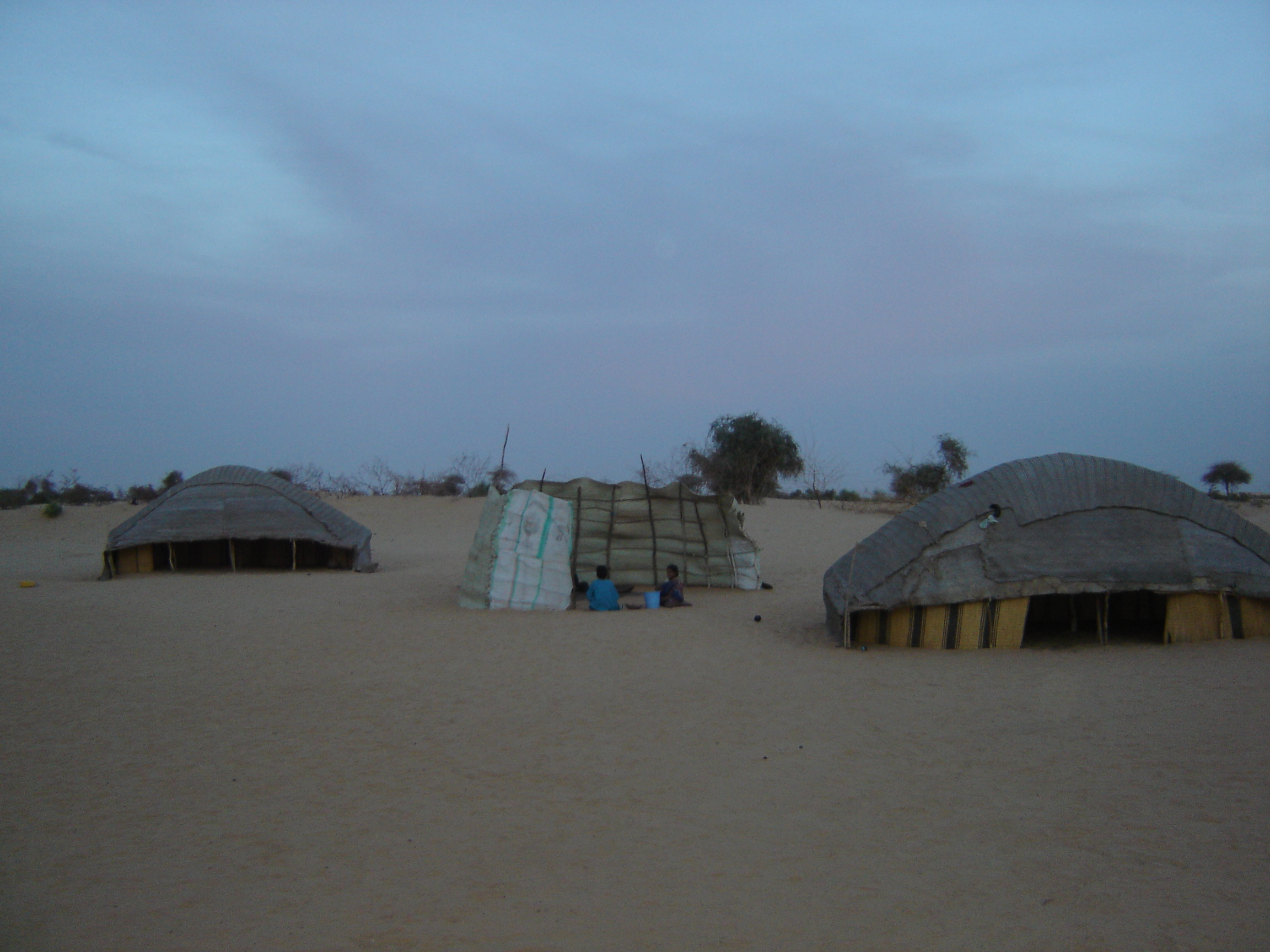
And so it was that after a slow and steady hour or so we arrived at a small Tuareg outpost that consisted of three tents and a firepit widely surrounded by a ring of thorned bushes. We were shown our quarters, which were spartan even compared to where the Tuaregs slept. Whilst they stayed in sizeable yurts, we would be sleeping on a mat lying on the open sand with just a single curved rattan wall set up along one side to serve as a windbreaker. There were large beetles running all over the ground making cute little tracks in the sand and burying themselves in preparation for the long, chilly night. It seemed like the beetles were happy to steer clear of us so they were a-okay with me.
The sun went down not long after we arrived and soon it became very dark. Our guy Mama approached from the yurts carrying a large, steaming bowl. His assistant handed everyone a wooden spoon and the five of us sat in a circle around the large bowl, collectively digging in to our shared stew of some nameless meat, rice, and gravy, which was liberally peppered with crunchy Saharan sand. For our desert dessert Mama cleaved up a large oblong watermelon.
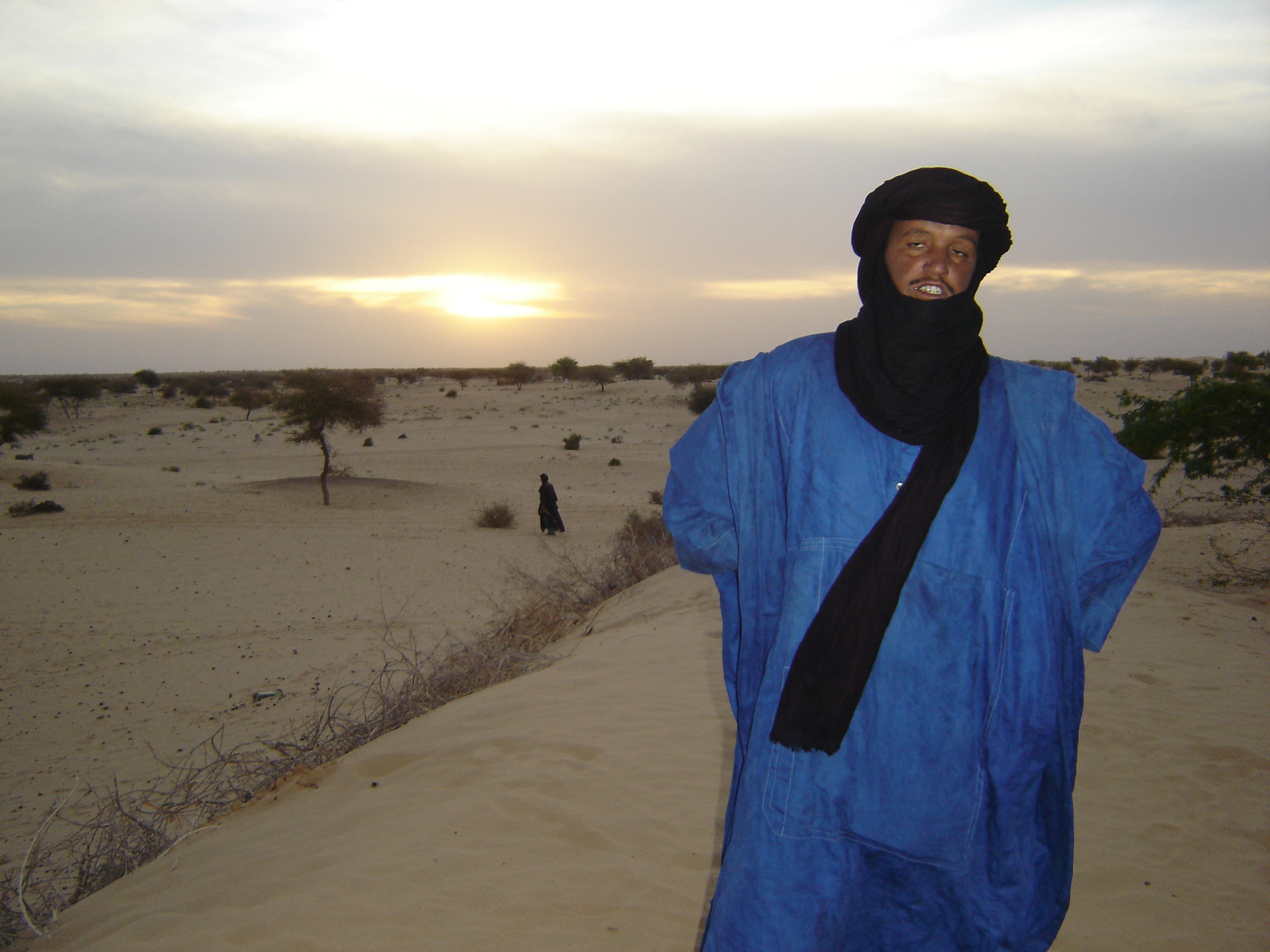
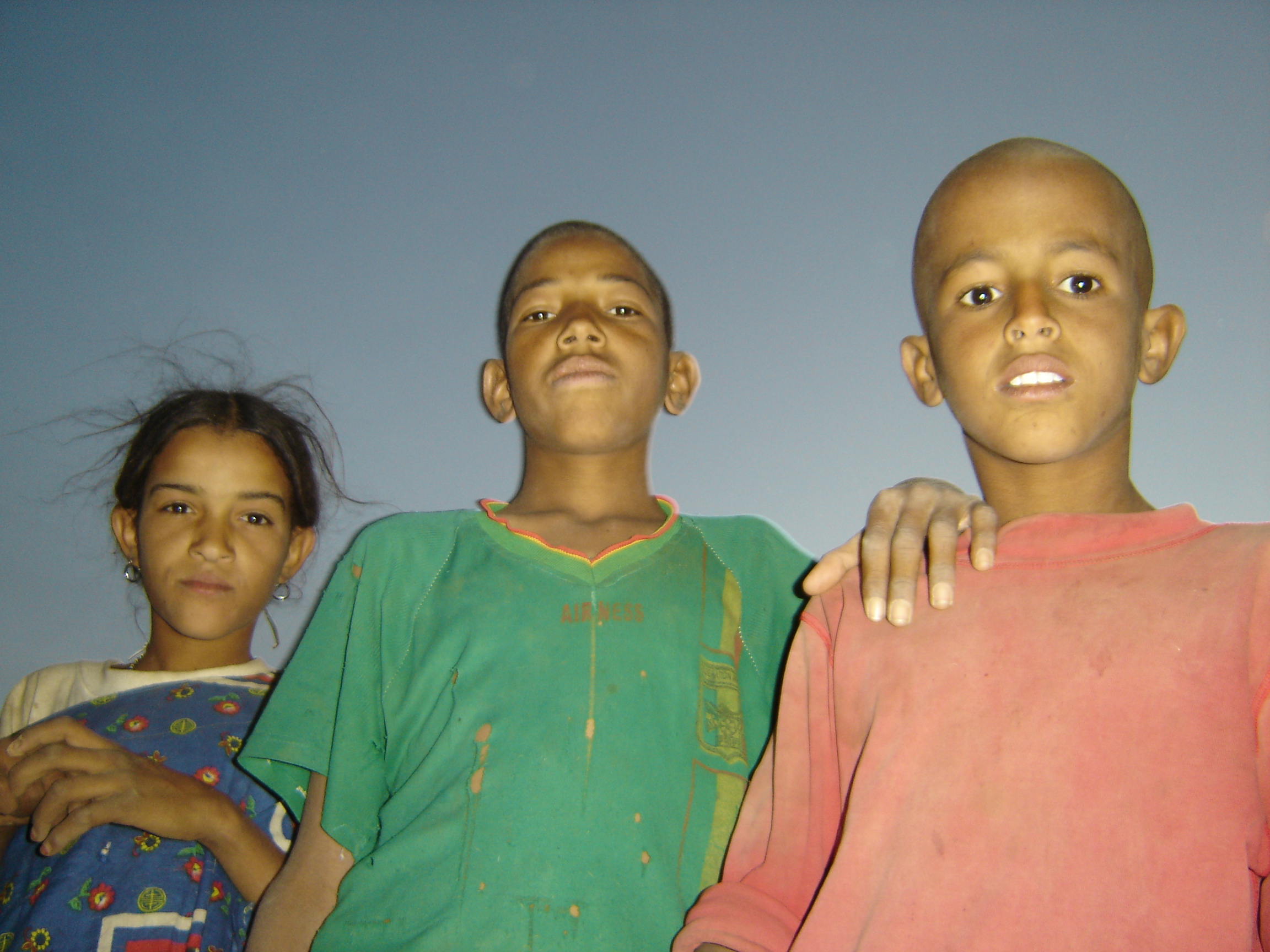
After dinner came the inevitable sales pitch. Mama and his friend began laying several pieces of cloth on the sand and set upon them countless handmade silver necklaces and bracelets. Most of these were formed into Tuareg “passports”; flat plates of silver that were clipped and cut into designs representing different regions within the vast Sahara, shapes that were recognizable only to the Tuaregs themselves. As they set out their wares Mama explained that if we saw anything we liked we should take it from their mat and put it on our own, and when all the selections were made the bargaining would begin. And indeed, they had laid an empty mat out before each of us.
Unspoken but obvious was the fact that if you put something on your mat you would definitely not be leaving without it, bargaining bedamned. We had heard of the Tuareg style of bartering; they make one offer, you make a counter-offer. They make a second offer and so do you, and then each party has just one more chance; it was during the third offer that the final price would invariably be settled (“The first offer is strong like death, the second is sweet like life, and the final offer is sugary like love”). Or so they say.
British Steve and I adamantly ignored any and all items pushed towards us, leaving m’lady to suffer the entire brunt of the aggressive sales pitch alone. While the two of us looked on m’lady tentatively placed a bracelet and a necklace on her mat. Three back-and-forth bids were made but no common ground was found. And whattya know? The men went on to counter with a fourth, fifth, and sixth offer, and then some. So much for the Tuareg bartering style, thought I.
But then, when it seemed like no price was going to be agreed upon Mama sighed and wordlessly unsheathed the menacingly large dagger that perpetually dangled from his side. He held it up and looked at it briefly before plunging it suddenly into the sand beside his mat. He then lifted his eyes and stared at m’lady, thickening the sudden, uncomfortable silence. Running his hand over the two item like a model on The Price Is Right, Mama calmly restated his third offer. M’lady followed up by repeating her third rebuttal. After a brief pause Mama pulled his dagger from the sand and sheathed it, agreeing to m’lady’s price. Sugary like love? It didn’t look like it. But under the circumstances, I thought as Mama and his pal left us to return to their yurts, I think we did pretty darn well.
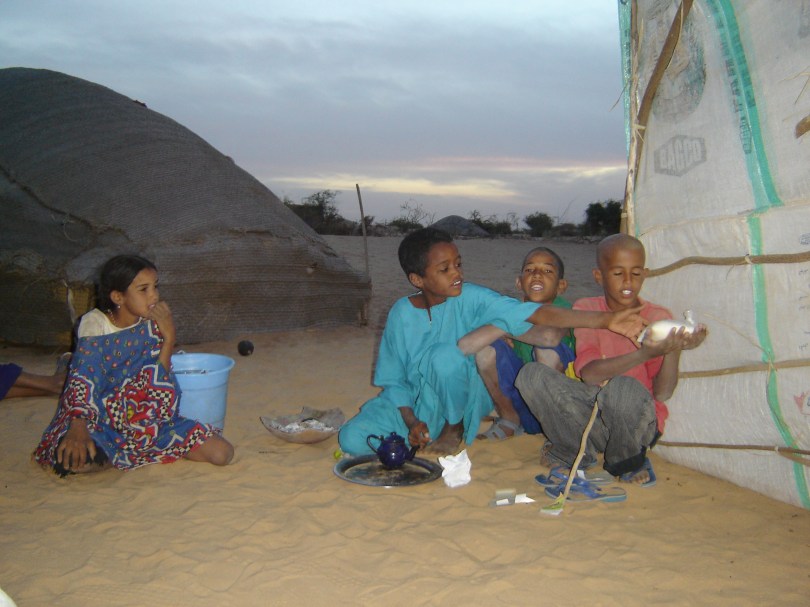
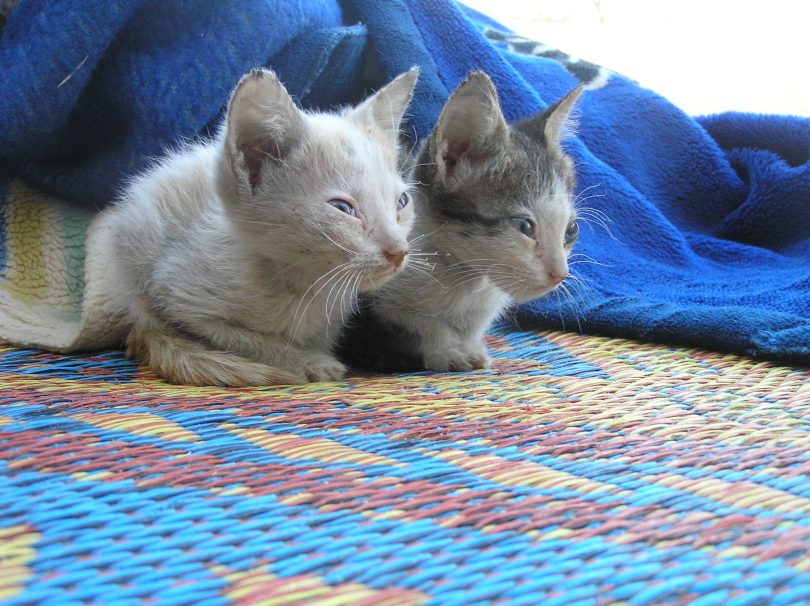
Before long about a half-dozen children came over to meet us, bringing with them a pair of impossibly small kittens that couldn’t have been two weeks old. The night had started to get chilly and m’lady busied herself coddling the kittens to keep them warm. Meanwhile I pulled out my handheld tape recorder and pressed the record button.
Three little girls ranging in age from around three- to nine-years old sang a stream of songs for me. Each melody was simply beautiful, reminding me alternatively of Indian music, Inuit throat-singing, or old pre-Blues field hollers. The music was tonal and full of inflection, and the singing was really impressive. After every song I rewound the tape and the girls sat enthralled, shushing everyone and listening intently. Once the playback ended they would rush to sing another, and with the final note they would clamour at the recorder insisting that I play it back. Soon all the kids wanted in on the action and the quiet trios gave way to group sing-alongs, with the boys (of course) eventually crescendoing to screaming, cacaphonic noise. Eventually I feigned dead batteries; the kids went to bed and so did we.
I offered m’lady and British Steve each a nightcap of tequila shots and I was so shocked to get no takers that I decided to abstain myself. With a nearly full moon reflecting brightly off the desert sand and only the occasional goat bleat and camel fart to disturb us, we three settled into the surprisingly hard ground, laid our heads on our stiff wicker pillows and tried to sleep, with m’lady still coddling those two tiny cats.
At some point during the night the three of us were awoken by a camel who noisily trotted by* not more than a metre or two away. We all sat up with a start, blinking back-and-forth at each other in sleepy astonishment before settling back into the hard-packed sand. As my gaze returned to the impossibly starry Saharan sky I tried hard to convince myself that I wasn’t dreaming. I suspect the others were doing the same.

*At night the Tuaregs leave their camels untethered, instead attaching a length of wood between their two front hooves. This hobbles the animal, reducing its mobility to short lurches and leaps and preventing it from escape.
111508 Camels, Trucks, and Boats
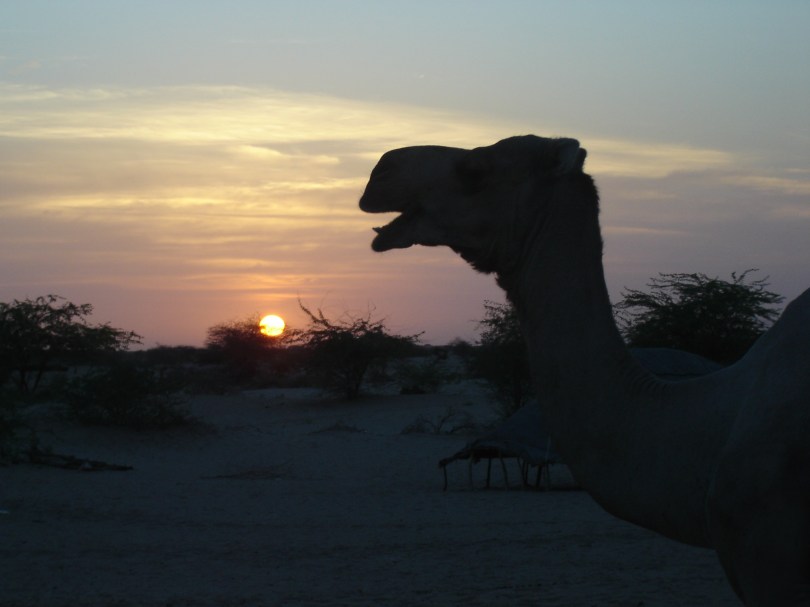
Neither m’lady nor I slept very well, for a lot of very good reasons. First of all, sleeping out in the open on a woven mat laid directly on the hardened Sahara sand ain’t no Club Med (thank goodness). Secondly, m’lady had to do a lot of tossing and turning to keep her new kitten friends warm and safe from squishing throughout the night, actions which helped to keep me awake. In the tiny pockets where I did manage to fall asleep my snoring would wake her up in turn. And so it went.
It was probably sometime around 4am when I tossed and/or turned for the last time of the night. I figured one of us might as well get some shuteye so I got up and waited for the sun to rise. I parked myself on the fringe of the small nomad camp and listened as the desert world slowly came to life around me. The camels and goats predicted the pending morning with increased bleating and snorting and eventually I was treated to a pretty Saharan sunrise.
In the dim morning light I silently watched as two women emerged from their yurts to start their daily chores. Moving silently through the din in their dark head-to-toe robes they looked for all the world like a pair of stealthy ninjas preparing a stealthy ninja breakfast.
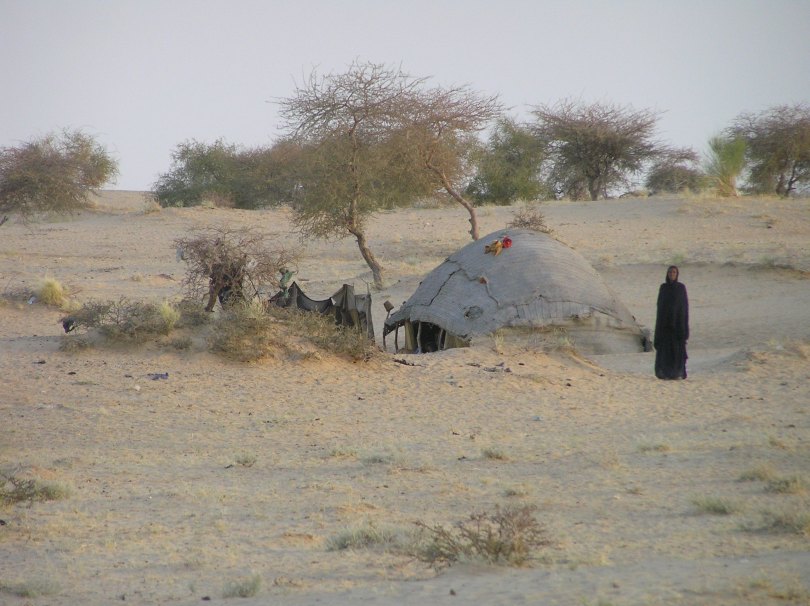
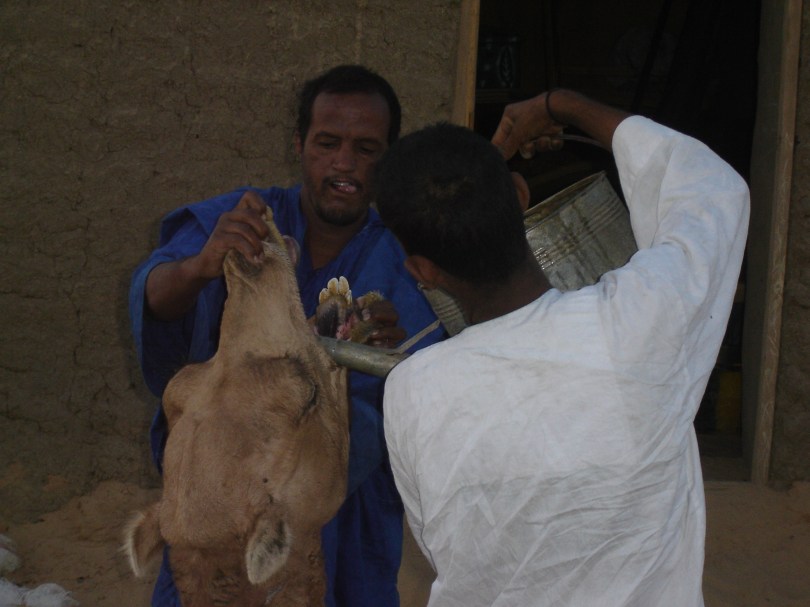
When the sun came all the way up everyone in the camp started to stir. Our Tuareg host Mama and his friend busied themselves filling up the camels, a chore that amazed me. You know that saying, “You can lead a horse to water…”? Well, that doesn’t apply to Tuareg camels! Going down the line, one man would tip back the head of each kneeling animal and hold its mouth open with both hands while the other man tipped a watering can deep into the creature’s mouth. No surprise: the camels didn’t like it one bit. The inevitable braying gave way to gurgling grunts as each camel’s “tank” was filled, and the procedure was repeated three or four times on every animal. Once each of the protesting animals had several gallons poured into them we were ready to mount up for our ride back to Timbuktu.
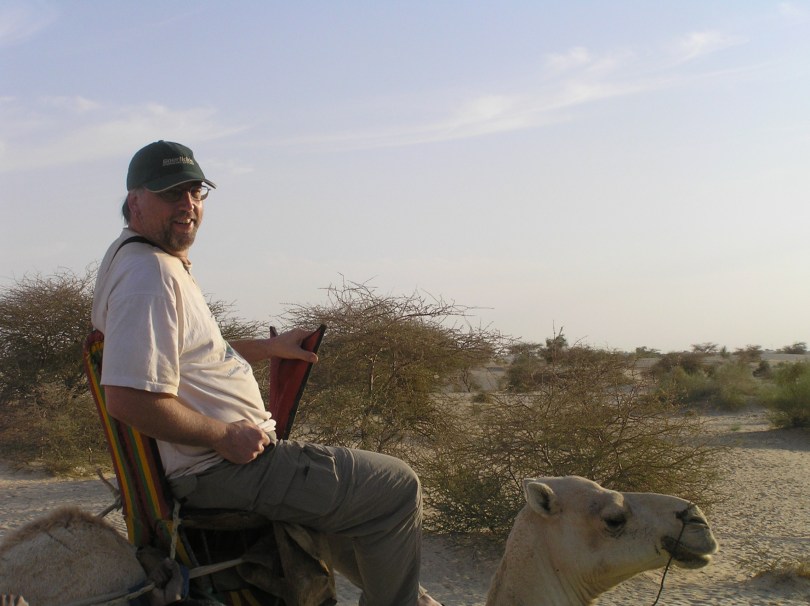
It wasn’t until we neared the city that I finally started getting comfortable sitting in the odd saddle and cupping my feet together to maintain balance, and the next thing I knew we got dropped off at our hotel. We went inside and immediately gathered up our things, checked out, and hopped into a waiting truck to be driven to the banks of the Niger River.
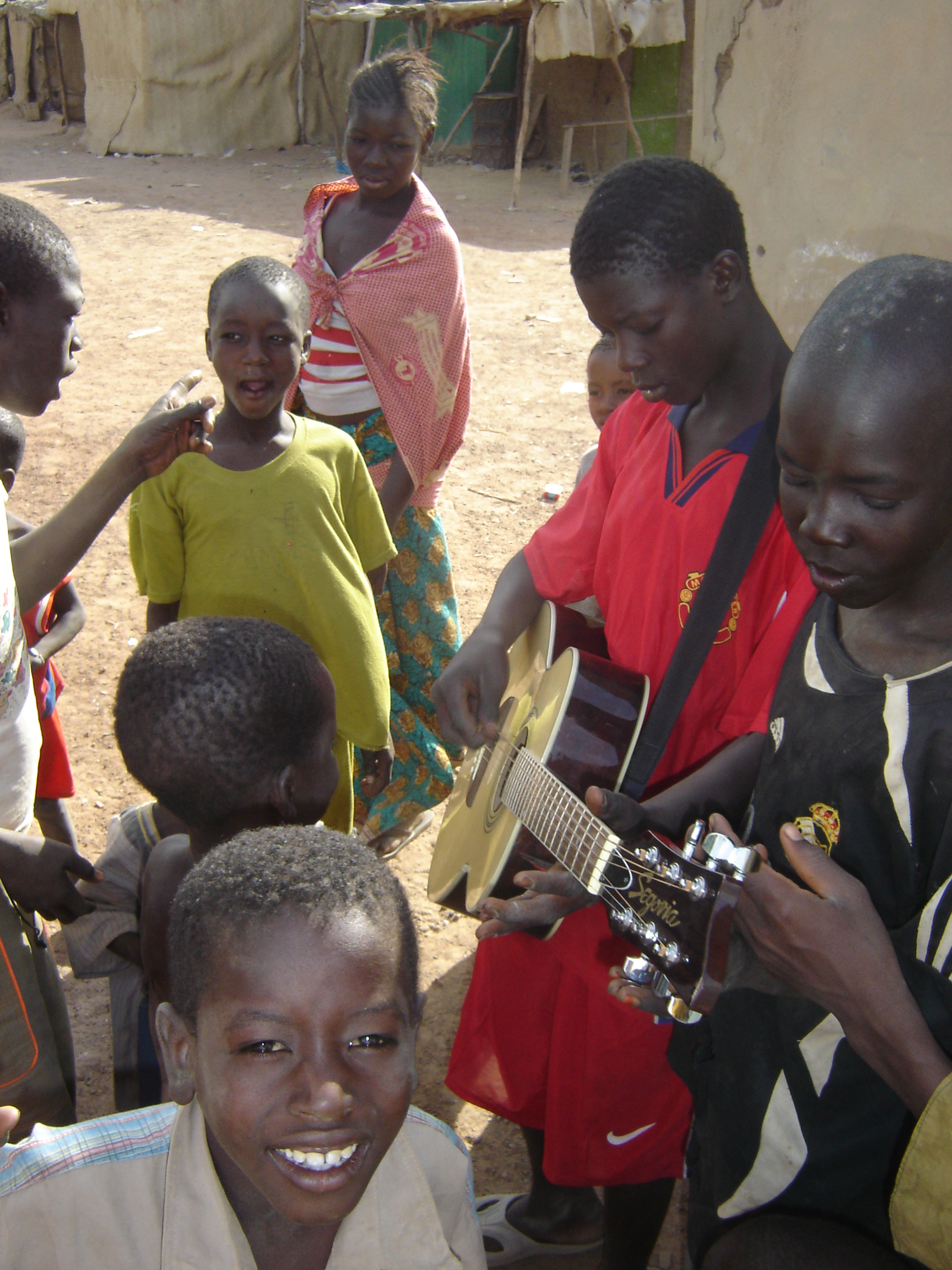
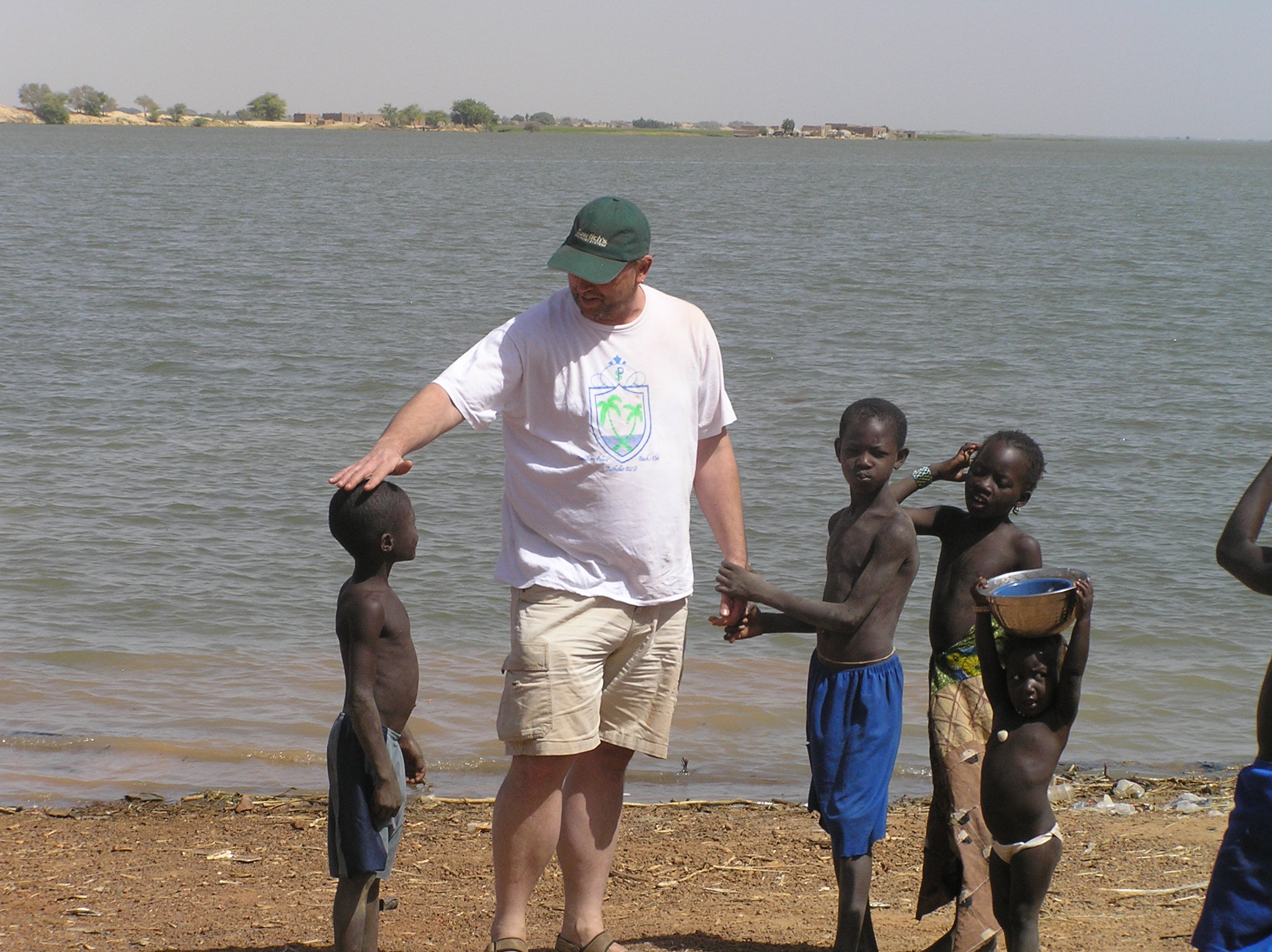
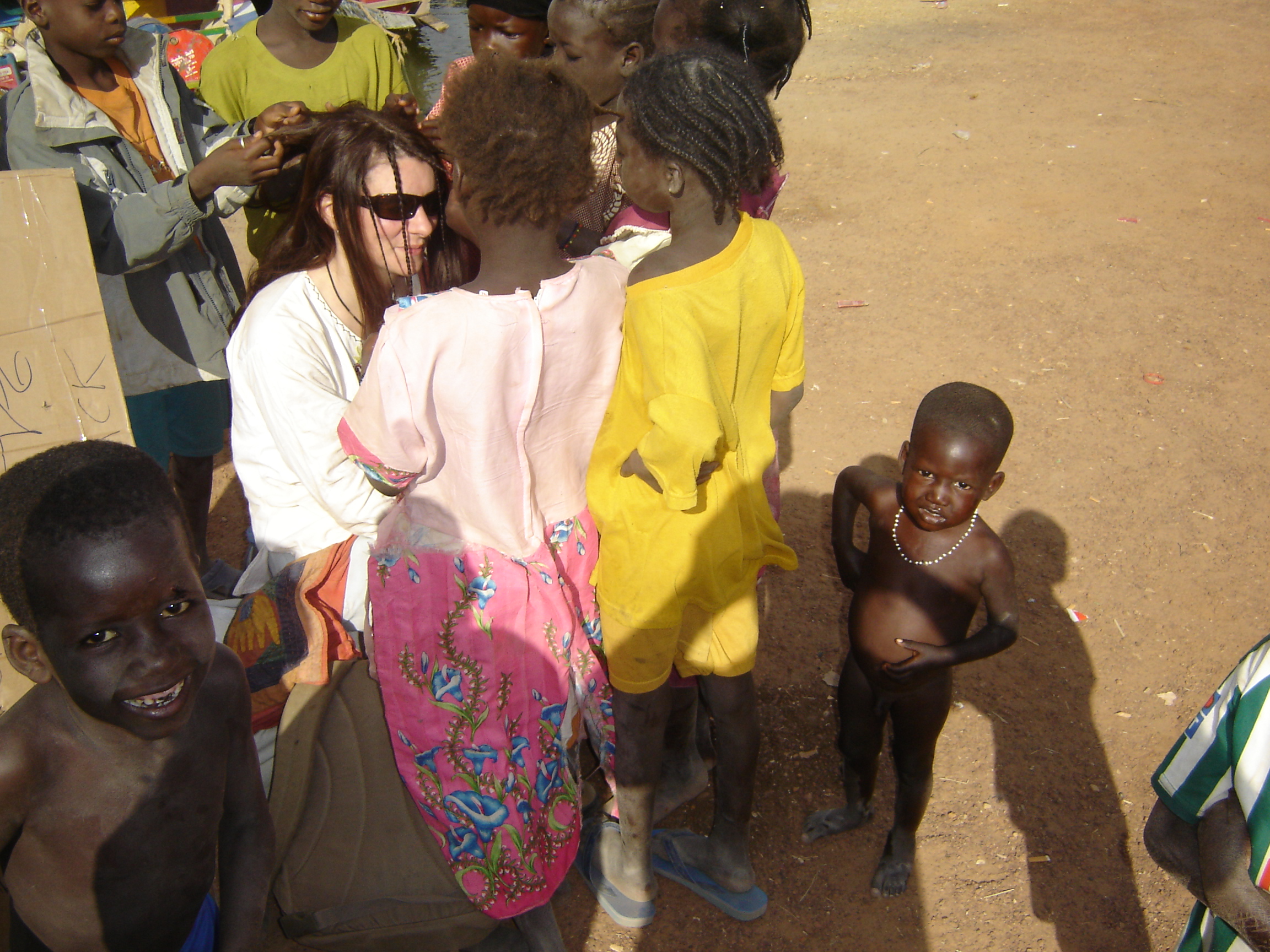
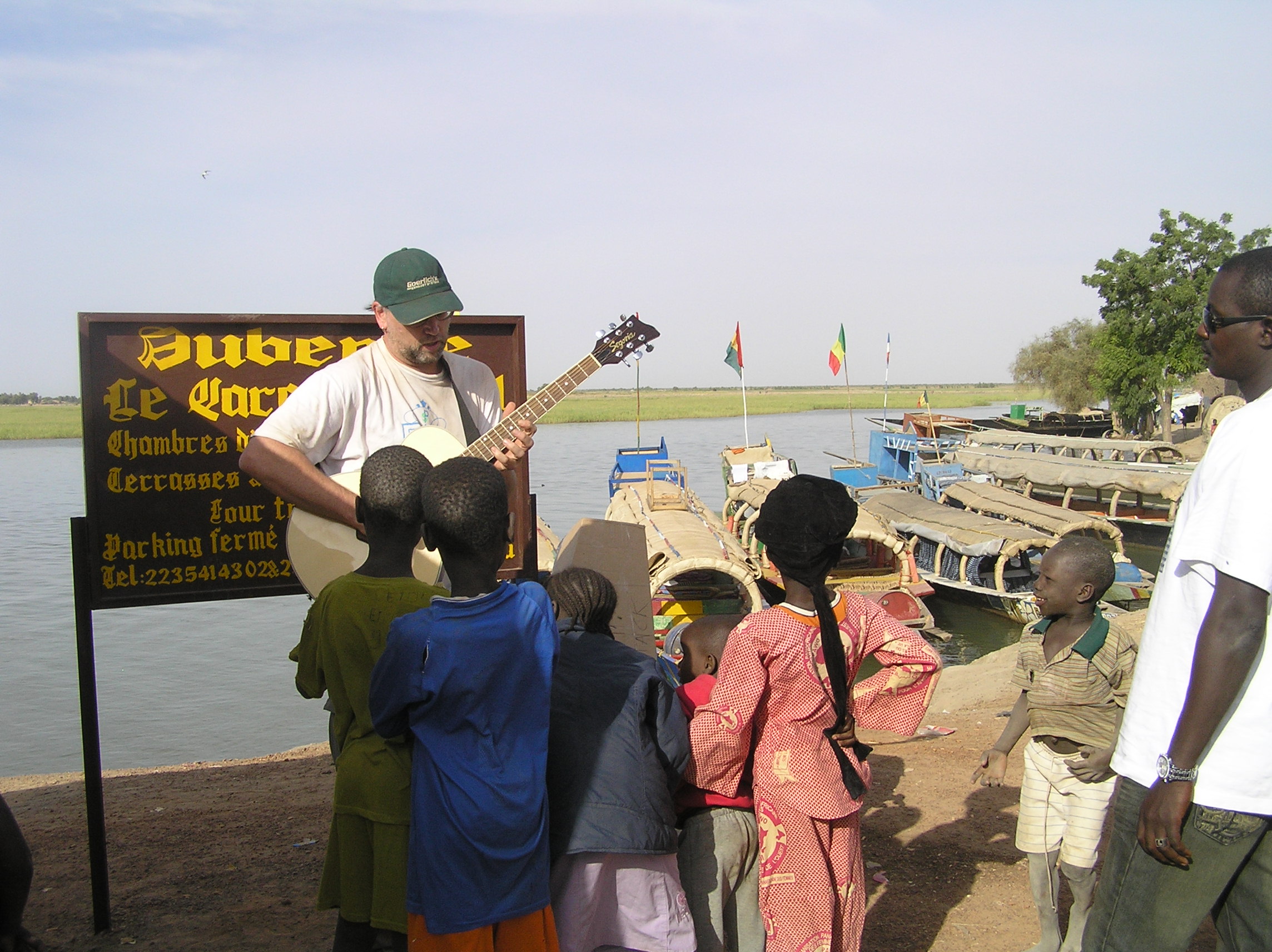
There were a few kids scattered around as we waited for the next leg of our journey to commence and pretty soon they started asking us for stuff. I am loath to give handouts, especially to kids, so instead I pulled out my guitar. Dozens of little tykes appeared out of nowhere and I was quickly swarmed. For the next hour or so I bounced between playing for them and giving them all a try at strumming the instrument themselves. Meanwhile m’lady attracted a swarm of her own as a half-dozen girls started playing with and ultimately braiding her hair. Eventually our boat arrived and the two of us along with an older Dutch couple named Johann and Ritt joined a crew of three and together we all set of on a three-day river journey back to Mopti aboard a long, thin vessel they referred to as a “pinnace”, which could easily seat fifteen passengers plus crew.
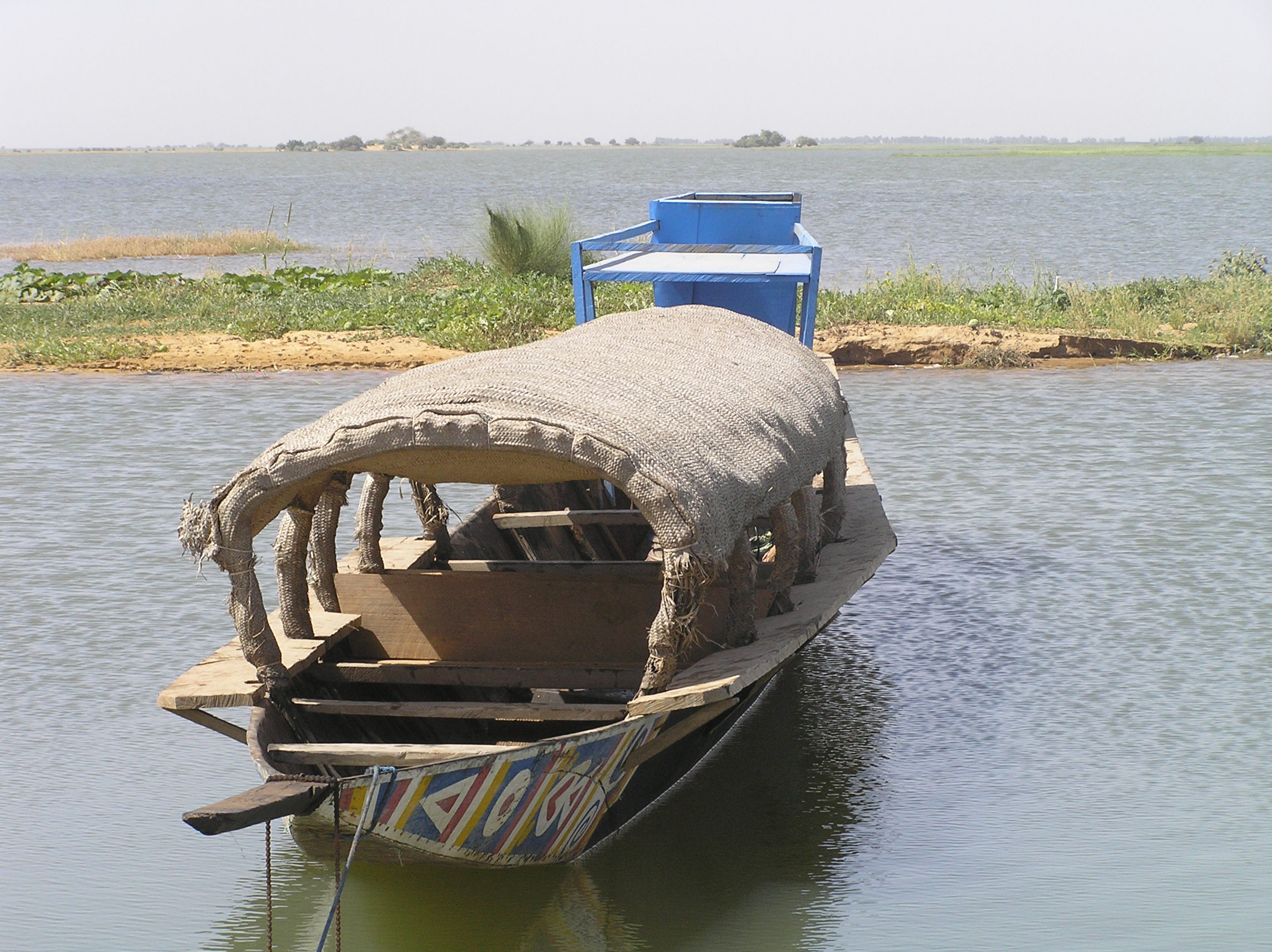
(Following pre-emptive apologies to m’lady and I, Johann and Ritt began the adventure with an extensive argument with the boat’s captain, insisting that they had paid extra for a private boat. They ultimately lost their fight and with embarrassed smiles to us we were welcomed aboard.)
About forty-five feet long and no more than seven feet wide, the pinnace was fitted with a pair of standard outboard motors lowered through a hole near the back. The boat featured a few thin benches covered by an awning, a table for eating, a cooking area, and a bathroom behind the engines that was nothing more than four short walls flanking a hole cut through the floorboards to the water. To maneuver around the vessel one needed to scuttle along a six-inch wide gunnel that circled the outside of the boat on all sides.
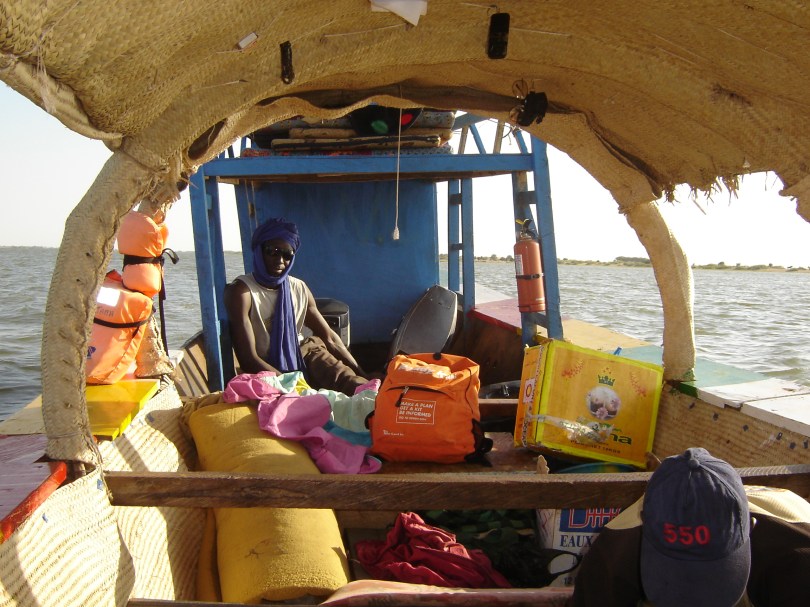
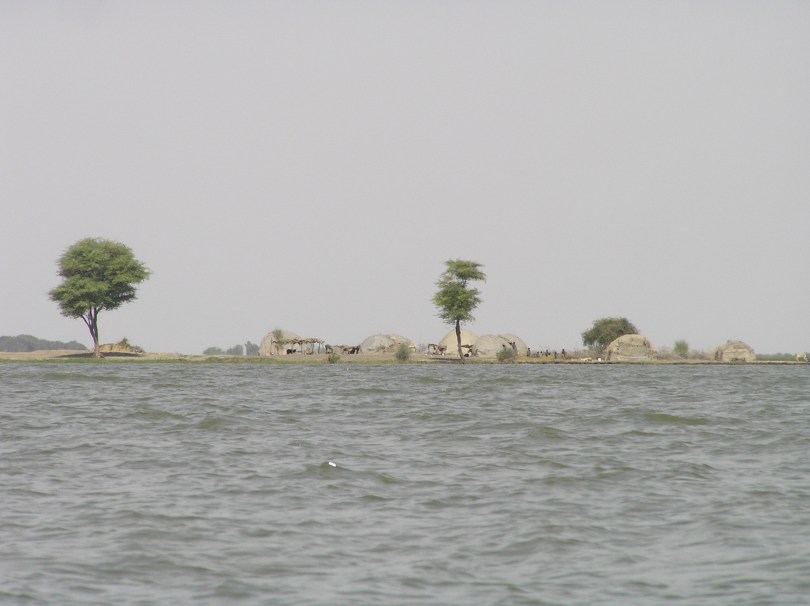
Though the pinnace was overtly plain, it had everything we needed to enjoy a lazy meandering trek upriver. Most specifically the boat offered unimpeded views of the villages and the people who inevitably appeared on the banks to wave as we puttered by. And while the views were continually amazing, astounding, and inspiring, I felt an enduring hankering to enjoy it all with an ice-cold beer in my hand. Unfortunately this was a feature that the boat was seriously lacking.

Wondering how I was expected to wash down my stash of tequila, with an hour left of sunlight we found ourselves floating past the city of Djiri. On my request the boat pulled in to the bank where men and boys were socializing, washing clothes and bathing. M’lady seemed happy to stay onboard while I bounded onshore to find a bar or something close. I soon met with success and returned with a cache of hot beer and ice, and once I combined these things with a cooler and a little out-of-character patience I was treated with quite a treat.
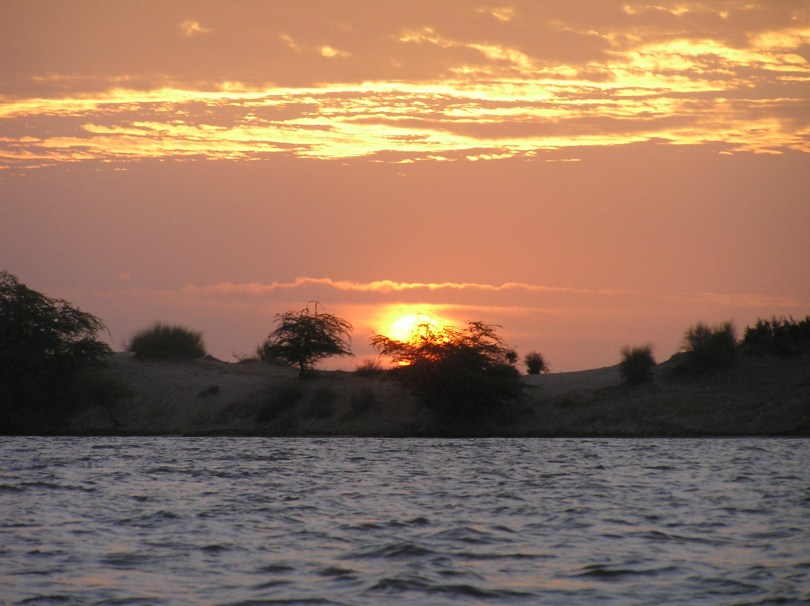
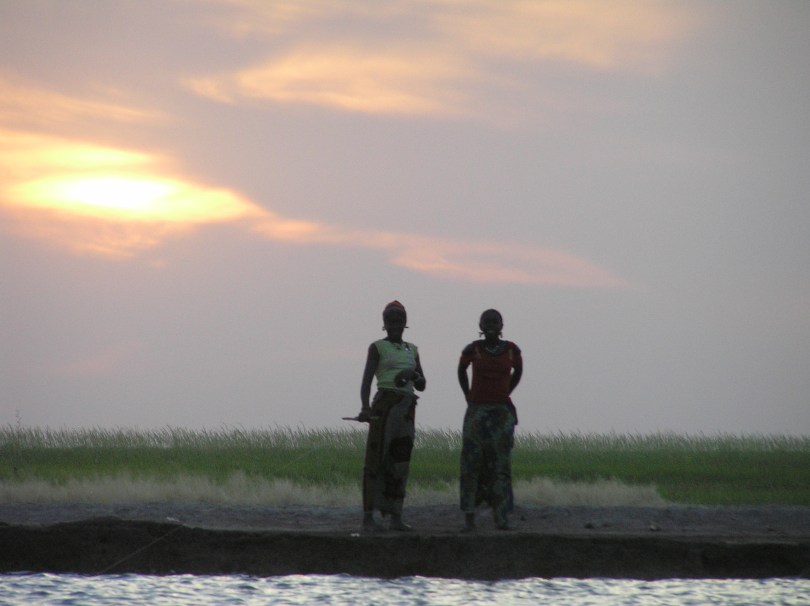
Our morning departure had come later than expected so we had to travel a couple of extra hours after sunset to arrive at our first camping spot. By the time we arrived I had treated myself so well that I promptly fell off the gangplank and into the water with no harm done. As our crew got busy setting up tents for the night we four tourists stood on shore and gaped madly at that glorious spectacle that can be had from nearly every vantage point on this wonderful planet: the Milky Way, which in this instance was made even more spectacular by the powder-like sand coursing between our toes and the now-familiar sound of steady drumming and joyous singing emanating from some nearby village. Eventually we were called back on board for a dinner of rice and bones which eventually gave way to slow, sparse conversation with our travelling companions until it was finally time to sleep.
As I laid down for the night I found it difficult to believe that only a week had gone by since we had landed in Africa.
111608 Niger River Beer Run
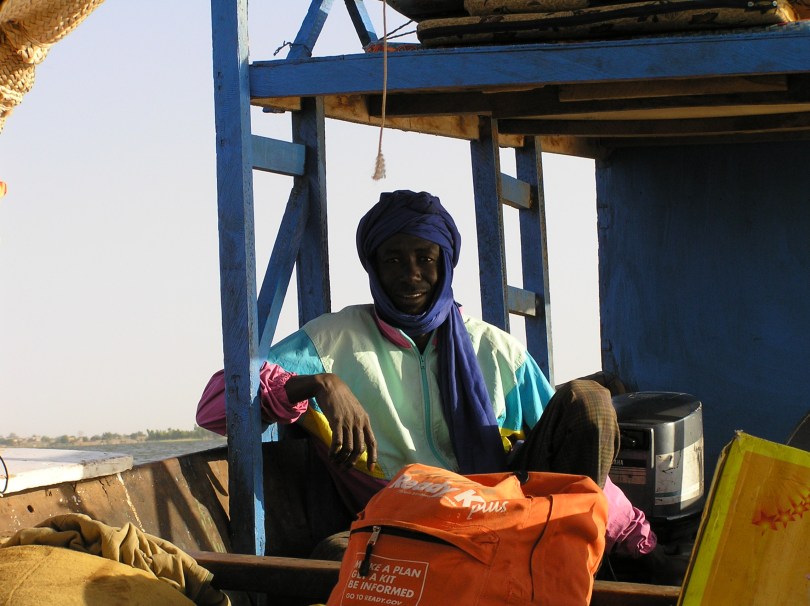
When I climbed into our tent to go to sleep it had been warm enough that I doffed my shirt and stripped all the way down to my skivviest of skivvies, but as the night progressed it started getting colder. Eventually it got downright chilly. I put my shirt and pants back on and was soon groping around for more clothes. When our 4:30am wakeup call came I looked like Milton Berle on a bad day. I had put on as many shirts as I could find, I was wearing the detached legs of my convertible pants/shorts on my arms like sleeves, and I had pulled one of m’lady’s dresses up over my head upside-down. I was wearing the dress like it was a pair of pants, with my legs stuck down through the arm-holes.
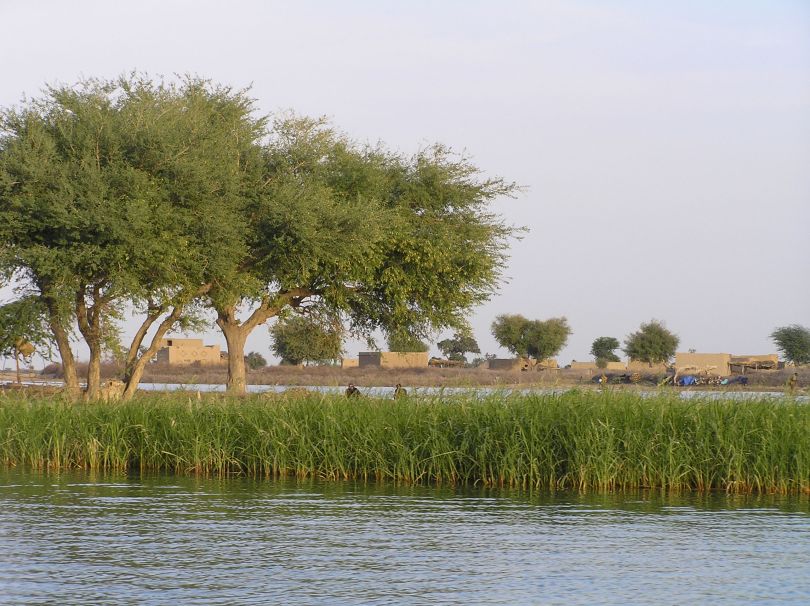
Under the generous light of a setting moon m’lady and I, along with our two co-travellers Ritt and Johann, were ushered aboard the slender pinnace to begin another day upon the Niger River. As the sun began to rise we were treated to a Lion King view that could only have been a collaboration: the swirling orange and blue water was painted by Van Gogh, the undulating hazy sky was classic Monet, and the sandy, suede-coloured shoreline dotted with surreal huts and bulbous termite mounds was undeniably Dali-esque.

At the risk of being a total cheeseball, I pulled out my guitar and lured the sun out of the horizon with a sleepy instrumental version of Here Comes the Sun. The Dutch couple was kind enough to share their breakfast with us anyway, and I followed up the tasty meal of buttered bread, jam, and cheese with a warm mug of instant Nescafe, so far the only coffee option I had found in Mali. Afterwards there was nothing but to settle in for another day of scanning the river for hippos, waving to the local villagers who invariably crowded the shoreline to greet us as we passed, and idly thumbing through my book. For this leg of the journey I felt it apt to read Joseph Conrad’s Heart Of Darkness for the first time. A good book to be sure, though it made me feel slightly, if appropriately, unhinged. In a good way.
Shortly after breakfast our captain pulled alongside a small boat and haggled for a couple of fish from the fisherman’s catch. As we pulled away our host proudly held up his end of the transaction, a pair of fourteen-inch Nile perch that he announced would be our food for the day. As I pretended to read my book I kept an eye on our captain/chef, and I watched in silent, stone-faced horror as he chopped the fish into large cross-sections and scraped the bloody mélange into a bowl. I’m talking the whole fish, as in everything but the hook; heads, bones, scales, guts…everything. Then he placed the bowl of raw fish up on the roof of our boat and let it sit there to roast/rot in the hot sun for the next hour or two. Meanwhile he had lit some charcoal under a large pot and begun frying up a mix of oil, cabbage, onions, tomato sauce, and a couple of packages of what I suppose were powdered chicken bouillon, along with plenty of salt. Finally he topped it up with water and waited patiently for the mixture to come to a lazy boil.
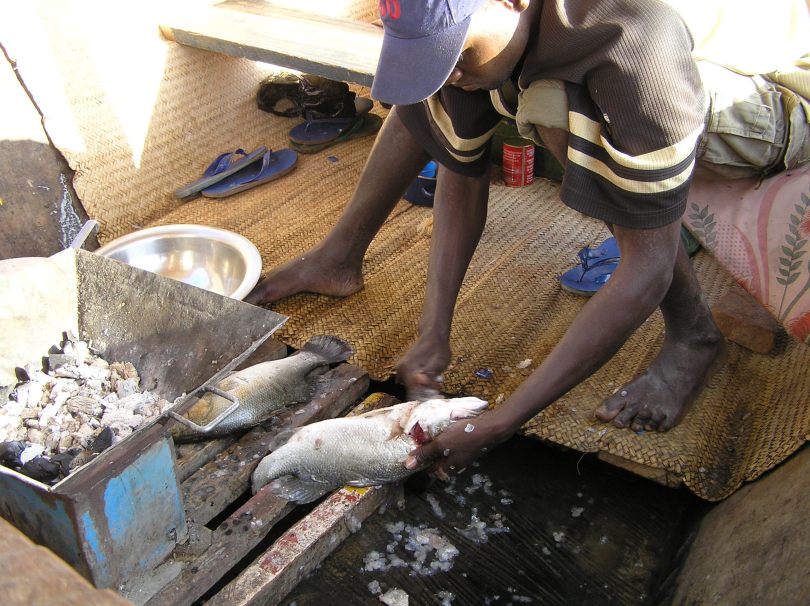
After what seemed like an immeasurable amount of shore-gazing, book-reading, and people-waving, I watched the captain retrieve his bowl of sunbaked fish bits from the roof and dump the whole thing lock, stock, and entrails into the semi-steaming pot. He ordered the boat ashore at the next village and jumped ashore, quickly returning with a small bag of rice which he boiled on a second charcoal stove. About ninety minutes later our chef announced that lunch was ready.
Now I generally don’t eat anything that comes out of the water (except tuna, which comes out of a can) but I’m usually willing to try a bite of pretty much anything. So willing, in fact, that even after telling m’lady all that I had seen and begging her not to eat any of the fish goo stew I agreed to actually try a spoonful. Otherwise I settled for a few slices of watermelon as my lunch, though to be honest the small taste of stew that I had was much more palatable than I’d expected it to be.
After lunch we finally spotted a couple of hippos. One of the crewmen hollered and pointed so the captain turned our pinnace around and took us in for a better look. The pair of megaherbivores were almost entirely submerged in the river so we could only really get a glimpse of their massive size when they lifted their huge heads out of the water to get some air. I tell you, hippos are big man. Like, I’m talking Volkswagens with legs. They say that hippos are the most dangerous animal in all of Africa with all the people-stomping and boat-flipping*, but it’s hard to believe they’re really so dangerous when one considers how quickly our captain spun our little boat around to chase after them. As if a guide in India would chase down a couple of cobras that slithered by.
Our captain suggested we break up the day with a stop at one of the small villages for a walkabout. We all readily agreed and around the next bend he brought the boat in. The moment we four tourists stepped onshore we were swarmed by smiling children. They crowded around the four of us, all of them reaching to touch us and taking turns shaking our hands. One asked for our autographs. Sure, most of them also called out “Cadeau!’ Cadeau!” hoping to extract some some money or candy from us but none seemed disappointed when we didn’t comply. Certainly no enthusiasm was lost, as the children continued to fight amongst themselves for the privilege of taking us by our hands and leading us all on a tour of their village.
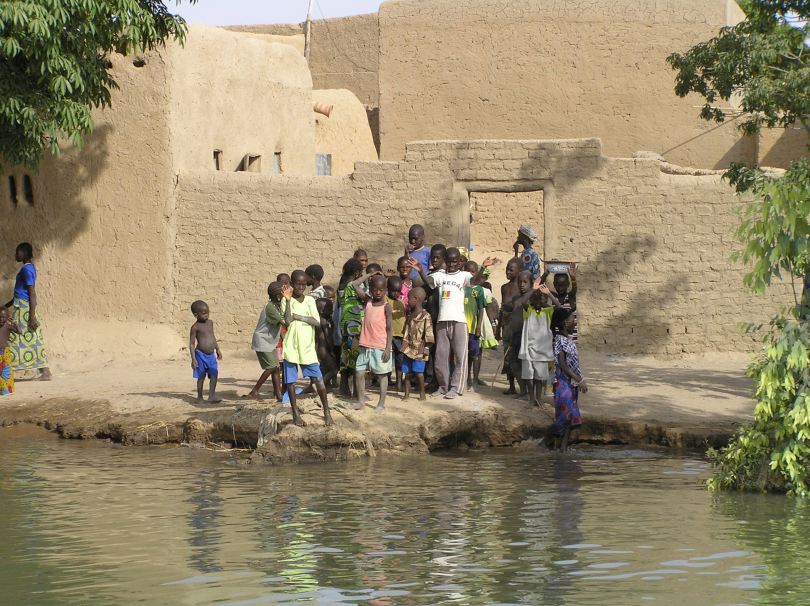

Up close we could see that yes, every building and every structure was indeed constructed entirely of mud: walls, roof and all, impossible as that seemed. The tiny homes were connected by way of narrow walkways that led ultimately to the town’s small mosque. It was all so stark, so simple, so stunning. It was a world apart; at times I felt as though I were being led around another planet.
Back on the boat we were offered leftover stew for supper. I quickly and easily decided to make do with a couple of snack bars, which I munched while casting astonished glances at m’lady for agreeing to eat more undercooked fish parts. To drink I only had a Hankerin, which is another way of saying that I had run out of beer.
After putting in a fifteen-hour day on the river we finally stopped to camp for the night. During the final couple of hours m’lady had started feeling ill. I blamed the stew as diplomatically as I could, but the consensus on the boat was that that she gotten too much sun, which was rather plausible.
For most of the day I had been bugging our captain for an opportunity to make a beer run and finally, as the tents were being pitched he tapped me on the shoulder; this was our chance. The Dutch couple asked for a couple of Cokes if I could find them and m’lady thought a ginger ale might do her stomach some good. I stuffed some cash in my pocket and followed the captain on what was to become a rather epic trek through the quickly darkening jungle. He said there was a village about two kilometres away. “If we walk that way we should find some beer for you.” Soon after we left night fell completely and we pressed on using a flashing red light atop a distant tower as a beacon.
When we had travelled about halfway to the tower we turned abruptly, the captain following a path that was invisible to me. Suddenly I saw a light just ahead of us. It was a lantern no more than ten metres through the brush.
I swear to you, when we stepped into the clearing I could have sworn we had stepped into the Star Wars universe. Standing before me were a couple of worn and weathered concrete igloos that looked exactly like Luke Skywalker’s home on Tatooine. And believe it or not, inside was a cantina, which we found inhabited solely by the bartender.
Amazingly, the place served as a hotel as well, though being the only sign of life within sight and hiding in the brush far from the river with no other means of approach aside from stumbling through the jungle on foot and, well, I can’t see how the place gets much business at all. But it got mine!
They didn’t have any ginger ale so I bought four hot beers and five hot cokes and inquired about ice. The barkeep barked over his shoulder and a young man appeared out of nowhere. The boy told us to follow him, so I gathered up my bounty and off we went.
He led us another kilometre or so, all the way to that flashing red light which turned out to be a transmission tower. Next to the tower was a fifteen-foot satellite dish, a generator, and a tiny hut. Inside the hut we found a man laying on his bunk watching a small black & white television. The only other furniture in the hut was a small deep freezer. It was this man’s job to keep the generator running. As a result, his little hut had a steady supply of reliable electricity, which made him the go-to guy for refrigeration. I paid him for a half-dozen small plastic bags of frozen water and the three of us, and then two, headed back. When the captain and I arrived at the tents m’lady was vomiting heavily and consistently. I wanted to help but could do nothing. I didn’t even have a ginger ale for her. But I must admit, where she didn’t sleep much at all I sure did. I was so spent that I opted to save all my beers and let them cool for the morrow. Then I fell immediately into bed and slept like a dead rock.
*C’mon now. I’m not going to bother looking it up, but I’d bet dollars-to-donuts that mosquitoes kill more Africans than hippos do, what with all the malaria and dengue fever they spread. I’d also bet that Africans kill more Africans than hippos do, people being people. But like I say, I’m just taking my word for it. I recommend that you do the same.
111708 Never Get Out of the Boat
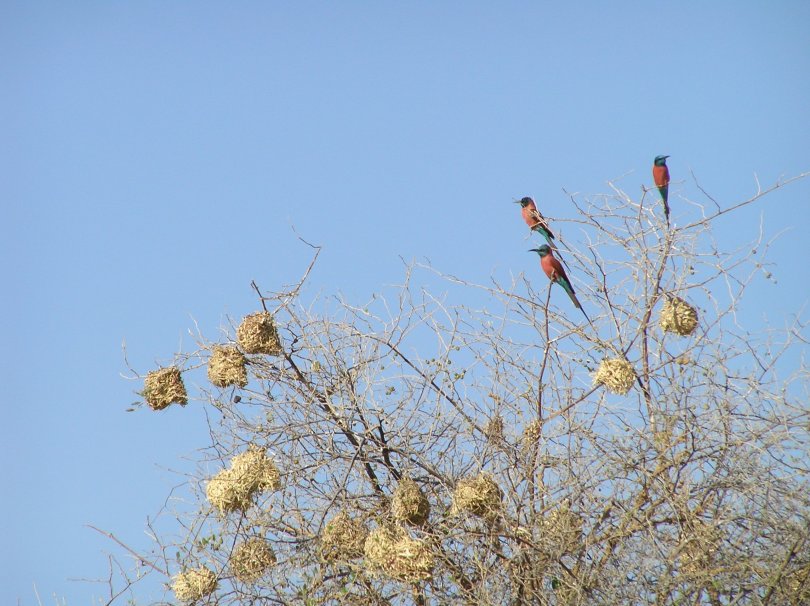
4:30am came very early, as I suppose it does by definition. M’lady was still alive, but just barely, having spent much of the night in the throes of retching illness. Her insides were scattered about the encampment and her stomach muscles were extremely tender due to her near-continuous expulsion. In the pinnace the crew had moved the hanging out/dining table and laid several mattresses in its place so m’lady could recline in malaise in the belly of the boat. Lying there with her arms crossed over her chest made her look like she was starring in a funeral pyre. Though she claimed to be feeling better than she’d felt during the night it looked like it would be some time before she’d be back to 100%. And so with sleepy cobwebs still clinging to our malrested minds we set off upon the Niger River under the cover of inky night. By the time the sun was ready to rise we had entered Mali’s “Great Lake”, Lac Debo, a body of fresh water so large that you could mistake it for an ocean.
Eager to show off this natural wonder, our captain chugged his pinnace straight to the middle of the fifty-mile-wide lake. Once we’d gotten as far from either shore as we could be the captain cut the engine and spread his arms to the horizon on all sides, urging we tourists to marvel at the sight.
While I’m certain the vast view of open water must be quite thrilling to the desert-dwelling locals, to a guy who has spent most of his life living a relative stone’s throw from the actual Great Lakes it wasn’t all that impressive. To be honest, I found the choppy water that was generously breaching over the gunwales of our small boat to be much more engaging than the view of the horizon. Sure, floating forty kilometres from shore dramatically lessened the danger of a hippo pinnace-flipping but at the same time it seriously upped the risk of large, sea-like waves swamping our tiny vessel.
As we tossed from side to side I cast a glance around m’lady’s unwavering torso resting in the bottom of the boat and tried to assess the lifejacket situation. From what I could see everything seemed to be predictably inadequate and obviously outdated. I tried hard not to look too concerned, with what I suspect was modest success. Regardless, m’lady seemed too ill to notice.
I’m not sure if the captain shared my concern or simply read it on my face, but either way he ordered the crew to light up both engines and get us to the mouth of the river as quickly as possible. This was the only time on the entire trip that he would use both motors simultaneously; normally the long days of virtually non-stop travel were spent alternating between the two. Arriving safely in the calm water close to shore we enjoyed a small breakfast (m’lady abstained), after which I poured a cup of coffee and turned my attention to the riverbank where the colourful and varied wildlife would give an ornithologist a woody.

As we floated idly, the crew busied themselves disengaging one of the engines and lifting it out of the water. They set it down in the galley near the back of the boat and crowded around, all of them poking at it and scratching their heads. Hammerless and forced to be resourceful, the men removed one part of the engine and used the heavy clunk of metal to pound away at another part of the engine. Then they moved in for another round of prodding and head-scratching.
Though m’lady seemed to be improving with every hour, for her sake I hoped our day’s twelve-hour trek wasn’t going to be inadvertently extended by this engine trouble. At the same time I was quietly overjoyed that we weren’t going through this whilst still bobbing away out there in the middle of the turbulent lake. Fortunately the men were able to beat the right engine part into the correct submission and in no time at all the motor was coaxed back to working order. They reassembled it in a jiffy and we were soon back on our continuous way along the magical, mystical Niger River.
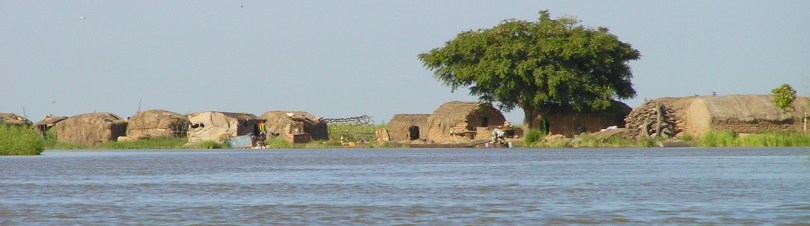
And still, every time we approached a village it was like the Rolling Stones had just pulled up in a stretch limo. As we puttered along the entire town would come out to greet us, including no shortage of young, topless women (which, I suppose, also happens to The Stones all the time). On the occasions when we would land everyone would be waiting at the dock to shake our hands. The children loved it when I would pick them up and hoist them into the air. I didn’t even think of pulling out my guitar during our stops in these tiny river villages for fear that they wouldn’t let us leave!
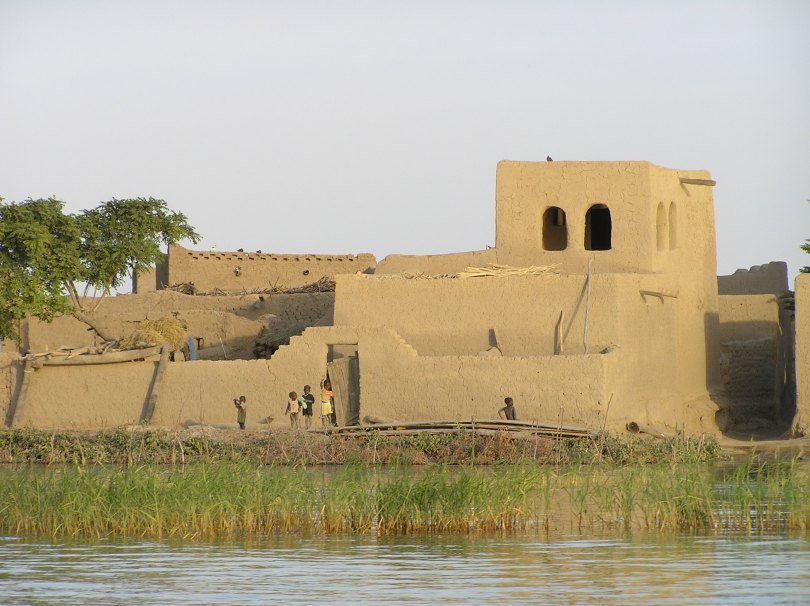
It’s possible that the people dropped what they were doing and rushed to the shoreline hoping us rich white tourists would throw them a small cadeaux, but I’m not convinced that is so. Rather, I suspect it was simple curiosity, and mostly boredom. It seems the main activities ‘round these parts revolve primarily around either mortar and pestling, tossing couscous into the wind, beating dirty clothes against riverside rocks, or goat-herding. And even these activities, difficult as they are, don’t seem to occupy too many people for too long. In the small villages school doesn’t appear to take up anyone’s time nor does any serious sort of commerce, for neither exists in any visible form. Perhaps without too many dollars to spread around in the first place the fight for the mighty buck slips a few notches down the priority list.
But what do I know about it?
And then, finally, our ride up the river was over. Our pinnace pulled ashore in Mopti and we were led to a hotel where showers and restaurant menus and most importantly cold-beers-without-walking-two kilometres-through-the-dark-jungle-to-get-them were the order(s) of the day. After several long, hot days and just as many nights spent sleeping on the hard ground our sparse and somewhat dingy hotel felt remarkably decadent, though I sure did miss the river view.
After nearly forty boat-hours spent floating past basically the same scenery you’d think that I would have started boring of it, but I didn’t. Not for a moment. In fact, I had to force myself to look away long enough to get through the Conrad book, which was a great read and mercifully short, plus it supplied m’lady with the perennial joke “Oh, the snorer…” referring of course to yours truly.
It was the same for the ten-hour bus ride and the day-long 4×4 trip as well. Everywhere I cast my eyes I am fascinated by all that I can see. Something about Mali draws my rapt attention, and I can only conclude that it has to do with the very resonance of this part of the Earth. This is the motherland, and I can sense it. Culturally, one could argue that I have no right to feel at home in Africa but really, I can’t see that race needs to play a part in it. This is where the precursors of humankind first crawled out of the water, and I am human. History pegs West Africa as the grandfather of almost all of the world’s modern music, and I am a musician. Whatever creates the connection, the connection is undeniable. I know that this will not be my last trip to Africa.
As we fell onto our soft bed marvelling in the air-conditioning and making dinner plans we agreed that the best move would be to chill out here in Mopti for an extra day before we embarked on our next adventure. That way we could relax, do some laundry, and maybe even find some local live music. At the same time we knew that were ultimately at the mercy of our man Baba, the fellow we’d met at the airport back in Bamako who had taken a large yet reasonable wad of our money in exchange for arranging all of these excursions, rides, and hotels, and Baba had yet to inform us when we’d be leaving for our tour of the Dogon Valley. Only time would tell so we hedged our bets and sent our clothes out to be washed.
After a long, languid shower and another bout of relaxing we climbed up to the rooftop bar/restaurant and pondered the menu under a star-filled sky. It was with a dream-like fervour that I pointed to the beef skewers with roasted potatoes; m’lady ordered the fish. I quenched my drooling foretaste with several slurps of frosty lager and the two of us sat numb with anticipation, drifting together into a quiet bliss as we waited for our supper.
So when the waiter plopped a large plate of fish and rice in front of me it was like he had hit buddha in the mouth with a brick. Oh, the horror! My astonished gasp might have been a bit strong, but I was flabbergasted when the waiter called me out and insisted that we had both ordered the fish. I was flummoxed, stammering that I couldn’t have, wouldn’t have ordered the fish – I don’t even like fish – but he was adamant. I pulled out the menu and pointed furiously to the beef that I had ordered and the waiter said Aha!, noting that I was tapping on the fish. But no!, my finger was in fact underlining the beef skewers and potatoes, the item that was listed directly above the fish with rice! In his mind I had clearly ordered the fish, in my mind I had obviously ordered the beef, but he was in control and fish is what I got, and furthermore fish was all I’d be getting. He walked away with a disinterested shrug, offering no apology, no acknowledgement of mutual misunderstanding, and definitely no beef skewers.
Displaying that I had learned as much from Conrad’s Kurtz as I did from the placid, meditative shoreline during my zen-float along the Niger River, instead of strangling the man and seeking out his next ‘o kin I somehow limited myself to silently seething with what I hoped was a searing intensity as m’lady dug in to her dinner. When the waiter placed our bill on the table without a word my burgeoning fury surged. While m’lady settled up at the register I stormed out of the restaurant, tossing my untouched plate of food on the counter and angrily calling across the room to our waiter, “Bon appétit!”
I went to bed hungry, drunk, and surly, but I woke up the next morning feeling deeply embarrassed at how poorly I had acted. Right or wrong, book or no book, I shouldn’t let myself get that angry.
111808 Enter the Dogon
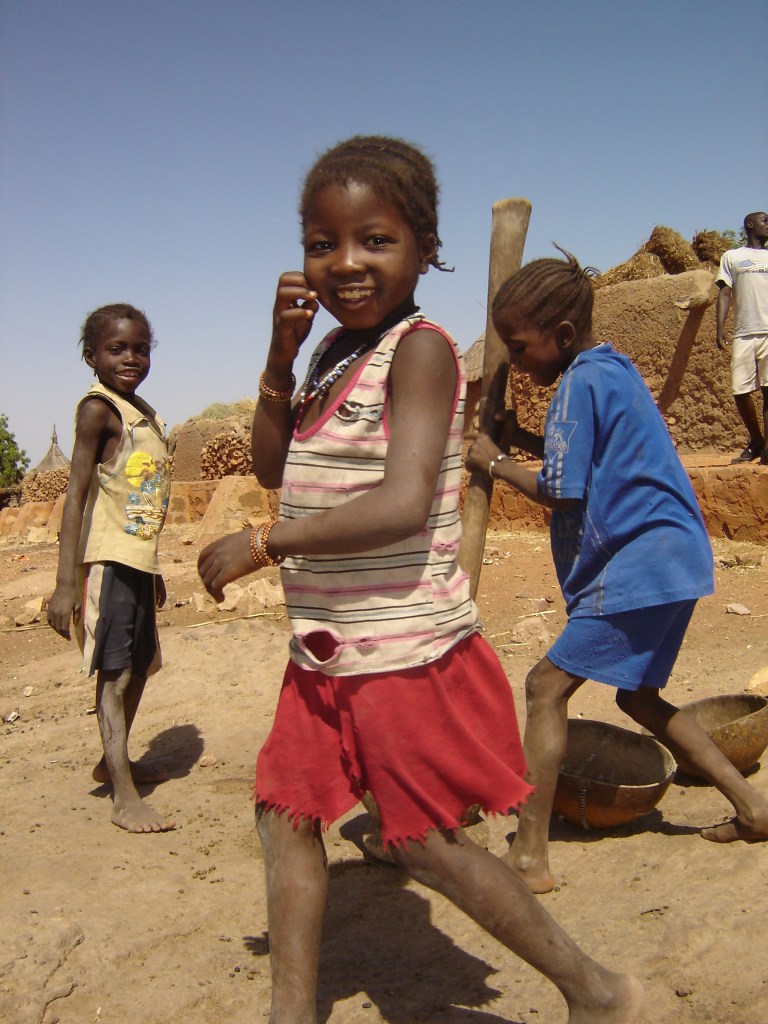
Time told.
Despite our hopes to the contrary, m’lady and I checked out of our hotel at 9am. We were driven about ten kilometres to the town of Sévaré where we met the crew we would be trekking with for the next several days: our guide Hama, our new old friend British Steve, a young couple from Madrid, and a pair of fellow Canadians named David and Martha (Prince Edward Islanders might know David as the owner and TV pitchman for Frosty Treats in Kensington, PEI: “Don’t drive by, drive in!”).
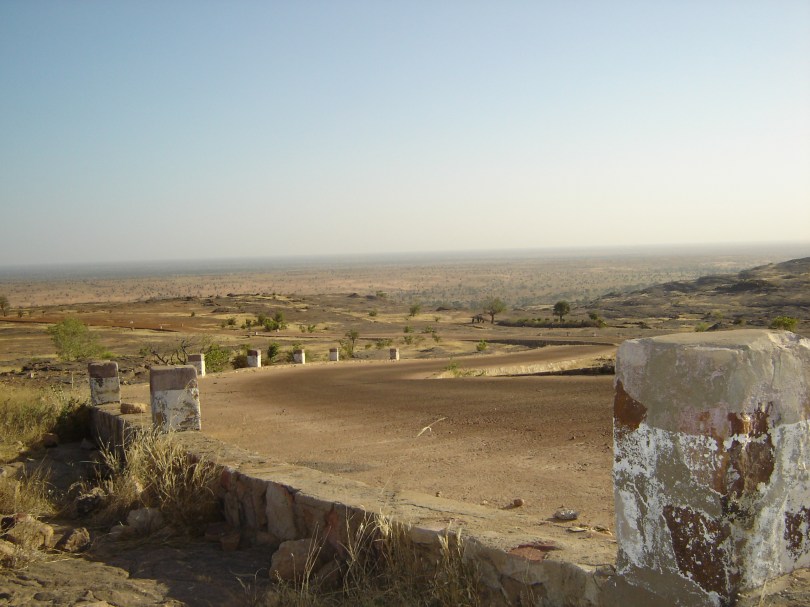
The seven of us and our guide piled into a couple of vehicles and headed for Dogon country, Mali’s most popular trekking region and an area that can be found on any respectable “must-see-before-you-die” list. On the outskirts of town we pulled over at a roadside stand and Hama instructed everyone to buy cola nuts. We didn’t ask questions. Okay, we asked how many cola nuts we should get and Hama suggested that a small paper bag full would be plenty for m’lady and I. It cost a pittance. Shortly afterwards our vehicles left the asphalt road and bounced along a concrete strip embedded in the sand, a route that ultimately delivered us to our launching site, a large Dogon village called Djiggibombo that lies on the edge of the valley.
We were herded out of the SUV’s and into a shaded courtyard that was lined with bamboo lounge chairs. We ordered beers (me) and soft drinks (everyone else) and waited for lunch with relaxed patience which in my case came in the form of a satchel – three envelopes, really – that our guide had secured on my behalf. I’m not the kind to embark on a five-day hike without the proper mojo risin’ and $60 in Ghanaian stalk insurance seemed a bargain so I picked up some Rizlas and hit the town, my mind freshly primed and ready to be blown.
And blown it was.
As we walked around Djiggibombo (population 2,000) my shock at the sheer beauty of the place almost brought me to tears. Walls built from loosely stacked rocks marked each family’s homestead. Within each of these small properties stood a flat-roofed mud hut along with several granaries, one for the husband and one for each of his wives (Dogons are allowed a maximum of four wives; who would want any more?). These muddy closets were capped with pointed thatched roofs that bowed and sloped in all directions, making them look like they were drawn by a Saharan Dr. Seuss. My gosh, it was all so damn beautiful!
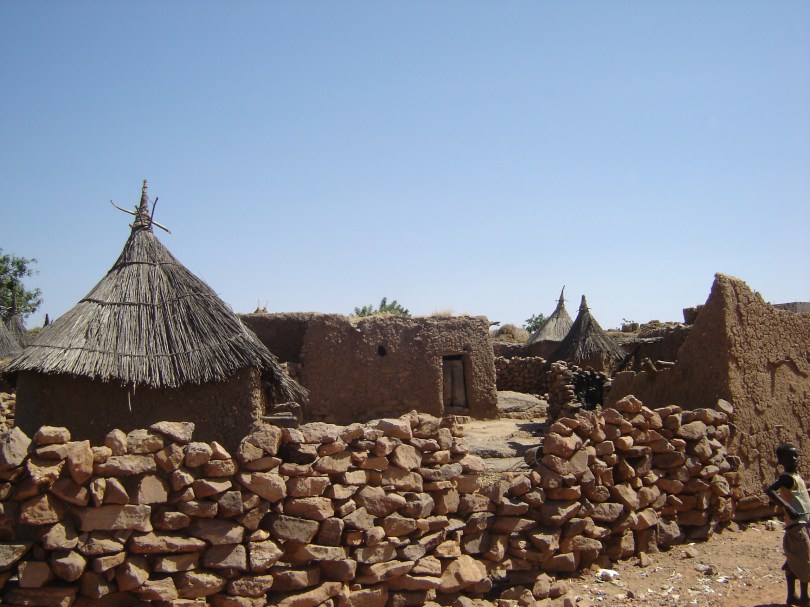
Every yard wall met up with the next, creating a maze of narrow pathways that snaked through the entire village. It was all so magical, so surreal. I staggered through the beauty with my mouth agape, enveloped in a stony bliss at the wonder of the place and struggling to bring the camera to my eye, lest I lose a moment of the experience. Soon the path siphoned us into the town square (though it was decidedly more of a polygon) where we met the town elders.
Though you will find shopkeepers who are happy to sell statues and masks to tourists for hard currency, as a rule money isn’t used at all in the Dogon Valley. Virtually all trade in the network of 300+ cities, towns, and villages relies instead on some form of bartering. At one time tourists would offer a gratuity of a dollar or two when visiting a village, but the elders tired of amassing what they considered to be a rather useless commodity so they lobbied the tourism operators and suggested that an offering of cola nuts would be more practical. The Dogons love cola nuts, and they aren’t grown locally. Who needs money when you got cola nuts?
The ancient men that were gathered in the town square accepted our offerings with humble smiles. Once the men had each collected a handful of nuts we were welcomed to explore Djiggibombo with a nod and a vague sweep of a thin, bony arm.
Well, except for a small, indiscriminate and unmarked patch of ground in the town square which was temporarily deemed sacred, which meant that women were not allowed to trod upon it. I describe the patch of ground as “temporary” because the sacred areas move around all the time. At the whim of the gods one tiny tract of dirt can return to being fair game while a new, seemingly random bit of earth suddenly becomes off-limits to all women. These shifting sacred zones will force Hama to hire someone in every village we visit to guide us safely around local forbidden areas.
Standing in contrast to the invisible and indiscriminate sacred spot was a stunning baobab tree that was an unmistakeable and unmissable centrepiece to the town square. We had seen the squat baobab trees with their short, angular branches and large dangling fruit fruit virtually everywhere, but it was the human interaction with the baobab that made the trees stand out as living wonders. The locals strip the bark to make rope, leaving large bulbous rings in the trunk.
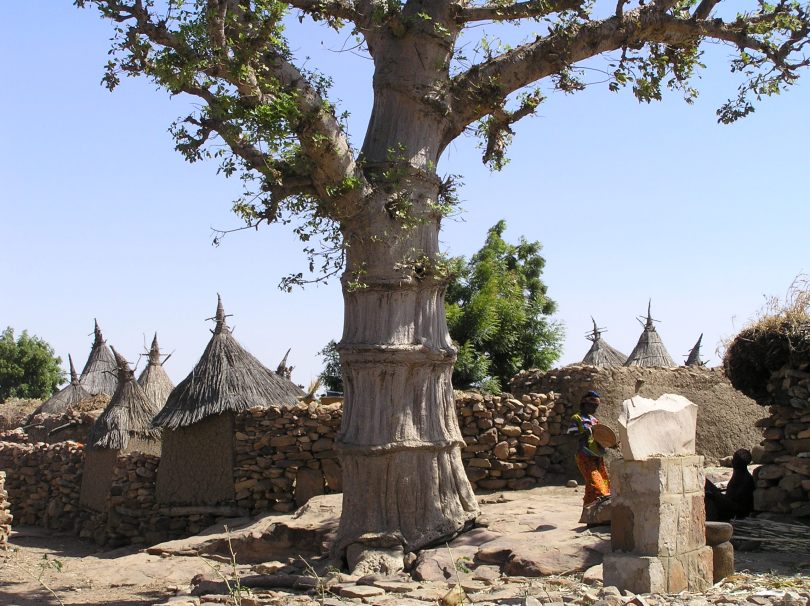
Seeing these magnificent trees scattered amongst the stone alleyways and nodding granaries gave me a Lord of the Rings vibe that was almost holy. And then there were the people! Men wearing traditional peaked hats walked along with rudimentary axes slung over their shoulders while women decked out in immaculately coloured gowns balanced baskets on their heads as if it wasn’t at all remarkable. And oh, the children! Each beautiful smiling face burst with sheer joy at the sight of every stranger. Trying to take it in all at once was overwhelming; collectively it was possibly the most beautiful thing I’ve ever seen. My yardstick for such things is a mist-covered morning spent discovering Machu Picchu. But as beautiful as that Peruvian mountaintop was, it was merely what remained of a long-dead society while this place was very much alive. The fact that Djiggibombo was a living, breathing town simply doing what it does made it all the more amazing, all the more magical. The realism of the beauty made my heart explode, the beauty of the realism split my soul open.
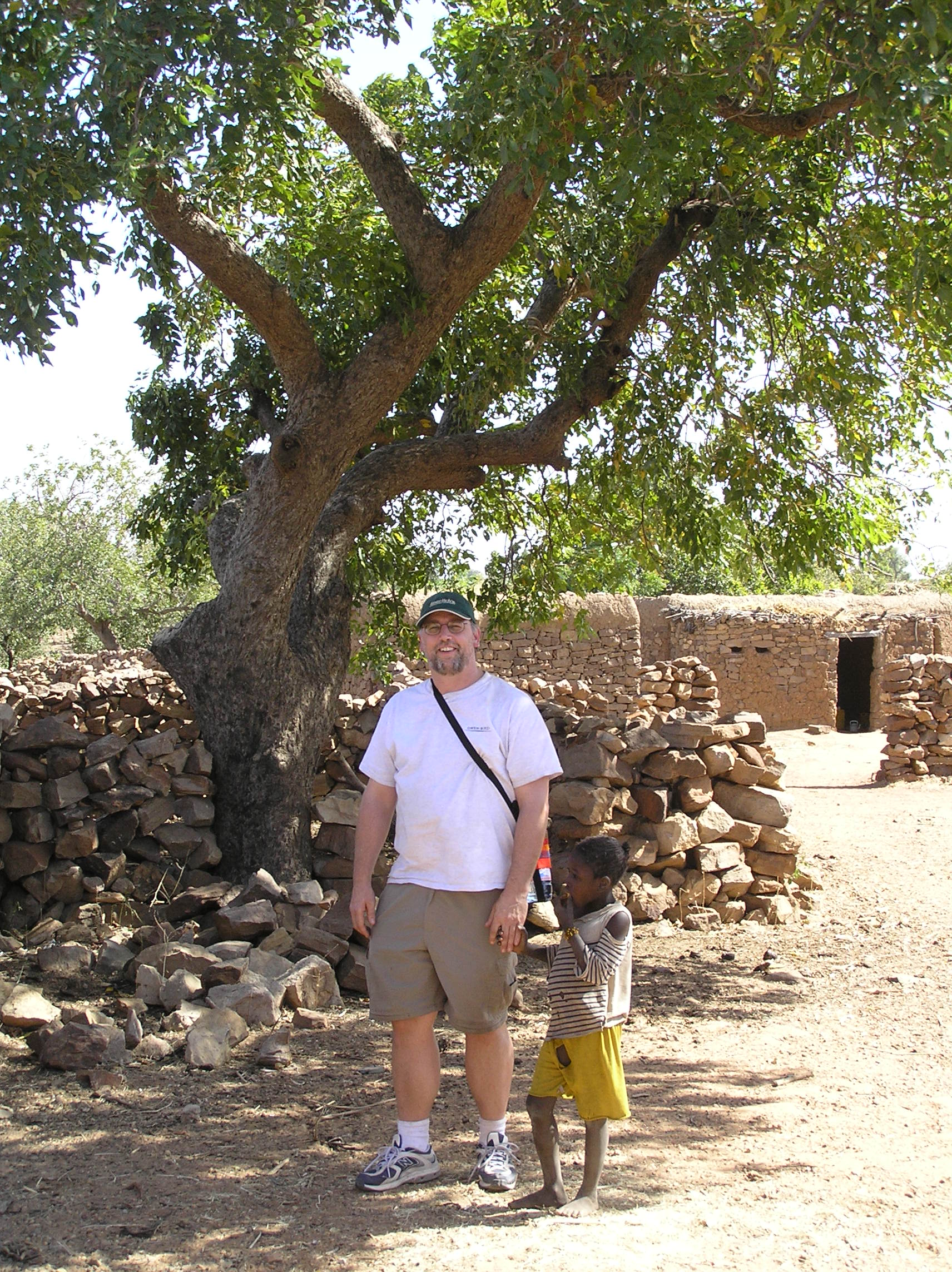
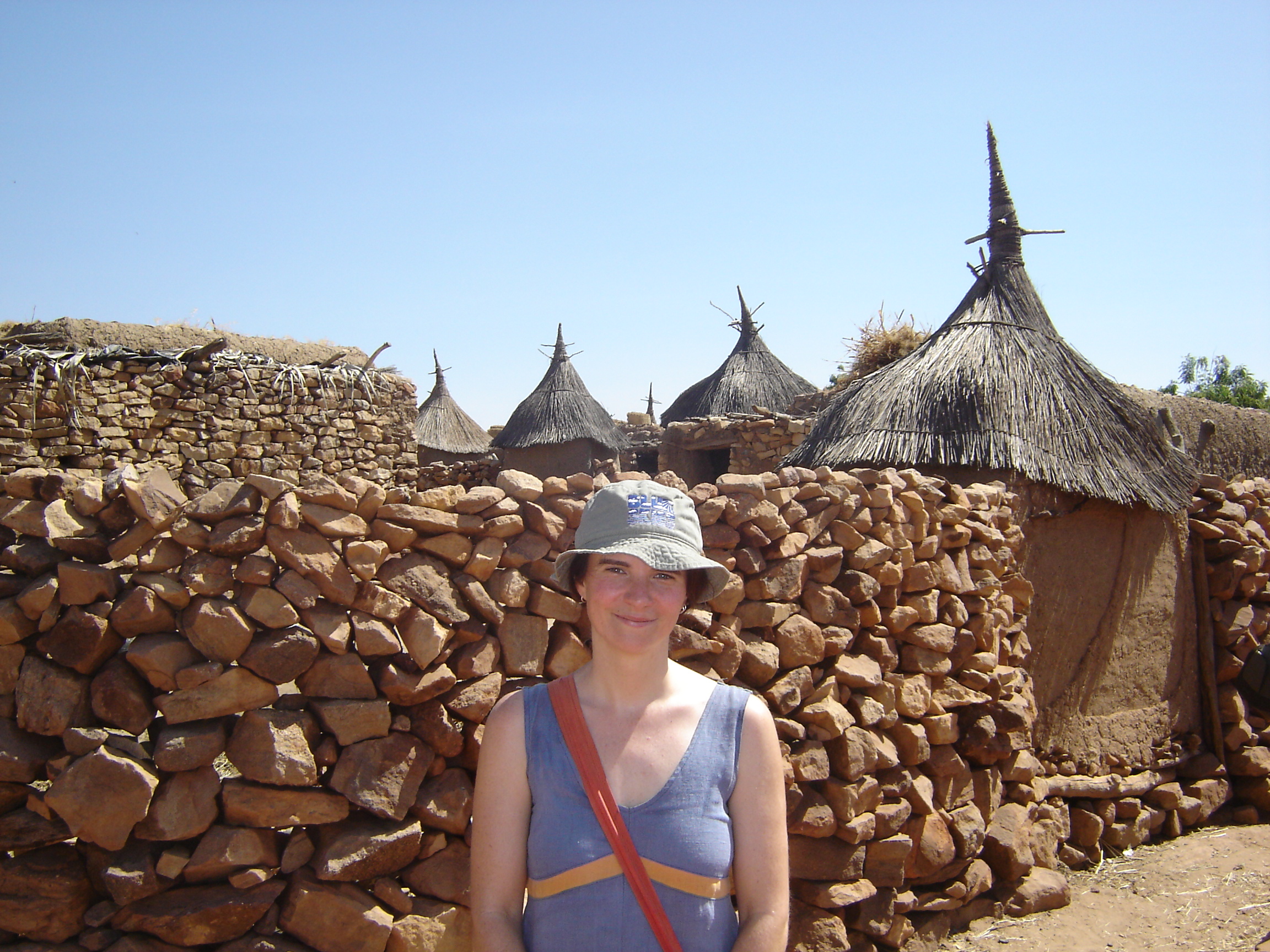
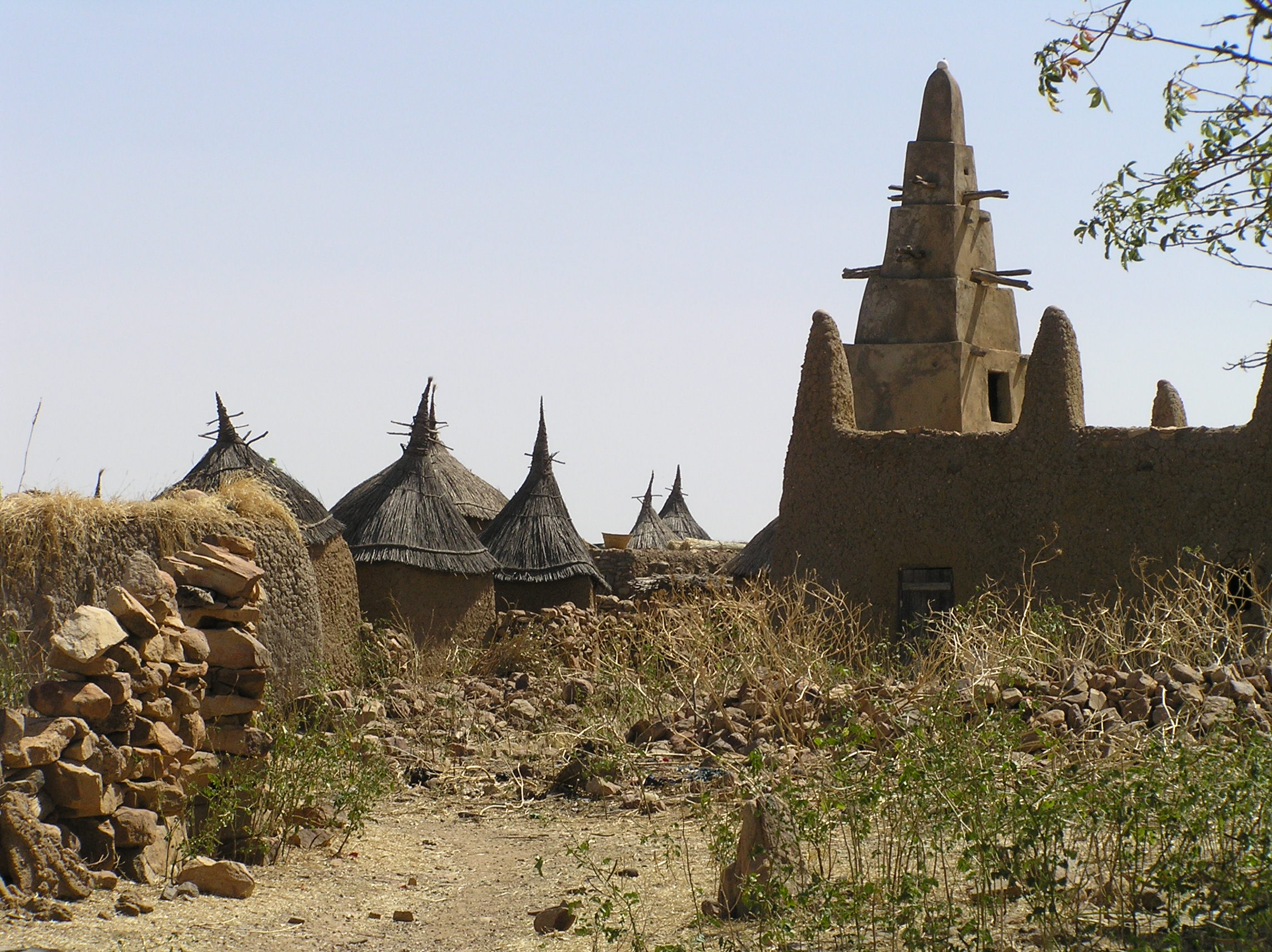
Eventually m’lady and I drifted away from the others and went for a walkabout by ourselves. As we sightsaw our way toward the edge of town we were met by three little girls who took our hands and insisted on leading us on a child’s-eye tour of their village.
We stepped carefully along the sunbaked sand and gravel pathways as the barefoot girls scampered ahead, pulling us towards the school, which had just let out a stream of classes. The small school was clearly the largest building in Djiggibombo and the only one that was made of brick. I tried to poke my head inside and found the door closed up tight. No problem! In a flash several of the dozens of kids hovering around jumped forward and moved the heavy rock that was holding the door in place. The metal door swung open with a creak and the children stepped inside, beckoning us to follow.
The blackboards that lined one wall in the large classroom displayed the day’s lesson, au Français of course. Facing the boards were perhaps twenty desks, each designed to be shared between two or three students. I’d estimate that the room had a capacity of perhaps fifty students per class, each of them, as it was pater explained to me, with their own pen.
Although school is free in the Dogon Valley, it appears that each student is required to bring their own pen. And crazy as it sounds, such a comparatively trivial item as a 29¢ disposable pen can be an unattainable price to pay for many that live in an earth-bound society that doesn’t use money. This is why so many children would greet us with the cry “Ça va Bic?!? Ça va Bic?!?” These children are hoping to parlay such a seemingly insignificant gift into an education.
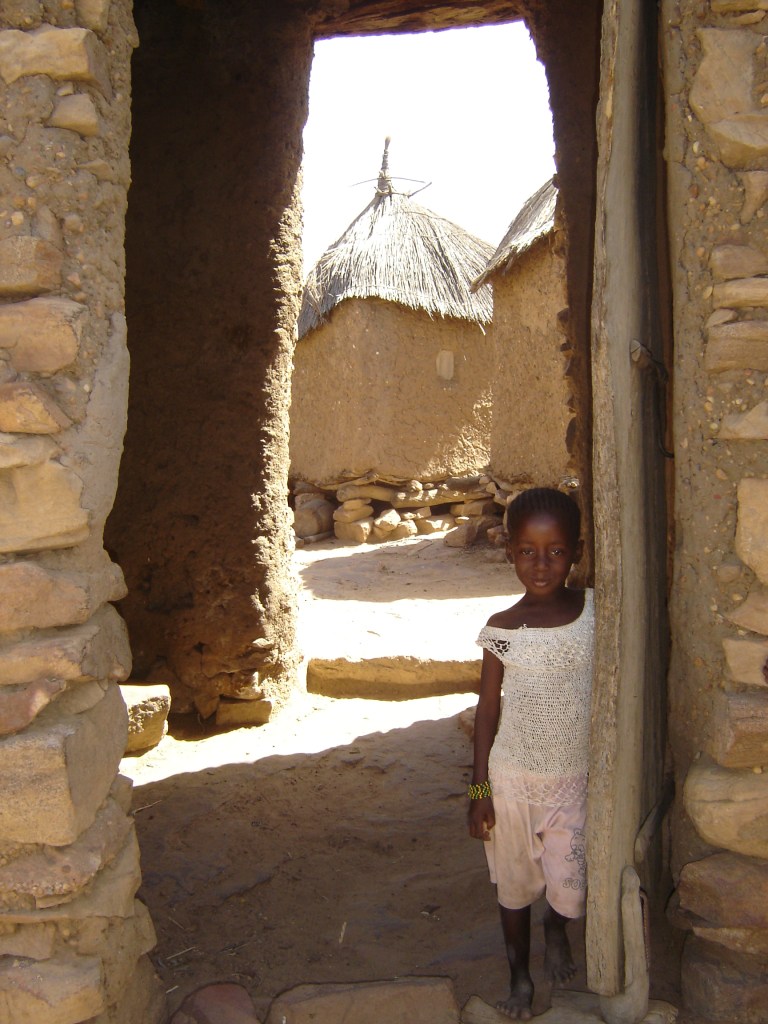
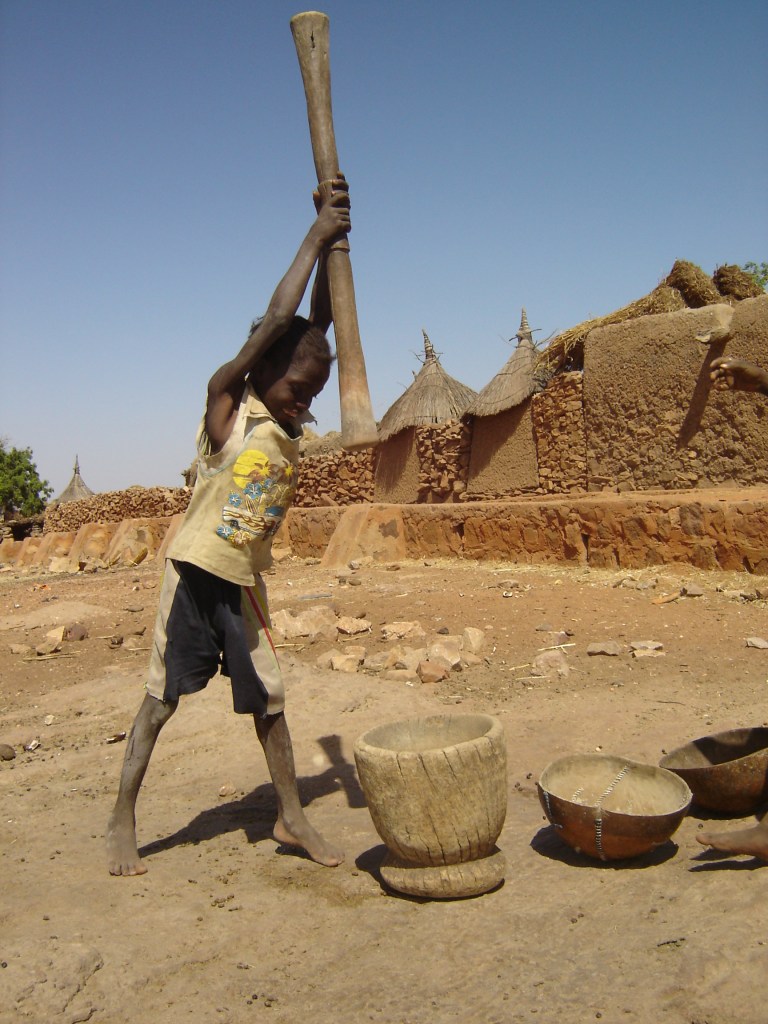
The thought of a simple item making such a difference in someone’s life is a stark indication of the drastic, ground-zero level of poverty that these villagers endure, a culture-wide hardship that is possible to overlook when faced with a beautiful child standing in the doorway of their dreamlike, sandcastle home. However, rounding the corner to find another small child busily pounding millet in the blistering sun provides another quick reminder.
After getting nearly mobbed by the adrenalin-rich schoolchildren m’lady and I begged off and weaved our way back towards the serenity of our campement, where we found the rest of our crew in a prolonged state of deep relaxation. We hunkered down in the shade and joined them, all of us waiting for the sun to wane from its midday searing peak to a more merciful mid-afternoon blistering level so we could begin our first hike of the journey. It wasn’t until 3:30 or so that Hama said we should get ready to go, and soon the eight of us left our shaded oasis and walked out of Djiggibombo headed for the valley.
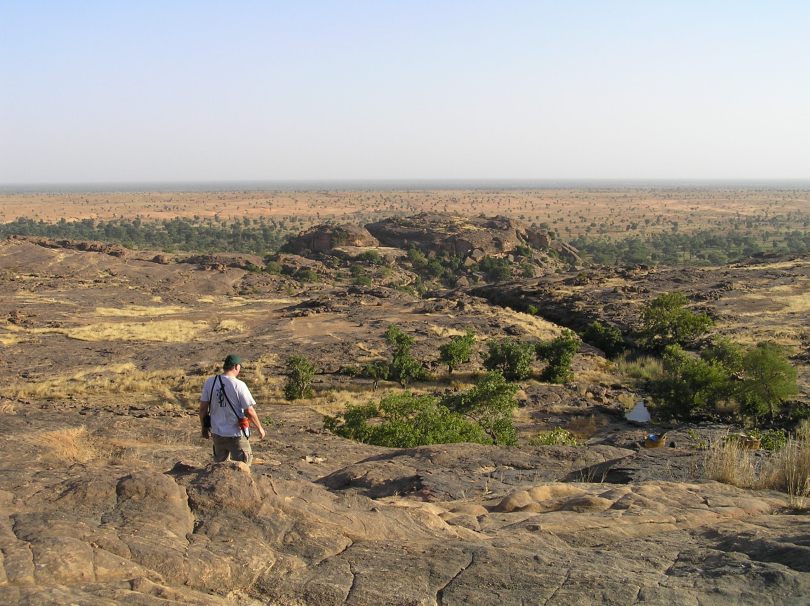
For the first couple of kilometres we followed a road that was mostly concrete and sand before veering left into the brush over the stone-littered ground. We reached the edge of a cliff and gaped down at the vast vista that lay below us before beginning our descent into the valley. We slowly scaled down the steep rocky escarpment, generally following a natural pathway that had been augmented over the centuries with rocks stacked into vague steps. The going was slow and rather nerve-wracking, and even the strongest among us were left to gape in wonder as the local women would pass by, marching matter-of-factly up the cliff face with several heavily-laden baskets balanced effortlessly on their heads. Returning home from market twenty kilometres away, these powerful women were in no mood for photos or small talk with lazy tourists who were sweating bullets and just three kilometres into their journey.
People here work very, very hard.
Once we had descended into the valley proper we tramped along the sparsely-treed and hearty-bushed savannah for a few more kilometres before arriving in the village of Kanikombole, where we would be bunking down for the night.
We stayed in a campement, which was basically a hotel except that the clients slept outside in the open air up on the roof. “Hotel” is a bit of a grand word for it; the campement was a rough-walled courtyard surrounding a one-story mud kitchen with a couple of bathrooms and a shower attached to the side. And while the facilities were undeniably spartan – the “bathrooms” were nothing more than waist-high walls surrounding a couple of holes in the ground, dinner was a choice-free bowl of bland millet allegedly containing bits of chicken, and the only method for getting to and from our beds on the roof required scaling a log notched with rudimentary “steps” that leaned loosely against the building – there was no reason to be anything but thrilled with the accommodations. With an endless landscape of Impressionistic beauty stretching out on all sides and the widest of twilight skies overhead and nary a wisp of cloud to impede the setting sun, we all looked forward to spending the night a dozen feet above the natural murmur of the Dogons and their jungle valley and a thousand miles beneath the world’s largest and most translucent canopy of stars. Plus there was a soda machine in the kitchen that dispensed cans of cold beers at an affordable price.
It was one of the greatest days of my life.

111908 Sand Trek
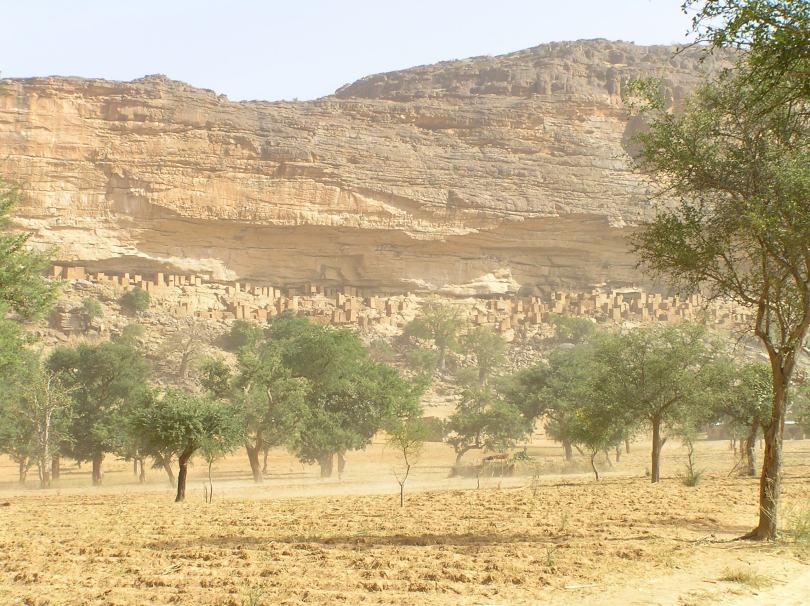
In the middle of the night the whole neighbourhood was awakened by a noise so huge and so near to where I lay that I instantly thought that the roof of one of the mud huts we were all on must have collapsed, sleeping tourists and all. Noticing that I and everyone in my immediate vicinity seemed to be fine, I decided to go back to sleep and get the body count in the morning. When we awoke to the rousing sound of a thousand animals who were themselves waking to the rousing sound of a whole other thousand animals we discovered that a large branch had fallen from the baobab tree next to our campement. It wasn’t quite 6am when I made my way down to the ground and investigated.
I was told that it is quite rare for a branch to randomly fall off of a baobab tree which is why villagers were already out in droves chopping the trunk-like limb into manageable parts and hauling it away. The branch was at least two feet thick and I couldn’t possibly guess what had brought down such a monster, and with the amount of people filling their baskets with baobab leaves and hacking away at the lumber with their primitive hatchets neither would anyone else; all evidence would gone by noon. We would be gone by then too.
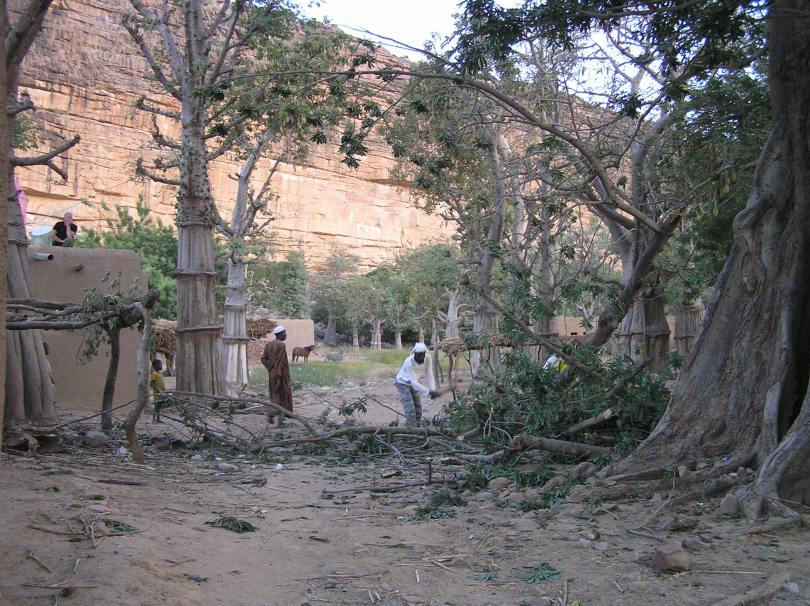
M’lady had woken up feeling very ill in her stomach. She skipped breakfast and put on a strong face as we headed out for the day’s hike. Unfortunately she was literally doubling over in pain so it was pretty slow going. The two of us soon fell well behind our group, preferring to set our own pace towards the next village. I felt so bad for her but we took our time, she toughed it out, and we made it.

The worst part was how stunningly beautiful the trek was, and rather than wondering at the amazing sights that surrounded us m’lady had to struggle and fight simply to endure the morning.
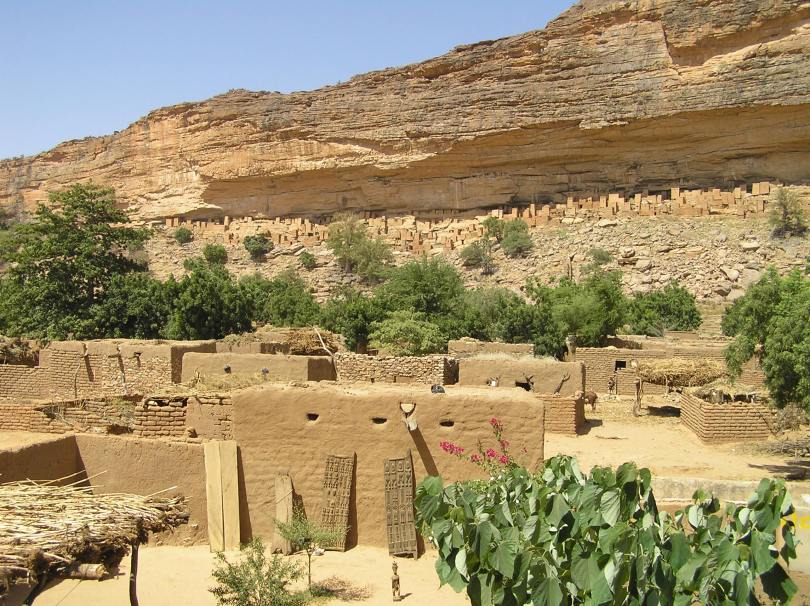
We walked along the plains passing a number of villages along the way. Each looked basically the same to me: naively elegant, seemingly fragile yet obviously resilient, and stunningly beautiful. Clinging to the cliffs above each village was another village, ancient and abandoned. Hama told us that this is where people lived many many years ago, back when lions and other dangerous animals roamed the valley. They were breathtaking.
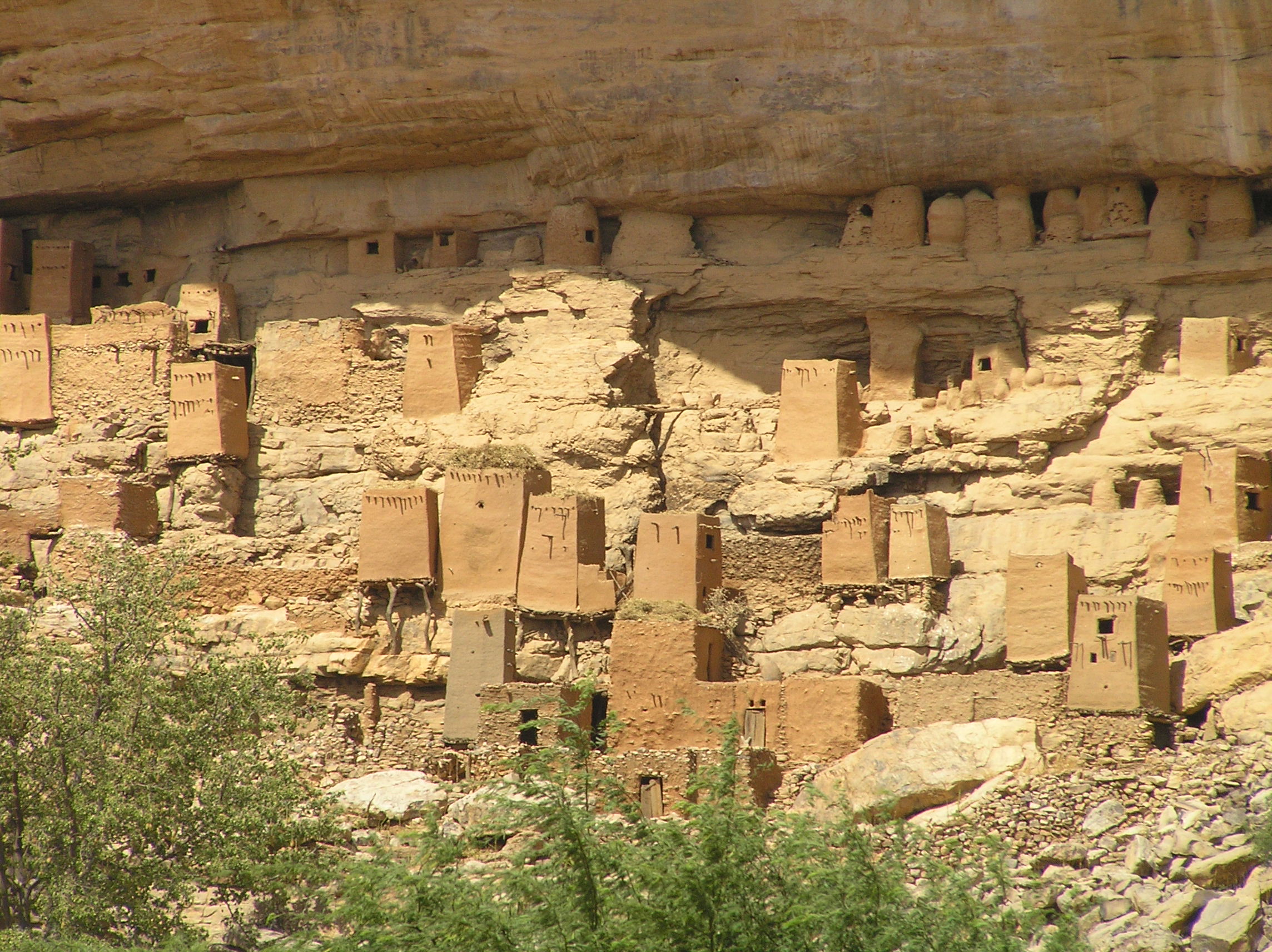
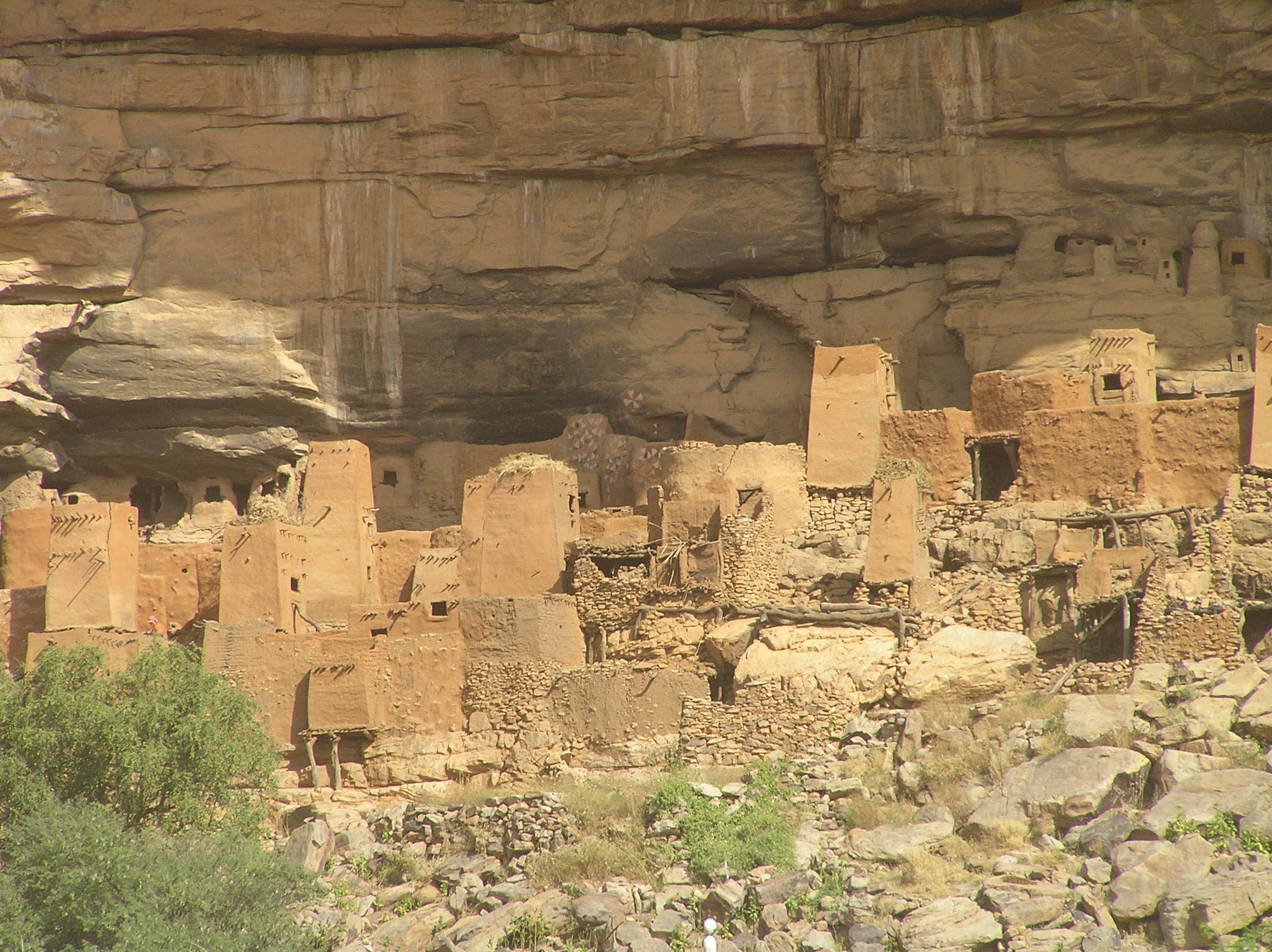
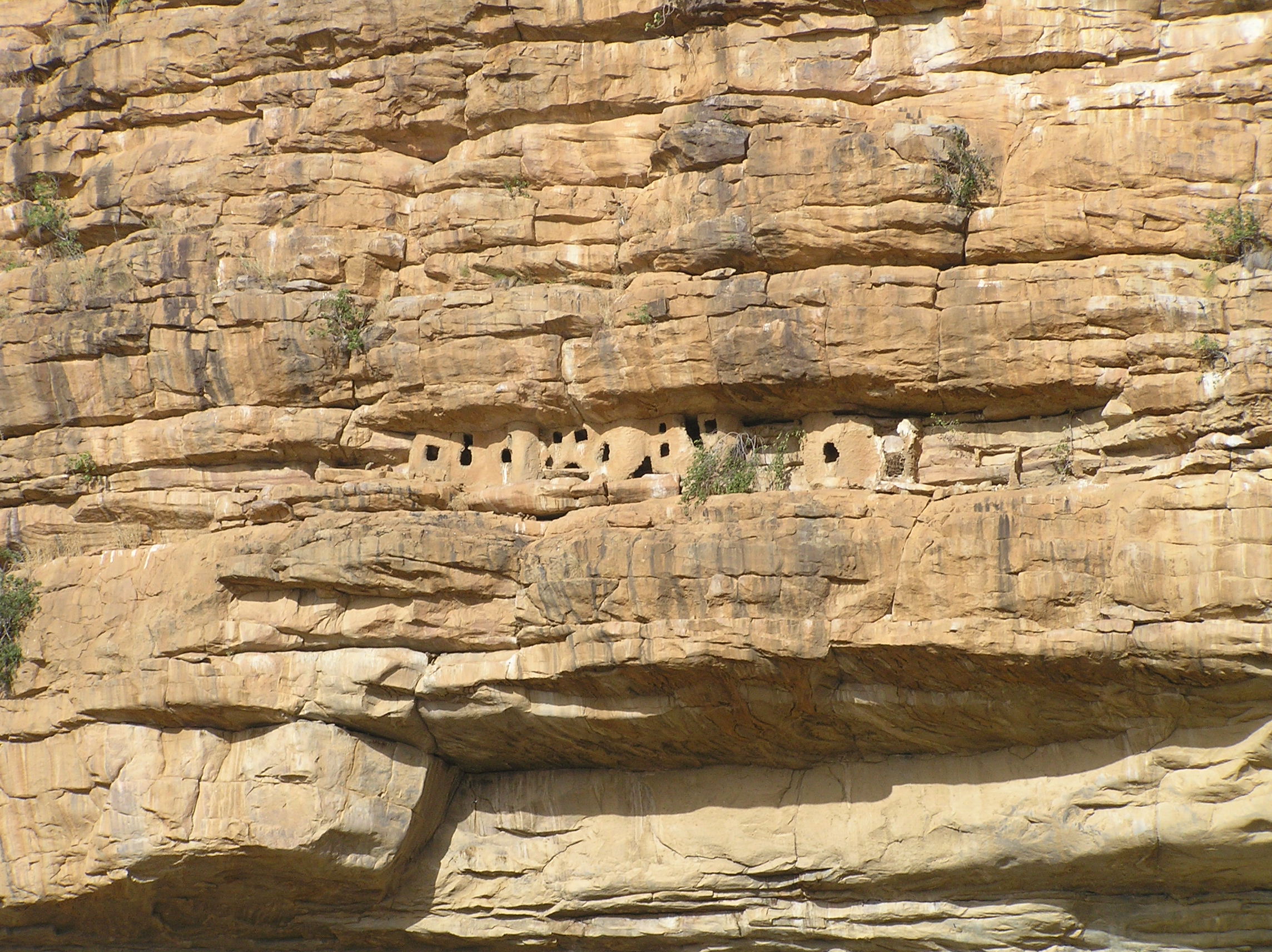
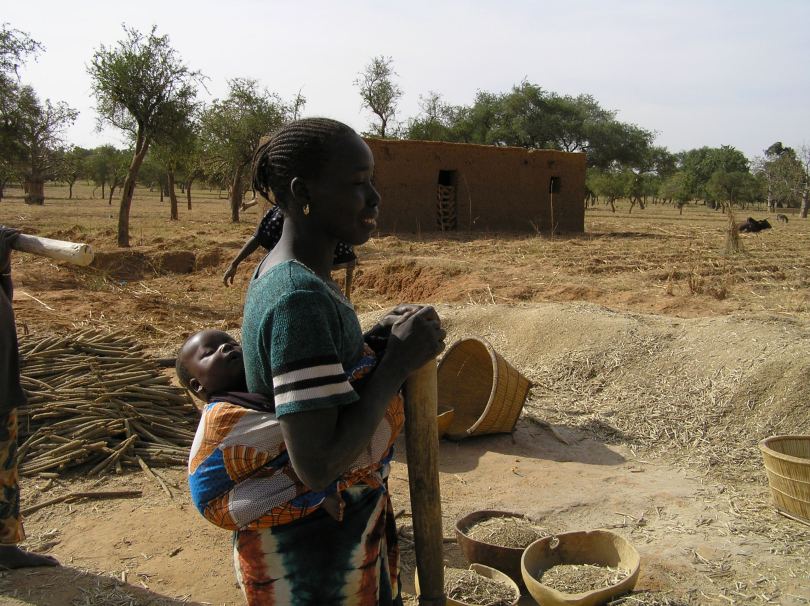
Several times we saw groups of women who were busily grinding millet with repeated stabs of their baseball bat-sized pestles into large mortars. It wasn’t unusual to see some of the women working away with a child trivially strapped to their backs, except that it was unnervingly unusual to see those little babies getting bounced back and forth with each thrust of the pestle. Meanwhile men commanded the aid of their older children to help them store hay for the upcoming dry season high up in the branches and safe from animals on the ground, inadvertently creating what looked like nests for a colony of Big Birds.
Donkey-drawn carts would pass by, bouncing along the ruts of the ancient pathway. The only powered vehicles we saw were a handful of motorcycles that would careen dangerously through the deep sand. Most of the children we saw came running, many imploring for “ça va bonbon!” or “ça va Bic!” and clamouring for our empty water bottles, which they use for everything from water storage to soccer balls. I started to joke that you could throw an empty water bottle over your shoulder anywhere in the Dogon Valley and it wouldn’t hit the ground. Talk about easy charity! But most of the kids just wanted to shake our hands. By noon I had signed two autographs.
When we stopped into one of the villages for a midday break our guide quickly sourced a bed where m’lady could lie down and hopefully sleep a little. Meanwhile I took my guitar out for a stroll around the village looking for a jam.
I was walking along and plucking away with a few kids trailing behind me when a man called me over. He went inside his tiny mud home and emerged carrying a drum made from a large calabash. We sat down and started playing tagether. He laid out a groove and I tried to find something to blend in. Whenever I fell back on the basic pentatonic minor scale the guy would give me a satisfying grunt, which made sense to me. After all, the magical five-note scale that western guitar players have relied on since the birth of the blues right up to the pop and rock music of today originated right around here somewhere.
We were making some really interesting music but I had to beg off so I could check in on m’lady and make sure that she (and I) ate some lunch. I told my new friend that I’d be back and right after lunch I returned, this time armed with my tape recorder. Our jam lasted an hour or more, during which we attracted a pair of flautists and an audience of several dozen locals. Everyone had so much fun! People were enthralled when I would rewind my tape recorder and play the music back to them between songs. I often bowed out of the music altogether, content to listen to the steady antique beats punctuated by the cacaphonic rhythmic pulse of the two out-of-tune flutes. The music reflected the simplicity of the world in which they were living, especially the architecture. Unique variances appear subtly within the constantly repeated figures, with a sound that is created and augmented by the very limitations of the crude instruments available in the drastic climate. This is easily comparable to their houses, their meandering fences, and their magnificent mosques, which are invariably punctuated with logs protruding on all sides. These logs are embedded specifically so they can support workers who will regularly have to re-mud the buildings to keep them from eroding, but at the same time the logs create a look and a style to the architecture that is beautiful and unmistakable.
Eventually the call to prayers came cackling from some hidden loudspeaker and the men bade me farewell. They all started off towards the mosque while I Pied Pipered all the kids back in the direction of my campement.
Just like the day before, once the sun had waned a bit our group set off for the afternoon segment of our hike. After having lunch, a good rest, and medications both professionally and personally prescribed m’lady said she felt dramatically improved.
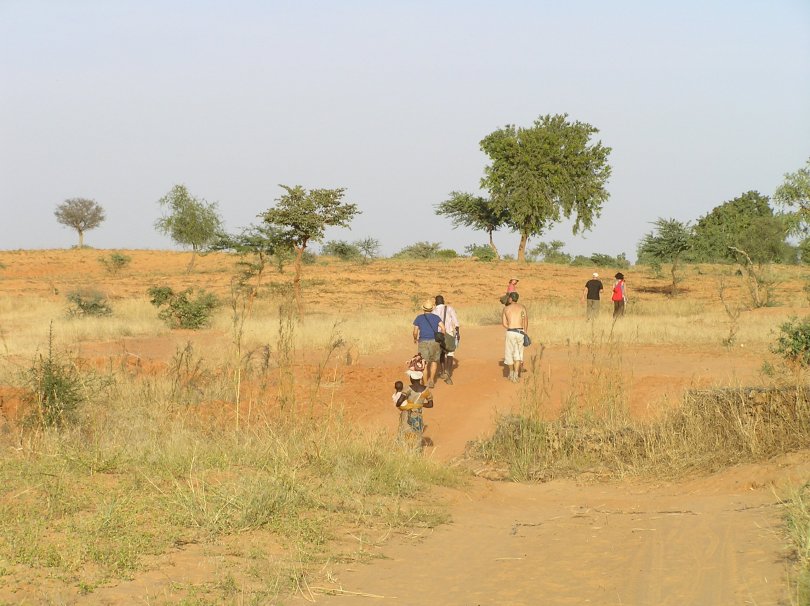
We had been finding it quite true what we had heard: that the Dogon Valley was a place where one is free to go about their businesses, an area with absolutely no police presence and where the only barrier to behaviour was social acceptance, of which there was much. Rather than happening upon the potential paranoia of carrying dagga with us in the cities we decided to try our college best to get through everything on our three envelopes right here in Dogon country. We had started off doing admirably well though logic and basic mathematics told me that our task was next to impossible.
So after a long, hot, smoky walk we were all pleased to end our day of trekking in the very appropriately named village of Ennde, appropriate at least until we departed the next day, when a better name might’ve been “Starrte”. In the Ennde we found a really nice campement, one I would even go so far as to almost describe as a hotel. They had toilets, really cold beer, and good showers and I can’t measure how much better I felt after utilizing all three of these amenities.
Our entire crew seemed to be hitting the beers pretty well so when they brought us a tray of bland orange wedges as after-dinner refreshments retrieving the bottle of tequila from my pack seemed the obvious next step. Amazingly, I could only convince myself, British Steve, and our guide Hama to have a shot. In fact it was Hama’s first time ever trying tequila, and the whole table was roaring as we walked him through the proper salt/shot/lime wedge (okay, orange wedge) technique for his inaugural kick at the can.
I was also surprised later when Hama was the only person I could get on board for trying to find a local bar in this, the largest village we had seen. We grabbed my guitar and stumbled through the dark together but all we could find was another campement. There was a Frenchman there who loved Neil Young so we sang and partied together for an hour or two, during which time Hama disappeared. Quite loaded, I eventually bid the room goodnight and found my way back to my own campement where, with a precarious steadiness, I scaled the notched-tree ladder up to the roof and found m’lady asleep under the stars. I joined her.
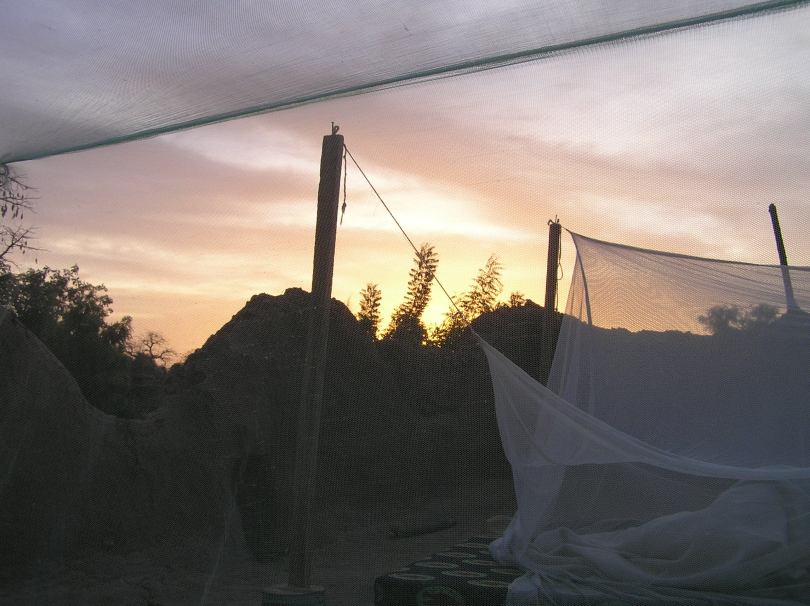
112008 Life in the Valley
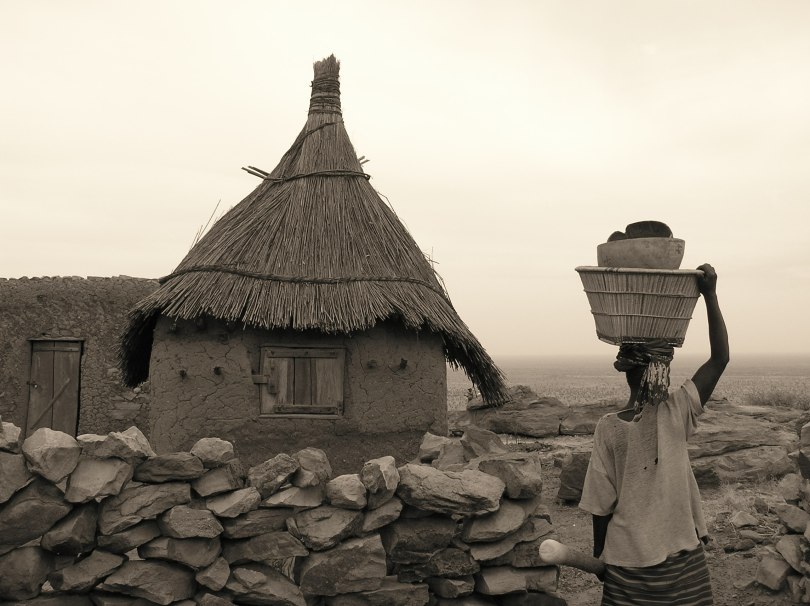
Waking up in the Dogon Valley is magical, though if you like to sleep in, look elsewhere. Mali is chock full of goats, with a sizeable number of roosters and donkeys and other bleating noisemakers thrown in, and all of them like to get an early start on the day.
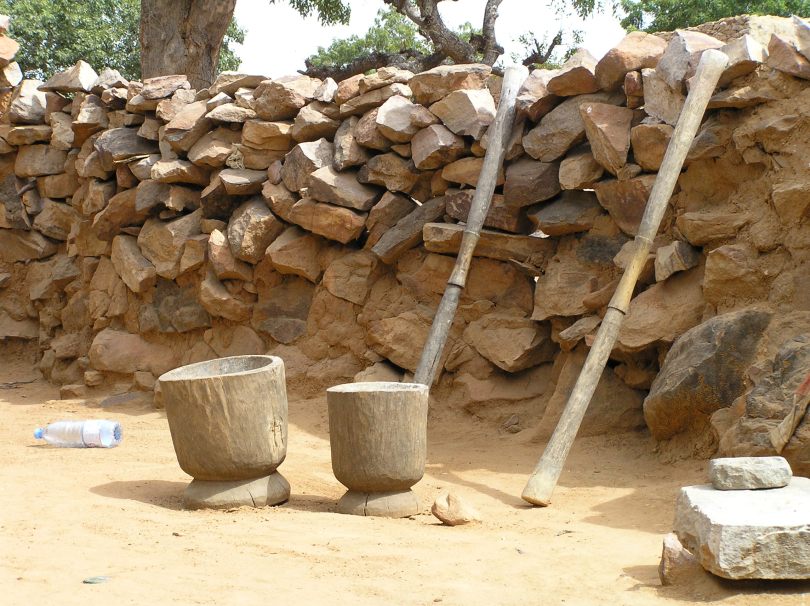
Laying on a thin mattress in the open air with nothing but a mozzie net between slumber and a busily waking world, deep sleep is easily infringed by the first critter call of the morning, which is (stereo)typically a rooster. From somewhere in the distance comes the inevitable response from another rooster in a neighbouring compound, prompting more and more local critters to get in on the act. Donkeys seem to require a little bit of of revving up to get their full-on hee-haws going, but it sure doesn’t take long before only the hardest core sleeper can stay down as all the animals welcome each other to the day. By the time the barnyard chorus is augmented with the drum-like thump-thump-thumping of early-rising millet pounders, sleepy or not, you’re up and feeling around in the weak twilight for your glasses.
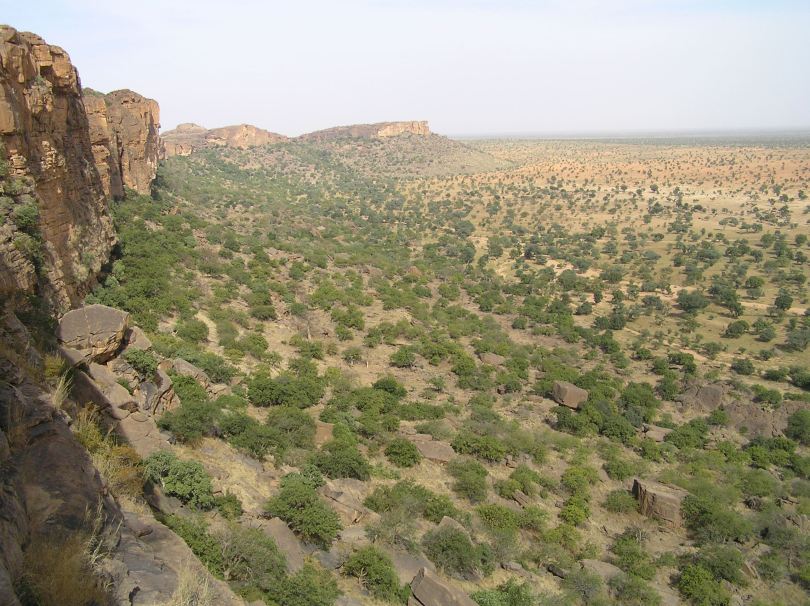
That’s when you sit up and shake the cobwebs out of your head and remember that you’re smack dab in the middle of fairyland. Time to start the day! Yawn, stretch, dig out your toothbrush and teeter down the notched log to terra firma, where a handful of “good morning”’s (to your fellow tourists) and “ca va”’s (to the locals) ushers you to a breakfast of instant coffee, bread sticks with jam and cheese wedges, and Martha’s mind-numbingly delicious treat of Kraft peanut butter brought all the way from Prince Edward Island. I was happy when m’lady joined us for the morning meal looking significantly healthier than the day before.
The village where we had stayed was well-known for making blankets. The weavers use basic looms that are little more than a spike in the ground anchoring about twenty feet of rope and convoluted wood bracing. The fabric of the blankets is stretched out on the web of rough rope. While I was admiring one of these simply complicated devices I was welcomed by the old man who operated it day in and day out. When I shook his hand I was amazed; his palm was so calloused from working the ropes that it felt like stone. Whether it was one rock-hard callous or a thousand I cannot say, but I’ve never shaken a hand like it before or since. I’ve typed it before and I’ll type it again: people here work very, very hard. M’lady and I bought seven blankets, haggling the purchase to include a porter to carry the sack to the next village where we can pick it up at the end of our trek.
(I became instantly smitten with a blanket displayed in the village that measured the distances to several other Dogon Villages. I was told that I could buy it – at a relatively hefty price – but I felt like I would be robbing the village and future trekkers of a somewhat valuable resource so I didn’t. I regret my benevolence.)
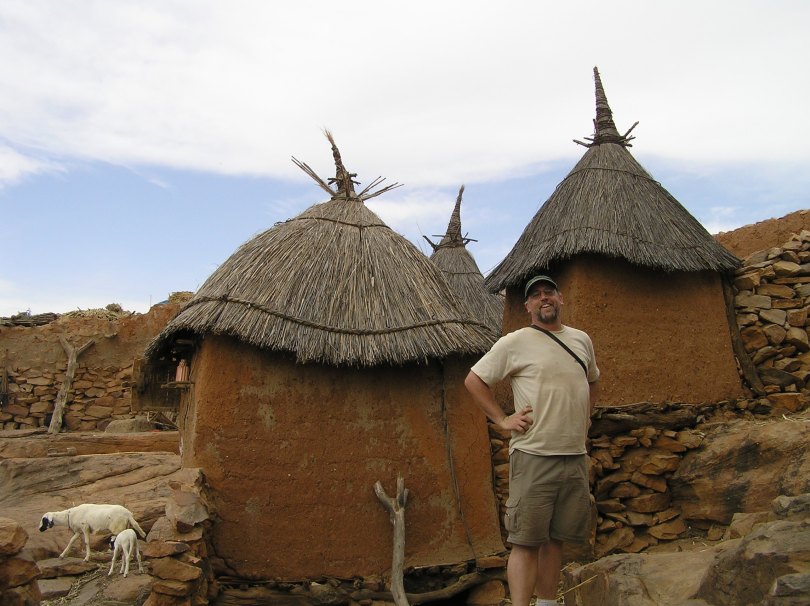
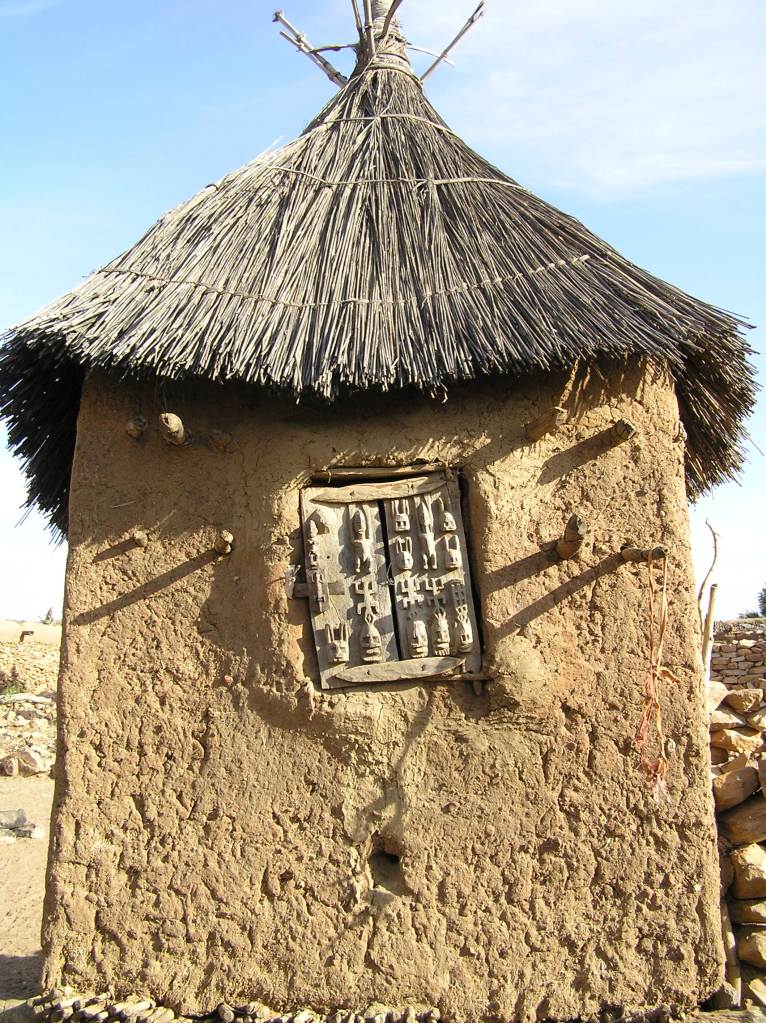
We toured the village and found similar amenities to the previous villages we’ve visited. With no police in Dogon country the people are left to take care of their own justice, so each village has a custom-built mud building where village elders pass judgment on any local cases that may arise. These courthouses are always made to be only waist-high, forcing everyone inside to sit down, which helps to quell physical altercations. Women are never allowed inside the courthouses, even if they themselves are the ones on trial, although women are allowed to follow the proceedings and offer their opinions and testimony from just outside the door. Each village also has a mosque, the size of which is relative to the size of the village and hence the number of Muslims living there. Some of the mosques are so small that they look like they could only hold three or four people at a time. Many villages also have a Catholic church – a plain building identified as such by a cross outside and nothing else – and there is always a brick schoolhouse, which is generally the only building in a village not made out of mud.
Each village has a hut where women stay when they are menstruating, a time when they are forbidden from staying with their husband (or, if unmarried, with their parents). Women must stay inside these buildings until the end of their period and men are never allowed to go inside. Even male children are barred from these structures once they are three years old.
Most of the villages hug the cliff that leads out of the valley. When the Dogons first came to this area millennia ago they built their villages halfway up the cliff away from wild predators, particularly seeking out areas with a natural overhang that would shelter them from the rains. As the centuries went by and the encroaching Sahara Desert moved in, many of the critters that kept the people up the hill started to disappear. Nowadays there are no lions or other man-eaters to bother the people so a couple of centuries ago the people decided they were sick of going up and down the cliff all the time and they rebuilt their villages down on the flat plain, in the shadow of their former homes. And while the old villages were made of mud, the strategic positioning that sheltered them from rain saved them from deteriorating. As a result every village in the Dogon Valley features another ancient village looming just above it. While these villages are uninhabited today, animist spiritual leaders remained living in them long after the rest of the villagers relocated. In fact, in one of the upper villages that we visited an old medicine man who lived up there with his pet snake had just died a couple of years earlier. (Legend has it that in his entire life the old man bathed only with the tongue of his snake.) Some villages that we visited still used these ancient buildings for storage.
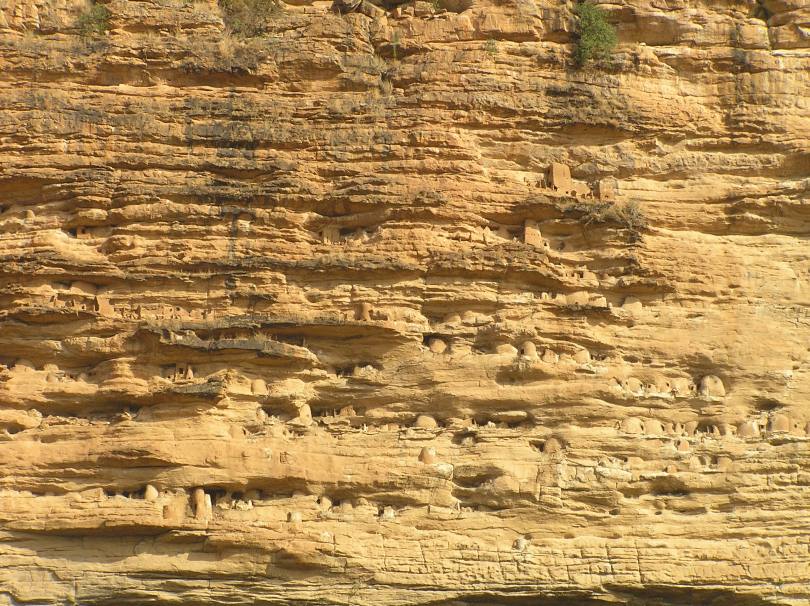
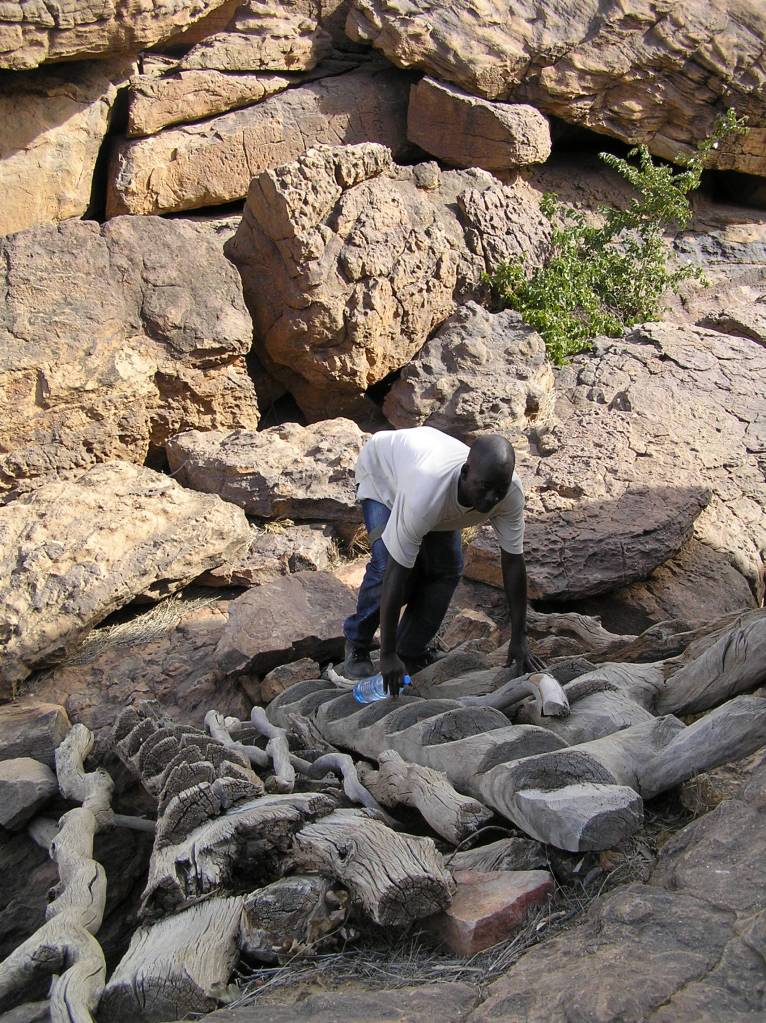
The day’s hike was a long one, split into three segments: seven, six, and five kilometres. The middle hike took place during the noon hour and was hothothot! Of course the heat doesn’t deter the locals from going about their daily chores, in fact they seem to find it quite cool this time of year. I can’t tell you how many people I saw that were wearing multiple layers topped with a winter jacket zipped all the way up Kenny-style whilst I was wearing just shorts and a t-shirt and still sweating off all my sunscreen. And we met them all. It’s customary to greet absolutely everyone you meet when you walk through the Dogon Valley, and not just with a quick “Hi, how ya doin’?” either. Rather, there is a specific set of questions that get asked back-and-forth by both parties, and it goes something like this:
“Are you well?”
“Yes.”
“Good. Is your family well?”
“Yes.”
“Good. Are your parents well?”
“Yes.”
“Good. Are your animals well?”
“Yes.”
“Good.”
Then they immediately switch roles and the questions get asked again:
“Are you well?”
“Yes.”
“Good. Is your family well?”
“Yes.”
“Good. Are your parents well?”
“Yes.”
“Good. Are your animals well?”
“Yes.”
“Good.”
And to be clear: This exchange happens every single time two adults cross paths anywhere in the Dogon Valley. As a result people tend to recite this ritual very quickly, and in their own language of course, so to me it sounded like a single rapid-fire sentence shared between two people, twice:
“Kaylab? Sui. Ben Deylab? Sui. Ben Baylab? Sui. Ben Raylab? Sui. Ben. Kaylab? Sui. Ben Deylab? Sui. Ben Baylab? Sui. Ben Raylab? Sui. Ben.” (I do hope you can bring yourself to pardon my poor pronunciation and awkward cultural sensitivity.)
Every. Single. Time. I heard it so often I’m shocked that I didn’t manage to memorize how the exchange actually goes.
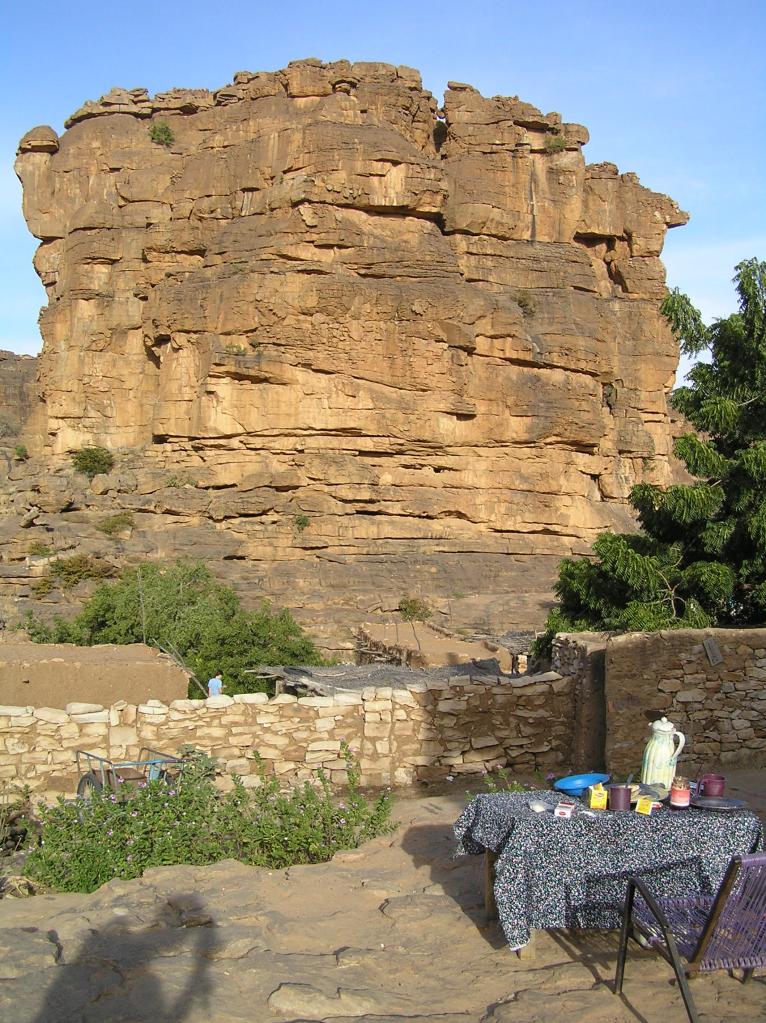
(When I talked about it to my guide he told me that if two Dogons pass each other in Bamako or some other big city they will always do the entire greeting – further explaining that a Dogon can always recognize another Dogon, even if they have never met – but he added that in the few Dogon villages that have grown into small cities [like Bandiagara, with a population of more than 25,000] they only go through the standard greeting if they meet someone they actually know. Otherwise nobody in the bustling little metropolises would ever get anything done.)
Our final stop of the day was up on top of the cliff, an ascent that our whole crew had been dreading and one that turned out to be absolutely gorgeous and not too tiring after all. The village we camped in was surrounded by curious rock formations that were tentatively balanced like a giant a geological game of Jenga. The monoliths were reminiscent of some of the more picturesque episodes of the Road Runner.
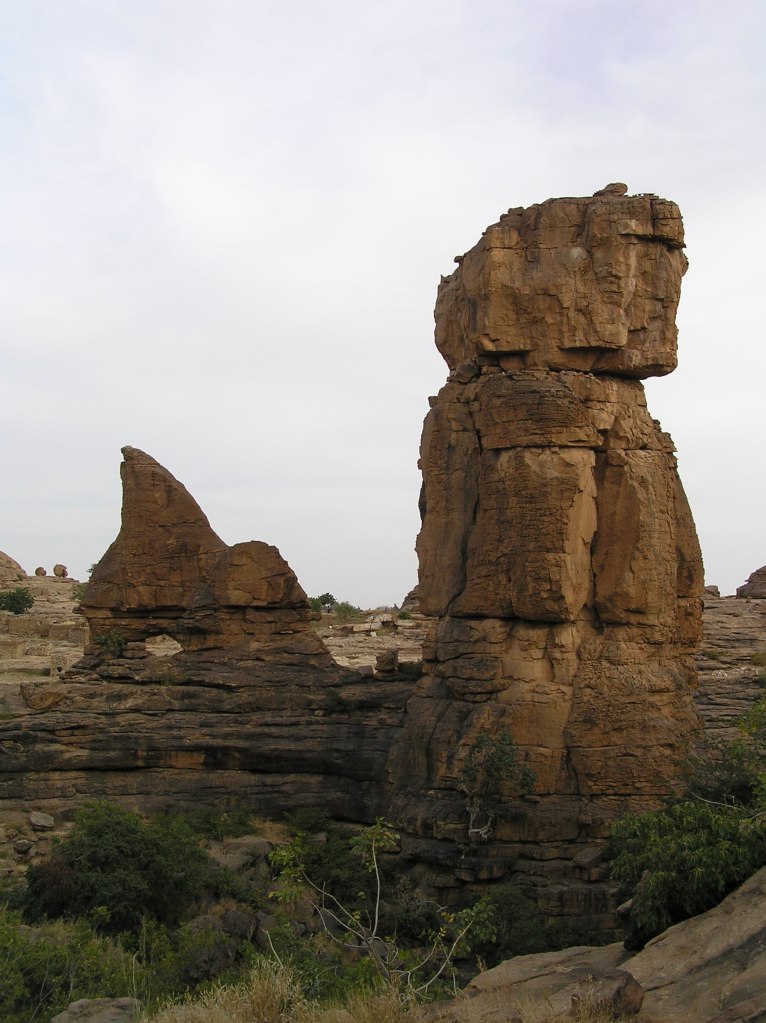
With the two Spaniards and British Steve scheduled to leave us after lunch the following day this would be our final night as a group of seven, so we had a little celebration. One of our guides brought us a plastic water bottle filled with locally made millet beer, which is traditionally served warm and was quite tasty. As the bottle made the rounds I inquired about stronger stuff and soon there was a small bottle of Dogon gin on the table, a harsh local moonshine called chappa-chappa. The very real fear of drinking myself blind on gut-rot liquor was quelled by my very real inebriation, which had grown strong enough to easily push fear to the ground. And all the while our guide Hama kept the group in stitches with his remarkable story of his first trip to the West, and the problems that arose landing at the airport in NYC after knowing nothing more metropolitan than Bamako.
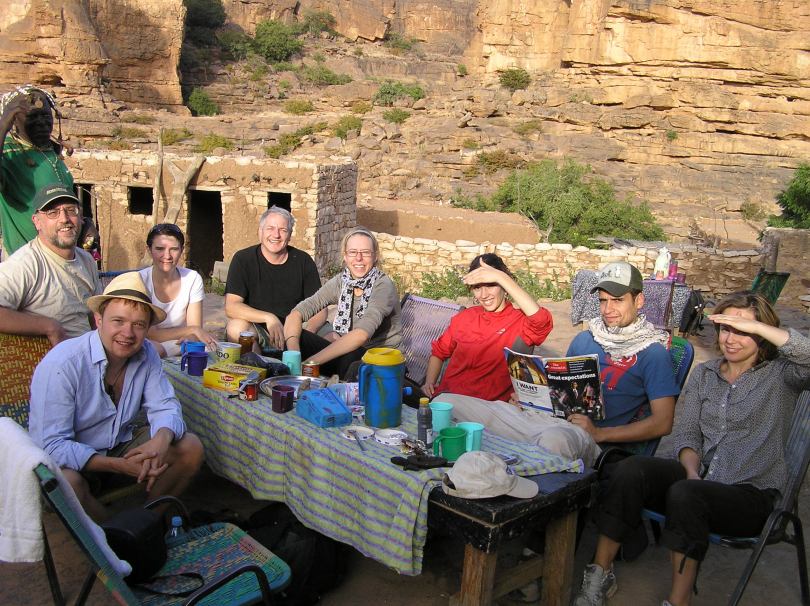
By this time my snoring had segregated our crew, so when bedtime became unavoidable m’lady and I crawled up to a rooftop on the edge of the compound – as far as possible from the rest of our group – and fell into a deep sleep.
112108 The Party
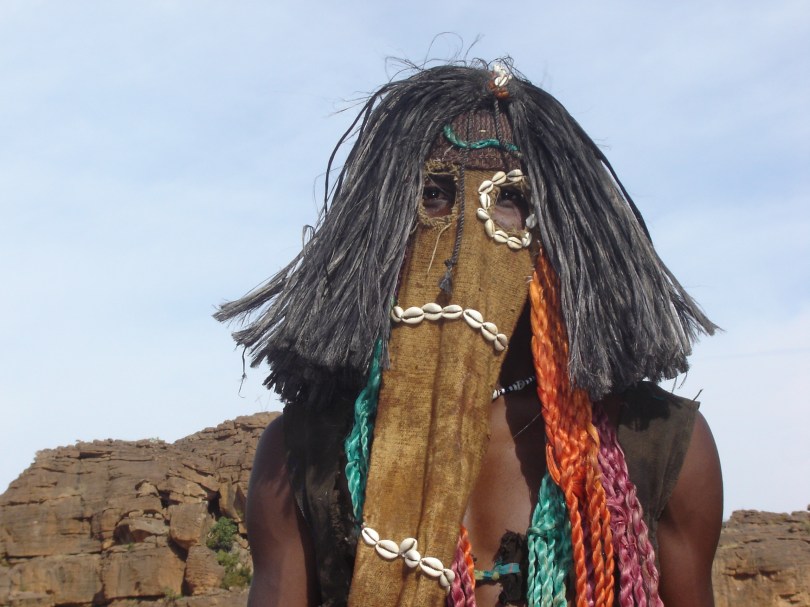
Once again nature’s alarm clock rang us all awake nice and early with a snooze-buttonless crescendo of squeaks, squawks and honks courtesy of the local wildlife. After struggling to peel my eyes open I found the prehistoric stone towers that surrounded the village of Benimato gave the wakeup an extra dash of unholy beauty that cut through my hangover like a mortar going through millet. It was like waking up on the set of a Spielberg movie about the Keebler elves on safari in the Grand Canyon. If you see what I mean.
I was also buoyed to discover that m’lady’s health had returned. Woo-hoo!
The night before our guide Baba told us that the people in Benimato village put on shows for the tourists in order to raise money for their local school. He assured us (and I believed him) that all money raised went straight to the school, no BS and no skimming, and the seven of us responded by pooling around 150,000 CFA francs ($300+CDN), each of us signing our pledges into a notebook. And so after breakfast we were taken for a walk around the other side of the rock mountain that bordered the village on one side. Once there we were treated to an amazing hour-long performance of music and dance rehearsed and performed for the twenty-five or so tourists who had stayed in the village the previous night.
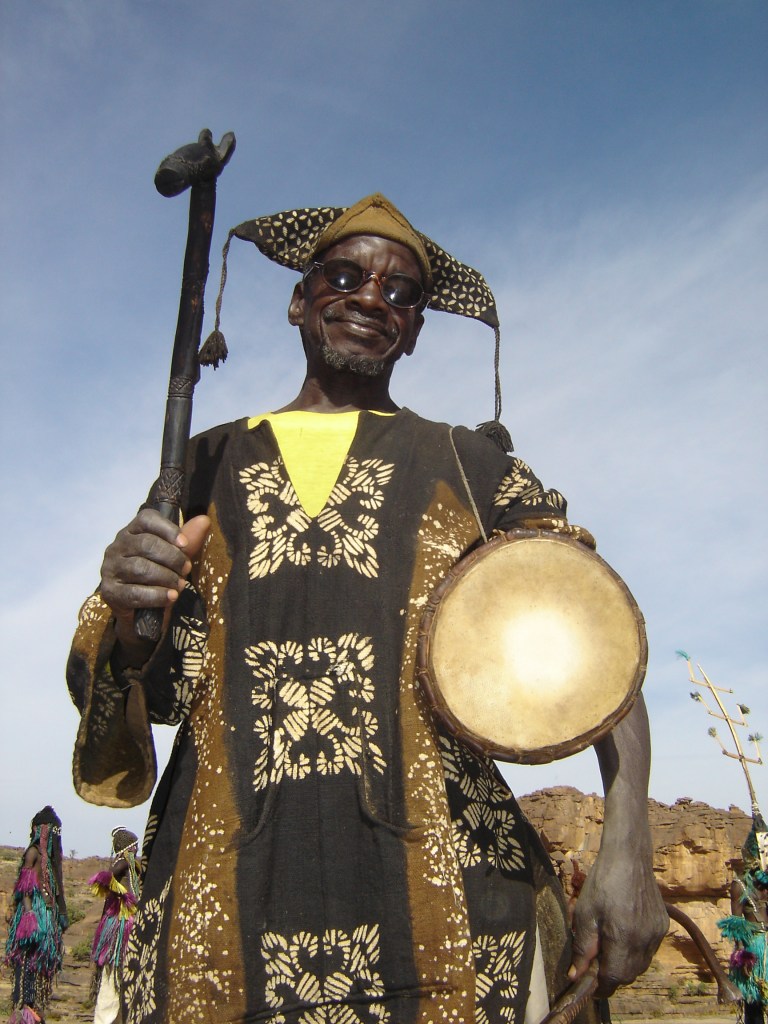
First, the music: Eight musicians tapped out repeated rhythms in unison, most playing the tama, known in the West as a talking drum. Held under one arm and struck with a curved stick, a player can suddenly change the drum’s pitch by squeezing it, and a group of them playing together inadvertently creates microtonal chords that randomly recur within the steady, unified rhythm. This served as a foundation for the call-and-response African singing style that is great-granddaddy of American field hollers and the blues.
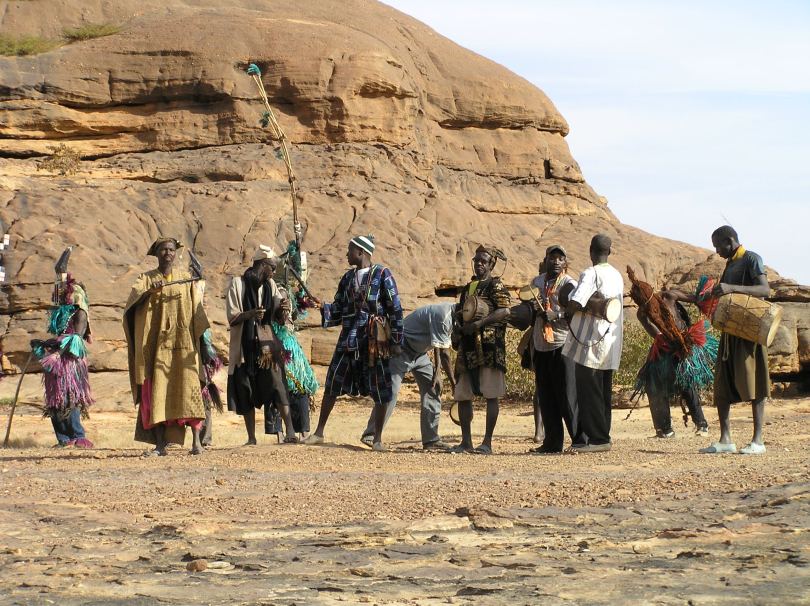
But for most, the featured attraction was the dancers, all of them in traditional masks and clothes, kicking up clouds of dust in an ever-morphing circle of manic, organized motion. The shaggy purple outfits made from fur and skins were peripheral to the large expressive masks, which were incredible. They danced and leapt about in synchronized patterns somehow seeing only through thin slats carved into the heavy wooden masks. It was really quite well rehearsed and entertaining. And then from around the corner came a pair of dancers on stilts! The musicians kicked off a new tune and the stilters pranced and swayed their ceremonial dance in a circle around the band, until they were suddenly joined by dancers wearing masks that were at least twenty-feet tall! These two faced off and tilted their enormous masks this way and that in mirrored harmony while the band played on behind them.
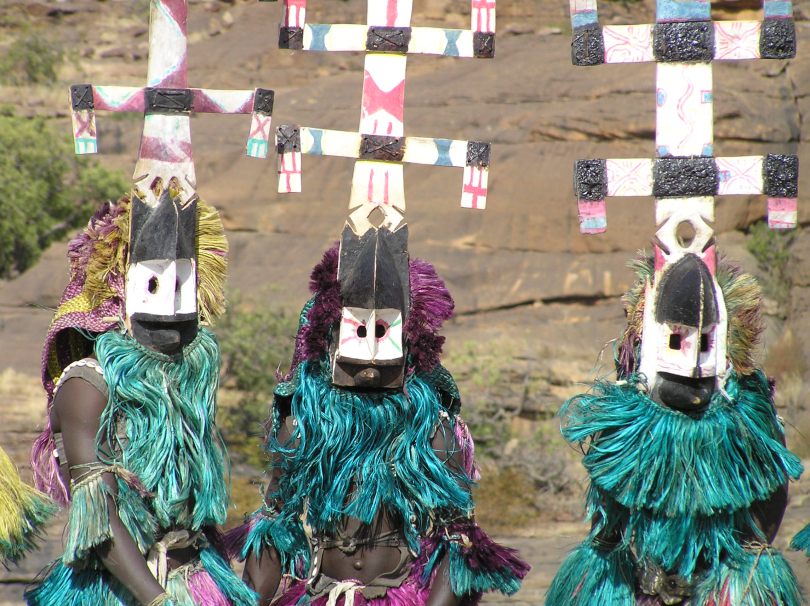
It’s fair to remind the reader to recall the venue. Picture a warm morning of sun and endless blue sky careening above a magical rocky plateau, which itself overlooks a curvature-of-the-Earth flat valley pocked with impossibly balanced geological wonders that towered just a hundred yards away. And these performers were really going for it, showing off moves that are traditionally saved for weddings and funerals and other special celebrations. Afterwards the dancers gave us a comprehensive explanation of the significance of each of the dances as well as their masks and apparel. It was all really quite awesome.
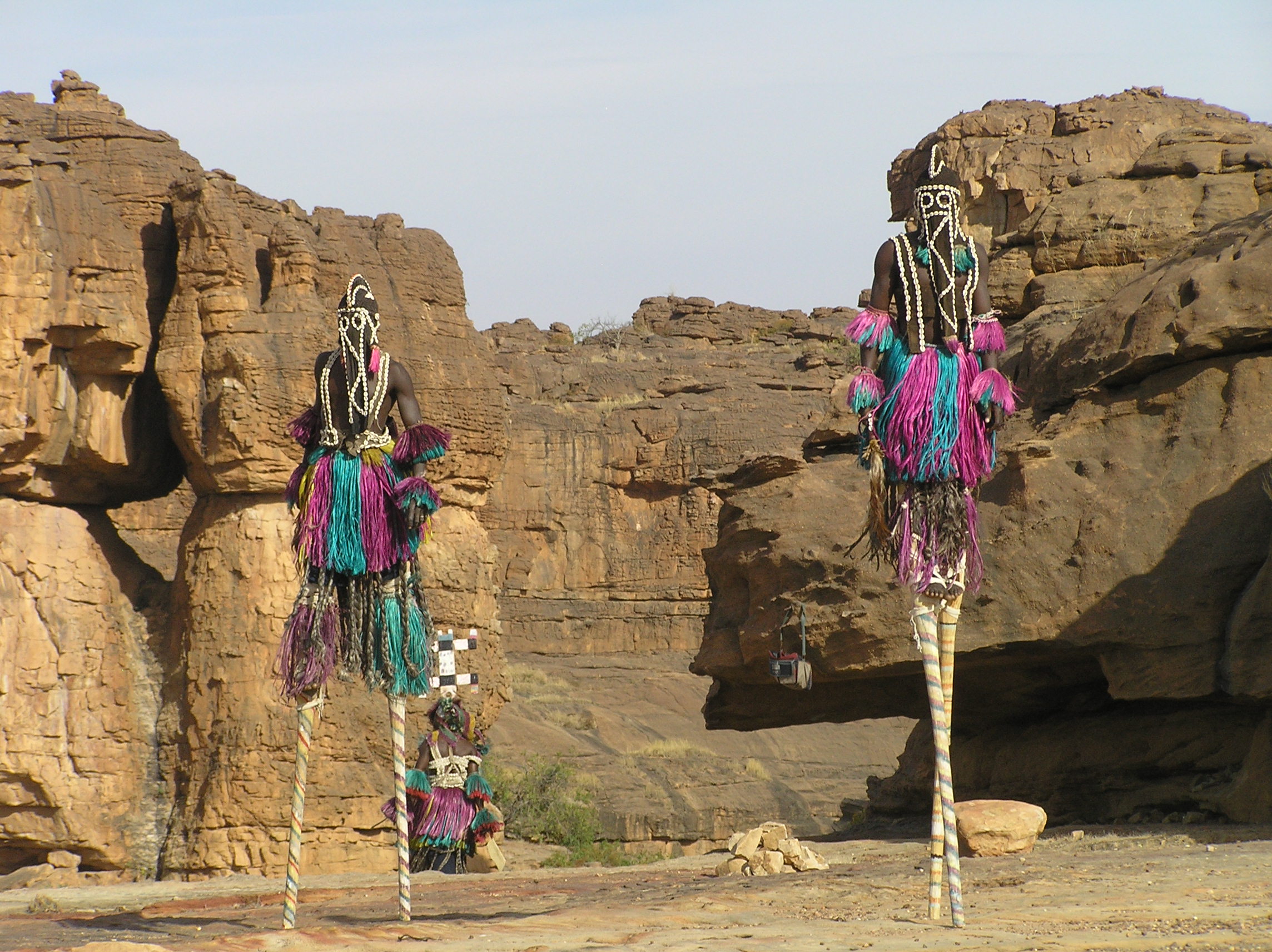
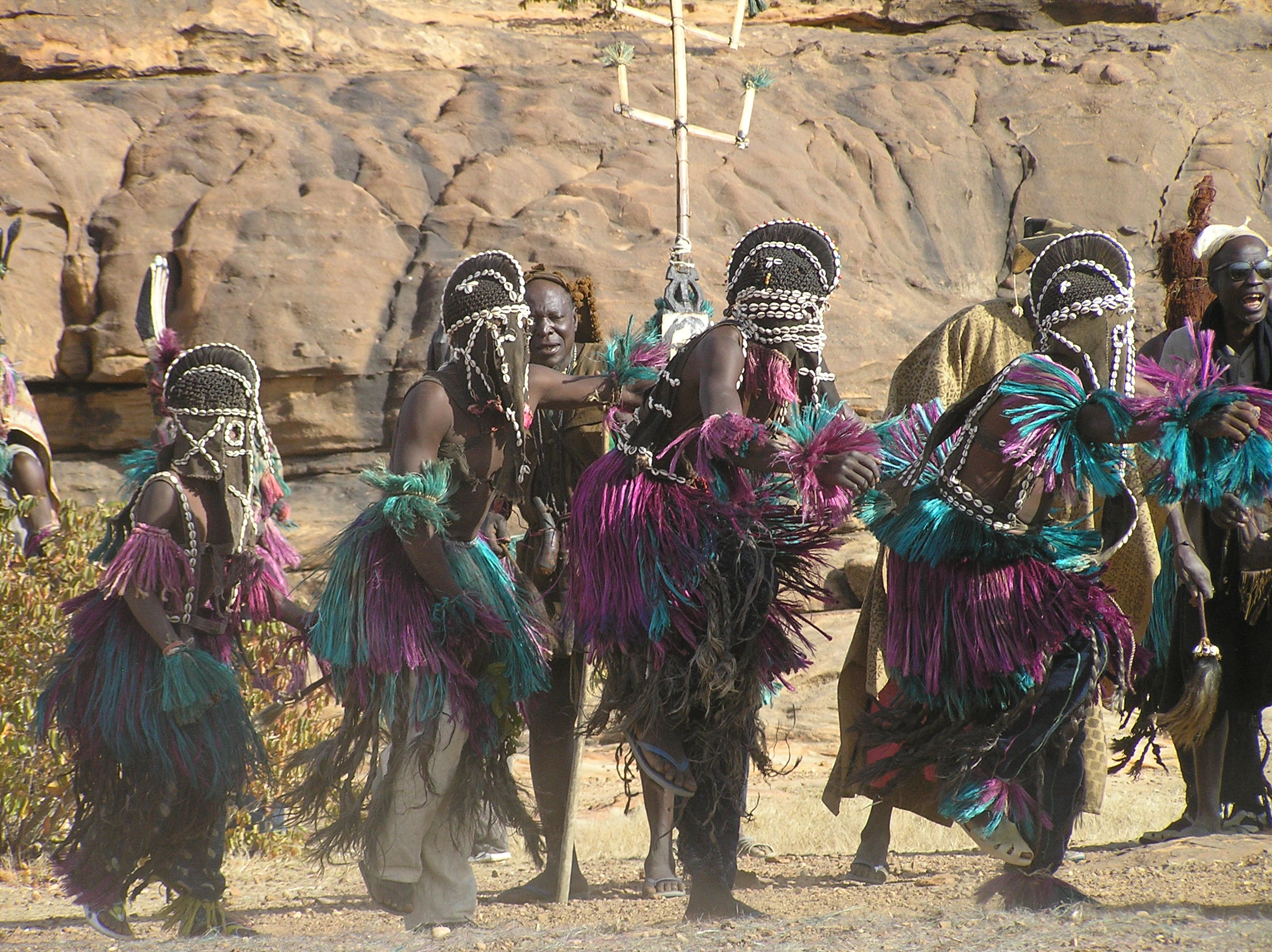
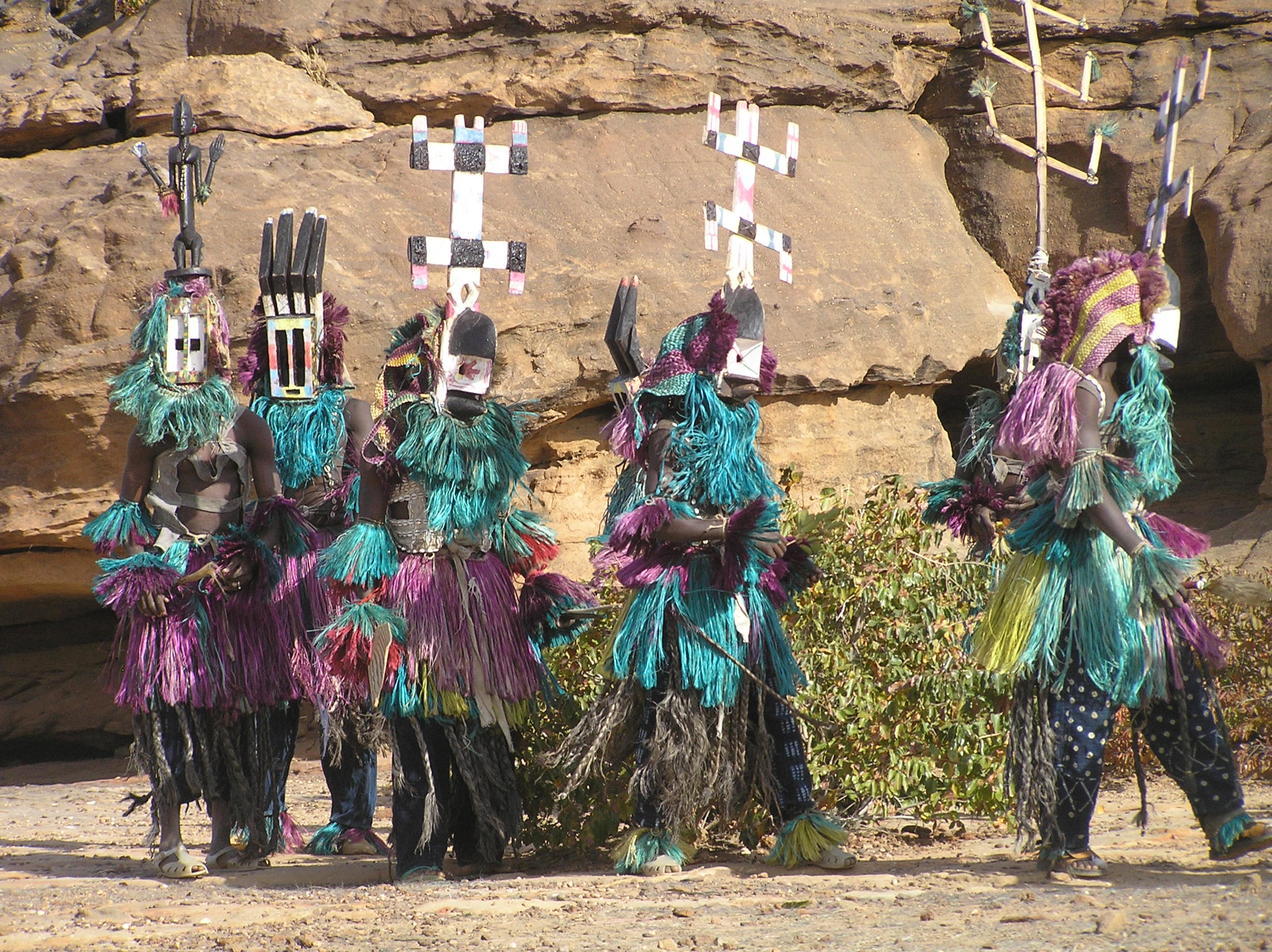
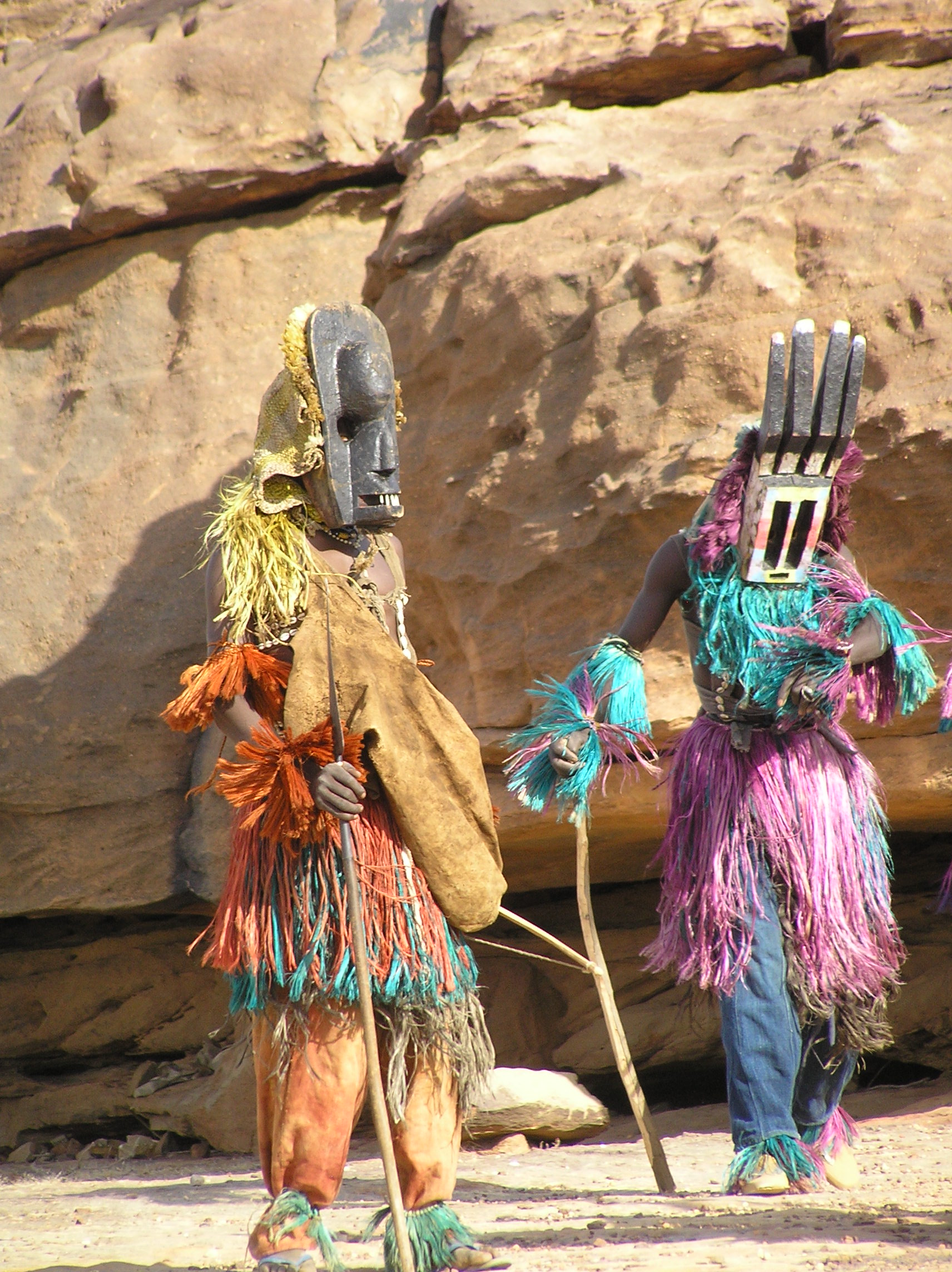
Now, I don’t want to diminish the astounding privilege that it was to witness such an incredible sight, but the knowledge that this was a presentation geared specifically for tourists forces me to admit that my dreams of witnessing an authentic drum and dance circle here in Mali were left somewhat lacking. That said, I was surprised to discover later that the locals perform this show quite rarely – only once every month or two – and that our tour guide Baba had purposely routed us to be in Benimato village on this day so we could see it. For some reason I took some comfort knowing that they weren’t grinding out daily performances that I’m sure the performers would eventually tire of.
After the show we set out for one final hike as a group of seven. The walk took us past several “farms”, locations where a tiny spring had be rerouted to provide a regular – if meagre – water supply for the plants. Here we found hard-working people bent over their lifeblood of peppers and beans, irrigating the sun-baked land with sparse sprinkles of precious water. We also saw the only pig I would see in the entire trip through Mali. I immediately asked our guide if we could have it for dinner, but the answer was “no”.
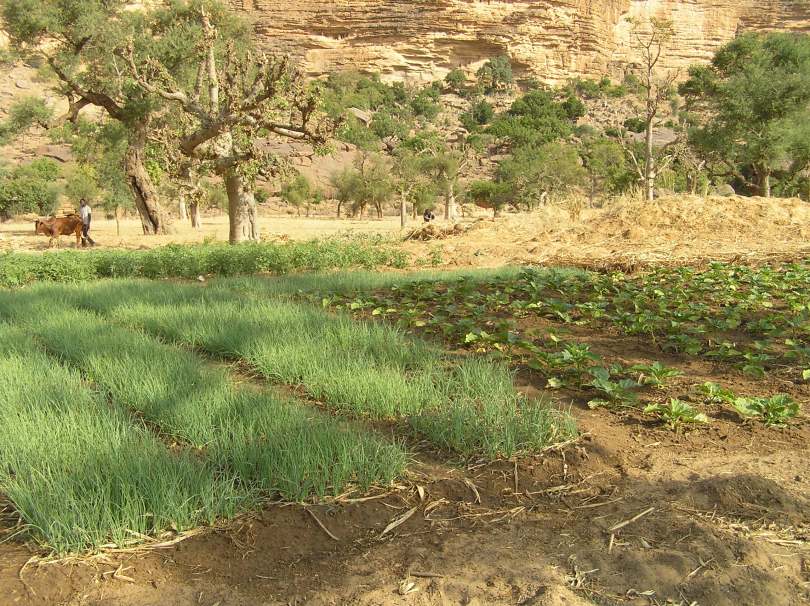
After walking across enormous slabs of rock for several hours our group arrived in Dourou, where we lunched and said goodbye to all but two of our travel companions. When I found out that we would be descending the cliff into the valley once again for our final night only to walk back up the next morning (making for our first backtrekking of the journey) I was somewhat disappointed. Actually, I was disappointed to the point that I felt like it had been kind of stupid to have booked a fourth day of trekking when most of the group had only booked three. What could we possibly see that we haven’t already seen?
Only an evening that will stay with me forever. That’s all.
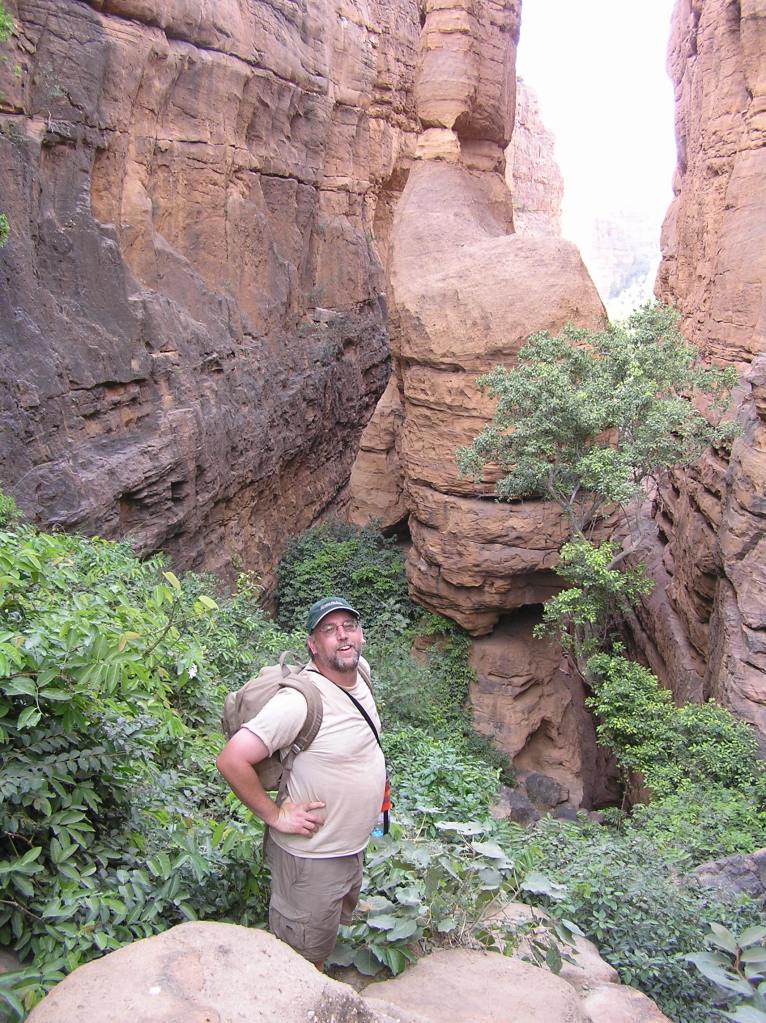
We four Canadians – m’lady and I and David and Martha from PEI – along with our guide Hama left Dourou mid-afternoon and walked over ancient curved slabs of rock until we came to a crevasse at the cliff’s edge. Here we descended into the valley along a route that has served locals for time immemorial, walking along a prehistoric staircase of rocks that had fallen into the crevasse eons ago, a path that wound beneath giant boulders that were wedged into the crack above our heads. Taking a break halfway down we watched herders in the distance bringing their animals in from the sandy fields for a drink and a bath in an almost-gone-for-the-season river that bordered the village of Nombori (which would be our final stop). The view was incredible and the crevasse we walked through was stunning. It was hands-down one of the most interesting legs of our multi-day hike. Once we had made it down to the plains again it was only a kilometre-and-a-half walk on flat ground before we were done for the day.
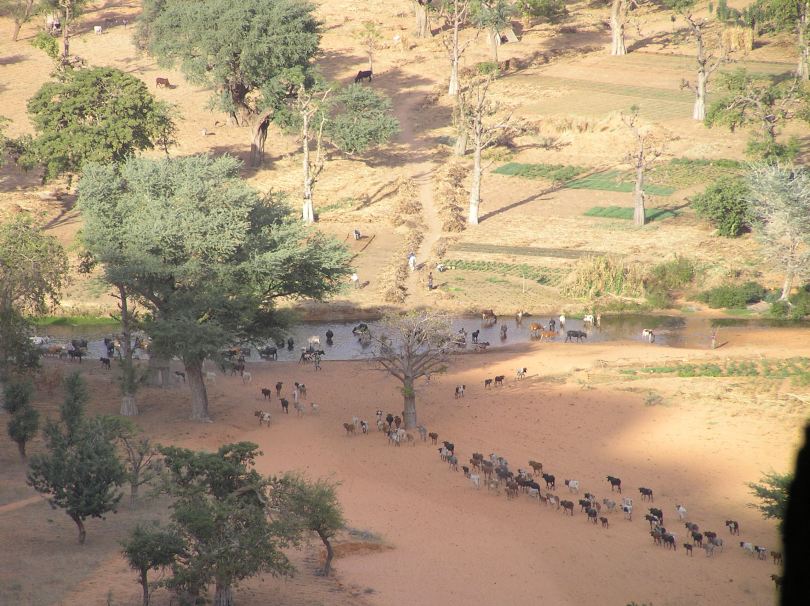
Our target was far-and-away the most un-hotel of the non-hotels we’d encountered on this trek through the Dogon. Please don’t get me wrong, I use the terms without derogatory intent but for description only. In fact I was extremely happy with the place and felt lacking for nothing, but it sure didn’t look like no hotel; it was definitely just someone’s house in a little compound. There was a bathroom and shower just beyond the fence, right outside the front gate and down a little walkway, and there was a whole extra house in the compound that nobody seemed to be using, though it provided an extra roof for us tourists to sleep on. That was where m’lady and I eventually camped and as spartan as it was, it was our first roof that had a little roof of its own. Not only that, instead of having to climb a notched log to get up to and down from our rooftop beds as we’d had to do every other night, this building was scaled via a curious looking and rather thin Escher-like mud staircase that careened up the side of the structure.

Relaxing with beers after a long day of walking, our guide Hama appeared restless. He asked the four of us if we had any plans for the night, and of course we collectively answered that we were going to eat dinner, have a few beers, and go to bed shortly after it got dark. What else were we going to do?!?
Hama told us that he had an idea. He said if we could get 30,000 CFA’s together (about $70 CDN) we could buy a bunch of millet beer and some rice and host a party. We all leaned in. “Tell us more…” He explained that if we each pitched in 6,000 we could probably get half of the village out for a night of music and dancing and we’d all have a great time. He added that there were a couple of French tourists staying nearby and if they wanted to chip in then it would cost us even less.
I was initially confused by Hama’s math until it occurred to me that he was including himself in the equation. It would be five of us pooling our money, not just we four tourists. It made me feel really great knowing that Hama was so into throwing the party that he was willing to go in on it as an equal partner. Of course the four of us agreed in a flash. Hama spoke a few words to the man of the house and set off in search of those French tourists.
Not long after he left a band started playing right outside our compound. I asked the proprietor and was told that this would be our band for the evening, and they were playing a rhythm that announced to everyone within earshot that there was going be a dancing party tonight, to be held right here where they were playing. Then Hama came back and told us that the French were in, and he handed us all back 2,000 each*. And right after dinner the party started!
A half-dozen musicians with their tama/talking drums, calabashes, and bass drums came in and took their place along one edge of the small yard. Soon after a bunch of women dancers started to show up, each one of them looking beautiful in their dangling jewelry and matching hand-dyed indigo robes. The fifty litres of millet beer we had collectively purchased arrived in yellow gasoline cans that dangled on poles balanced on calloused shoulders. The warm beer was poured into wooden bowls which were then passed around the growing circle. We Canadians (the French arrived rather late) were given a bowl to share amongst the four of us, and as party hosts our table also came with a dedicated bowl boy who sat with us all night eagerly waiting to refill our bowl whenever it emptied, which was often. The group of dancers grew to about twenty or twenty-five, and they weren’t shy to empty their millet bowls either! The musicians had theirs too and as did the seventy or so other villagers who crowded into our compound to join the festivities. From the outset everyone seemed to be enjoying the party as much as we were.
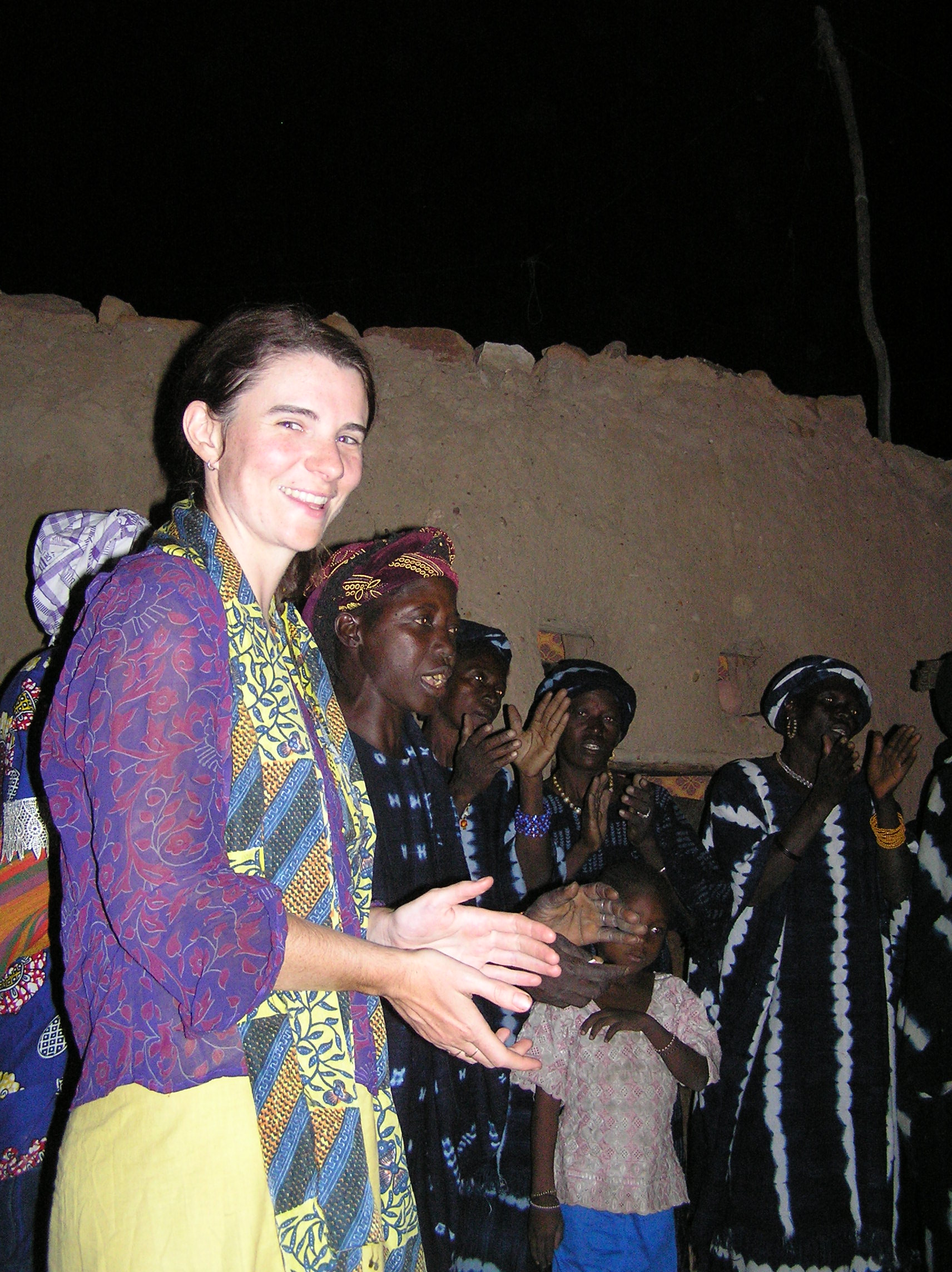
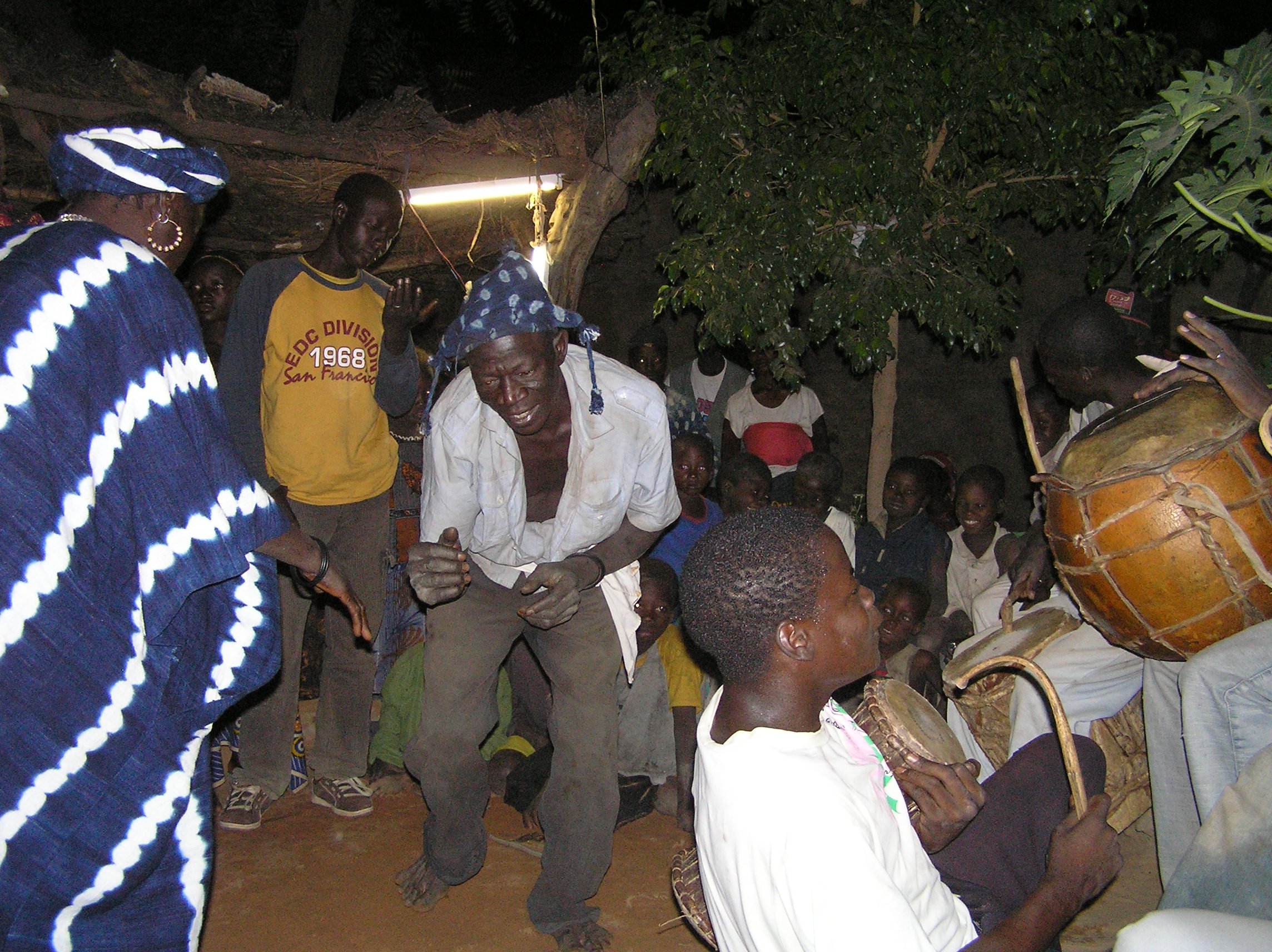
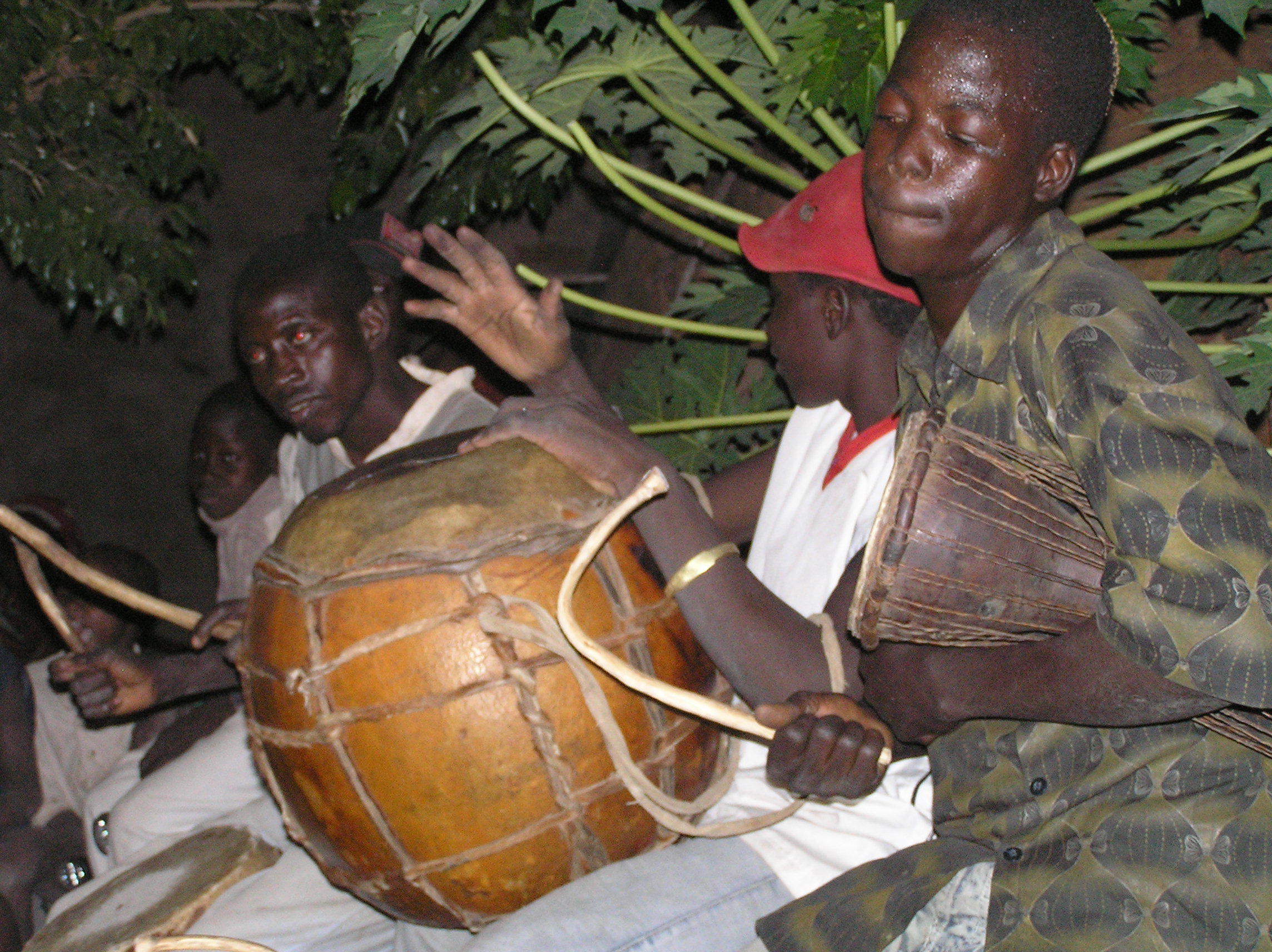
After a couple of impossibly large wooden bowls teeming with cooked rice had made the rounds a few of the kids sprinkled water on the sandy dancefloor and the musicians began to play. The women stood in a semi-circle facing the musicians and began a pulsating dance that would continue unabated for the rest of the evening.
From out of nowhere the dancers would begin chanting repeated phrases over the rhythms, often drawing a single woman to speak/sing a story between the collective vocalizations. Her lines would invariably be met with hearty agreements from the entire crowd as the dancers continued their hypnotic chanting. Somewhat reminiscent of a soulful Southern church service, the music was exclusively upbeat and extremely lively, and continually punctuated by solo dancers.
Somehow the sudden appearance of a solo dancer bounding and flailing into the middle of the circle seemed to surprise us tourists every time it happened, though every everyone else always seemed to see it coming. It was always a breathtaking sight, as one or just as often two women would rush the centre of the dancefloor with short fast steps, bent over double at the waist and blowing short repeated patterns on reed whistles that all the women constantly held between their front teeth. Just as quickly the music would explode in frantic impersonation, as the musicians would instantly start reacting to the rapid-fire movements of the soloist.
(In Mali musicians learn to follow dancers, while we in the Western world tend to look at it the other way around. So instead of “dancing to the music” in Mali they “music to the dance”. When a soloist enters the circle one of the drummers will start drumming along to their every move. Sometimes a dancer will have moves so animated that one drummer will concentrate on playing the soloist’s upper body movements while a different drummer altogether will take care of the lower body movements.)
Completing their maniacal dance the soloist(s) would make their way back to the perimeter, and just as I became lulled by the collective rhythms and gyrations of the group BAM! I would be jarred once again by the shrill whistling and explosive movements of another soloist, who would enter the fray and repeat the ritual in her own way. Occasionally a soloist would be jumping and flailing like the rest and it would only be when they turned to return to the semicircle that we would notice the baby strapped to her back, its eyes bugging and head bobbing as if in the throes of cultural whiplash.
Several times over the course of the evening a musician threw his drum at a soloist in exasperation. My African drummer teacher back in university had told me about this. It was the drummer’s way of telling the dancer that he was not skilled enough to keep up with her movements, and it was meant as a great compliment. Something that puzzled me was why the dancers would reach down and quickly tap the ground every time they finished their solos. I asked our guide about it the next day and he explained that because the Dogon people believe that God exists within all things (including the dirt beneath our feet) the dancers touched the earth as an apology for dancing upon it, a logical gesture for an animist to make.
My goodness, the entire evening was such an amazing thing to behold; it was all so vital.. It was the oldest music in the world decorated by the most primal human art form.
The millet swilled, the Frenchmen showed up, and the party raged on and on. All smiles and giggles, the ladies pulled each of us tourists up to dance with them one by one, and though I tried my hardest to mimic their moves I must say that m’lady won the prize for most natural African dancing. Eventually the town elder called Hama over and told him that that was it; we had gotten their women too drunk and he was shutting us down. But not before half the village managed to have a rockin’ good time on a Friday night (or whatever day it was in their five-day calendar)!

As people started filing out we were treated to an encore as the children jumped into the circle and mimicked the dancing of their mothers, all of them trying to make a reedy whistle sound by blowing through their teeth. I’d taped the entire party on my little cassette recorder and had to promise the crowd that soon grew around me struggling to hear themselves sing and dance that I would mail them a copy of the tape.
I had been dreaming of visiting Mali for almost twenty years, and one of the main things I’d hoped to do if I ever got there was be a fly on the wall at a real village dancing and singing party, and there it was. This was not like the show we had witnessed earlier in the morning, as great as that had been. Though this party was primarily funded by tourists, it was an actual party; this was what people really did and how they really acted when they got a chance to cut loose;. It was real. And I hd been in complete bliss the whole time. I went to bed with a big fat drunken smile stuck hard on my face.
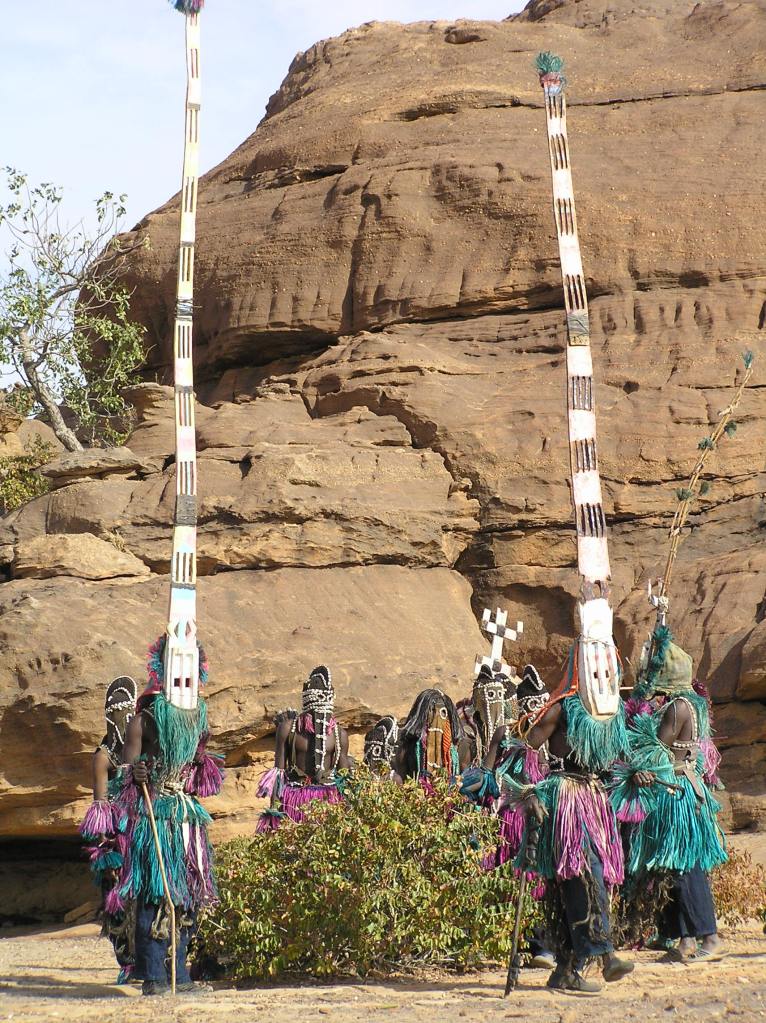
The smile stayed for at least three or four hours before being suddenly replaced with a shocking, striking grimace in the middle of the night.
*So lessee now…that’s 6,000 West African CFA francs minus 2,000 francs…at an exchange rate of a thousand francs to about $2.35 Canadian…so if you carry the nine…and multiply by what, was it four?…and add a couple more just to be on the safe side…then round up…or was it down?
…and it looks like hosting this party cost us less than ten bucks each, Canadian. Not too shabby.
112208 The Great Fall

Having consumed countless bowls of millet beer enjoying the party of a lifetime I woke up in the middle of the night with a bladder ready to burst. Half-asleep and still three-quarters drunk, I was in such a panic to relieve myself that I didn’t take time to put on my sandals and I rushed to the toilet in my bare feet. Traveller tip: this is always a bad idea, but given the Turkish prison-esque anti-sanitation of our compound’s toilet it was an appallingly poor decision. But really, I had no choice. I was in a hurry, man.
In the darkness I clambered down the labyrinth of steps that hugged the side wall of the mud building and hit the ground running. I hadn’t taken time to put on my glasses either so in addition to being half-asleep and three-quarters drunk I was also mostly blind as I made my way down a narrow fenced strip out of the compound and onto the village pathway.
Outside the gate I knew that the toilet was just a few metres to my left. I turned and suddenly slammed into the ground with a violent ferocity as if I’d be struck by lightning. BAM! Somehow I’d fallen facedown into the dirt with a lung-emptying thud and a pathetic moan. I laid there motionless for a second or two scanning my body for pain and wondering what the hell had just happened. I knew that I’d gone down really hard and I was pretty sure that I was injured, but the shock of the moment kept me from figuring just how badly I might have hurt myself.
After a moment of lying prone on the dark pathway the urgency of my mission enveloped my attention and forced me onto my feet. I limped to the 4’ x 4’ walled enclosure that served as a toilet and aimed my relief at the small hole that had been roughly dug into the centre of the square. I felt so good and so bad at the same time.
As I turned to hobble back to the compound I noticed with horror that I had left a circle of blood inside the filthy, horribly-contaminated toilet area. I stepped back onto the path and looked down at my feet. At first glance I thought that I had severed the big toe on my right foot, as it appeared to be oddly dangling. I sat down on a large rock that was embedded in the path and looked closer, squinting without my glasses and trying to peer through the drunken cobwebs that clouded my brain.
It seemed that I had tripped over the very rock that I was now sitting upon, blindly thrusting my bare foot down onto the rough edge of the stone and shearing the bottom off of my big toe in the process. What I had initially thought was a dangling digit was in fact a slab of skin the size and thickness of a loonie that was just barely clinging to the side of my toe. One of the toes on my other foot had gotten banged up pretty badly too, and the sole on that foot was bleeding quite a bit. Overall it wasn’t as bad as I’d thought but I was certain that if I had been sitting in front of a doctor I would definitely be getting several stitches. But I sure wasn’t sitting in front of no doctor.
Groaning, I stumbled back up to our resting place and fumbled around for my insignificant little first aid kit – more a giftshop novelty item than anything – and with a flashlight held between my teeth I tried my drunk and groggy best to clean and dress the hearty wounds with an antiseptic moist towelette, and a couple of Q-tips, a handful of antique Band-Aids.
I soon gave in and went back to bed. Despite my exhaustion I had some difficulty sleeping, partly because of the throbbing pain emanating from several sources and partly out of concern about my woefully inadequate meatball home-surgery work. But mostly I was worried that the only way out of the valley and back to the nearest road – a journey I was supposed to be making in a few short hours – seemed to be by foot.
When I got up in the morning I borrowed a much more comprehensive first aid kit from our fellow hikers Martha and David and made a second, more sober attempt at dressing my wounds. In the light of the day it was easy to see that I had missed plenty of nasty dirt and debris the night before. Though the torn skin had already started to rebind to my big toe I was forced to tear it off again in order to dislodge a couple of sizeable pebbles that had been left inside. When I had done as good of a job as I was able I bandaged everything up tight enough to stem any residual bleeding and took a few tentative steps to test my handiwork. Not bad, if I do say so myself. I was still rather concerned about a five-kilometre trek and how I would make out trying to get back up that cliff, but at least I could walk.
After breakfast I enquired about buying a cane and was directly basically next door, where an impossibly old man opened an impossibly small shop chock-full of wooden masks, trinkets, and intricately carved walking sticks. I picked out a sturdy cane adorned with rough carvings and haggled the proprietor to throw in a naively charming wooden alligator statue that I adore. M’lady bought herself a pair of brass figurines that I thought ugly at the time but have since come to admire.
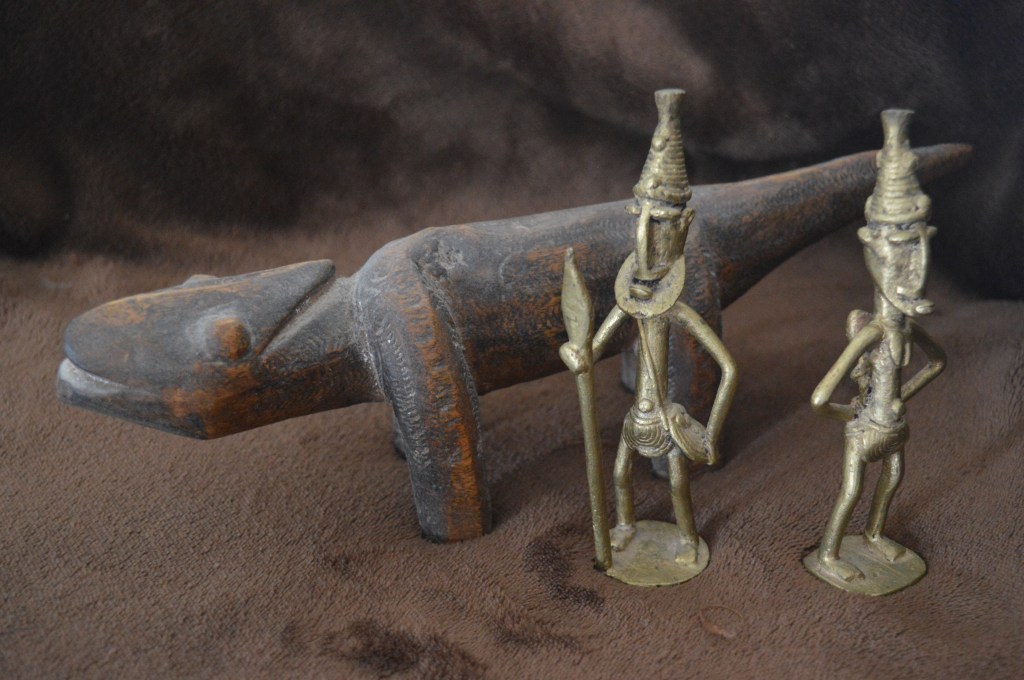
Armed and ready, we four and our guide Hama bid farewell to our final (and most fun) compound of the trek and began our walk out of the Dogon Valley. At first I was in significant pain but once I got accustomed to the cane my pegleg gait and the dregs of my self-medicinal envelopes came together and allowed me a somewhat sprightly step. Eventually my pains turned numb and I did an okay job of keeping up with my fellow hikers (though I suspect everyone was secretly taking it pretty slow). When we arrived at the crevasse for the final climb out of the valley I even led the pack, though again I suspect this was a gesture intended to help save my dignity and keep me from falling too far behind.
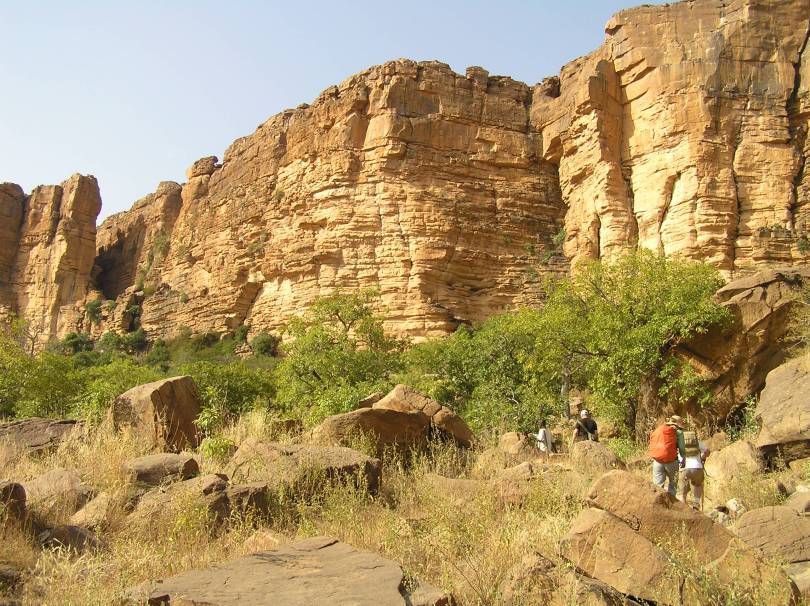
Early in the hike we came upon a group of women who were returning from doing chores. When they saw us they all broke out in dance moves from the previous night, rhythmically blowing air between their teeth mimicking their reed whistles. Clearly these ladies had been at the party! They thanked us and made it clear that they’d had a very good time and we reciprocated in kind.
A little farther on we passed two older women that were hard at work pounding millet. They said something to our guide who in turn asked if we had any aspirin we could spare, as the ladies had headaches. I ponied up some Advils to each of them while our PEI companions did much more, giving their flashlight to one of the women and their very nice Swiss Army knife to the other. And while these were certainly all very worthwhile gifts, I think I can truthfully say that the pocket knife might be a real life-changer. I mean, some of these people have nothing. Our guide later told us that both of the ladies were childless, which meant they had an even more difficult life than most. It is unquestionably a climate where the impulse to give people things, anything, is compelling. British Steve had given his hiking boots to Hama before he’d departed from our group the previous day.
In the end, even hobbled with injury I was able to appreciate our final hike in the Dogon Valley as a beautiful and transcendent stroll through some of the most beautiful scenery in the world. When we reached our final village we enjoyed some lunch and were eventually ushered into a car that would deliver us back to Mopti.
On our way out of the village we found the road blocked by a truck that had gone half off the road and become buried in mud. The other half of the road was block with the truck’s spilled cargo and the winch that was trying to extract the truck. And so everyone was left to employ some good old African patience, which lasted about an hour.
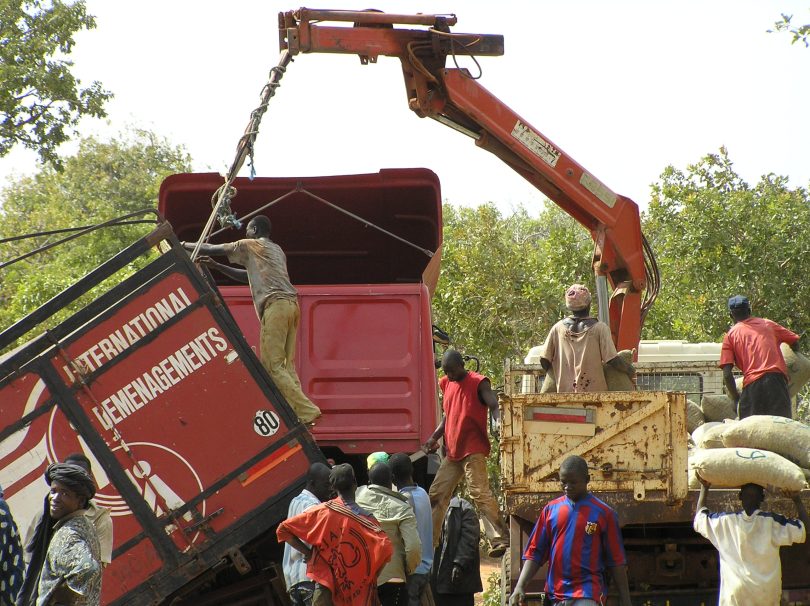
Finally people tired of waiting and took it upon themselves to begin loading the sacks of fallen rice onto the winch truck, which eventually pulled ahead and allowed the pent up traffic to squeeze through. I couldn’t imagine how they were going to get that truck out of the mud, but Hama assured me that they’d just keep bringing bigger winches until they got it out.
We stopped in Bandiagara for some roadside beers which helped me to drowse most of the way to Sévaré, sleepily relishing the hot air that rushed through the windows of the moving car. In Sévaré we said goodbye to our PEI friends and bade final farewell to our guide – who by this time was probably very sick of my MCHammer “Hama-time” joke – and continued on to the Ya Pas De Probleme hotel in Mopti. M’lady went for a swim in the hotel’s small pool while I showered and properly cleaned and dressed my wounds for the first time. I found a pebble the size of a child’s tooth wedged into the sole of my right foot and managed to get it out, which really helped to alleviate my limp. And then the ultimate luxury: I sent our clothes out to be washed. This would be our first time laundering clothes so far this trip, and I’d only brought three t-shirts with me!
Feeling downright human, we spent the rest of the afternoon into the early evening exploring Mopti, which perhaps wasn’t the best thing for my foot. The city is known as the Venice of Africa but aside from straddling a wide river rife with small, slender boats I couldn’t see the resemblance. Nice enough city, don’t get me wrong, but it’s not Venice.
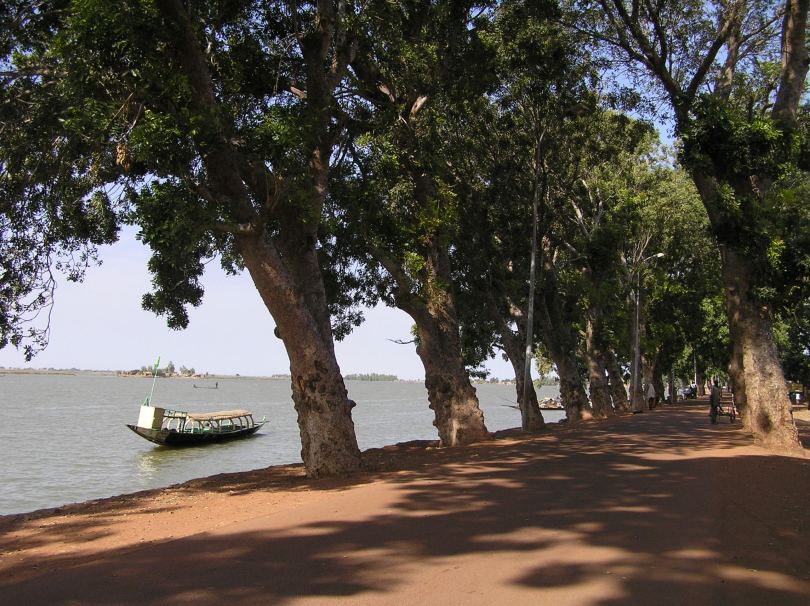
On a tip from one of the hotel employees we took a taxi to Sévaré later in the evening and caught a really good band at an even better restaurant. The food was simply to die for (especially after the couscous cavalcade that was the Dogon culinary norm) and the music was amazing. The star of the band was a fantastic djembe player who spent most of the show soloing while the other percussionist held down the beat with just a bass drum and a tambourine. They were backed up by a really solid bass player and a fantastic guitarist who laid down impeccable looping rhythmic grooves, and all of it underneath a singer who weaved his vocals into the music in the most disconnected and surprising ways. Gawd, the music was so good that it left me breathless. The band was obviously having a good time too, and the crowd that eventually grew to standing room only was clearly enjoying the show just as much as I was.
Curiously, the guitar player never once tuned his ever-stretching guitar strings, playing delicious sinewy lines that were so absurdly out of tune I could hardly believe how good it all sounded. I’m telling you, if he had tuned his guitar it wouldn’t have sounded any better; it couldn’t have sounded any better. The secret?
Nobody played a chord all night; not one. So instead of focussing on harmonies that the local climate and primitive instrumentation would invariably force out of tune, the music relied strictly on monophonic lines, which cut down on the cringability of the guitar to the point where there was no cringe at all. I’d never heard of ensemble music that worked without any sort of tuning, but it reminded me of the Tuareg ngoni, that untunable three-stringed instrument that I’d encountered during my jam session in Timbuktu.
Fatigue prevented m’lady and I from staying until the very end of the show, although my hardline wheeling and dealing for a taxi back to Mopti left us standing on the side of the road with few options until well past midnight anyway. I finally haggled a ride the ten or so kilometres back to Mopti in a “taxi” that might have once been a Peugeot and had a top speed of no more than 30kph, and that was only after the thing really got going. I mean this was the poorest excuse for a car I’ve ever been in that moved. There were no handles or knobs left anywhere on the interior – hell, most of the interior was missing from the interior – and anything that could open was held shut with baling wire. The thing travelled down the road at an angle that was almost sideways. It had a shimmy so severe that I lost five pounds on the drive home. The vehicle was so bad that we got out several blocks before we reached our hotel, opting instead to walk ourselves through a dark field littered with rubble, rocks, and roustabouts because we figured there was no way the car was going to make it the rest of the way. I doubt the car was sound enough to have made it back to Sévaré after it dropped us off. Regardless, I’m confident that the 3,000 we gave the guy for the ride could easily buy him twice the car.
But we had made it. Entering our hotel room we fell into bed sweetly anticipating our first alarmless sleep-in for what seemed like forever.

112308 Music, Music, Music, Music!
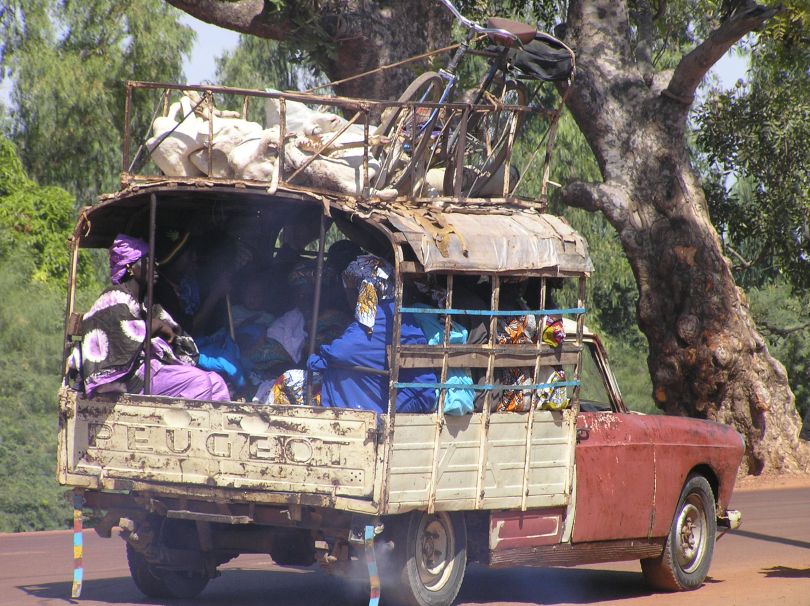
M’lady and I awoke in our hostel-like Mopti hotel to find our first batch of clean laundry waiting outside our door. Well, to be frank I’m not sure any actual soap had been involved but the clothes had clearly endured a heavy riverside beating so they were clean-ish at least, and that was way better than the Saharan sweat-drenched Dogon-dusty camel-smelling dirty laundry we had dropped off the day before!
In the bathroom I peeled the bandages from my feet and liberally doused my wounds with rubbing alcohol that was purchased during yesterday’s walkabout. The burst of pain that hit my brain when the alcohol seeped into the gash on my big toe was just inches short of unbearable; I had to slam both my hands hard over my mouth to muffle the screams. Fortunately the shock subsided quickly. I’m confident the alcohol did a lot to further my healing process (as it almost always does), a process which seemed to be going rather well already. It’s pretty amazing how resilient these bodies of ours can be!
After a shower I redressed my injuries and donned my freshly beaten clothes, which left me feeling more refreshed than I had since we’d arrived in Mali. i spent the next hour deseeding my airmail envelopes and tubing everything up. The man who had delivered the goods had told us that Ya Pas De Probleme hotel was truly pas de probleme for such endeavours and rigorous in-room testing proved the theory correct.
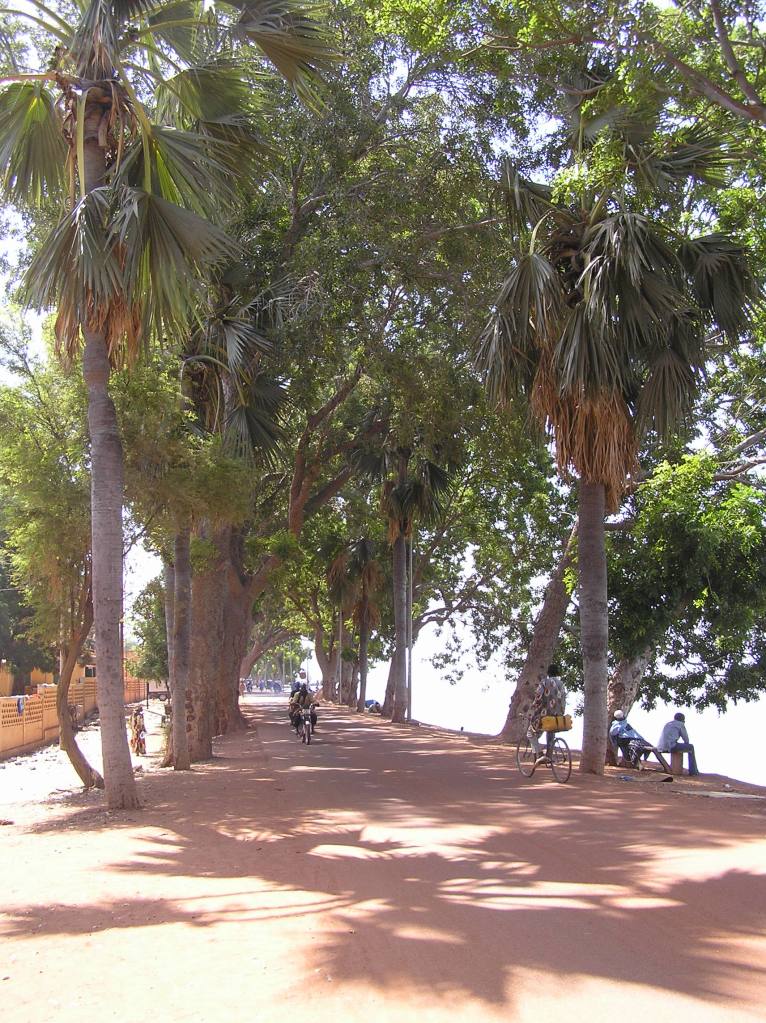
We decided to go out for a walk and were forced to ponder once again why Mopti was nicknamed “the Venice of Mali.” Sure, there is a river that hugs the edge of the city, but I must say that is where the similarities end.
We wandered through the market though our only purchase was some faux Pringles to take care of my sorely needed chip fix. Back at the hotel I lounged by the pool with my chips and a few beers – bouncing back to the room now and then for a scattered draw – while m’lady alternated between reading and swimming. My still-sensitive and occasionally-bleeding pedal injuries kept me out of the water.
I popped open my Alphasmart portable word processor and, after having typed countless freshly experienced words during our five-day exploration through Dogon country, the machine displayed a mysterious message about checking RAM files before inexplicably deleting everything in its memory. Oh dear. A similar thing had happened when I was in St. Petersburg a couple of years before and when I got home the Alphasmart support dudes had helped me retrieve everything, so I wasn’t as concerned as I should have been. Unfortunately all was indeed permanently lost and the Alphasmart would later end up in the e-trash.
Stupid technology.
This being our second visit to Mopti, and indeed our second time staying at Ya Pas De Probleme hotel, by this time we’d figured out that while our hotel’s rooftop terrace restaurant was nice, clean, and comfortable it had the worst and most expensive food in town. So we had been avoiding eating there until this evening, when we heard live music wafting down from the terrace. Heading upstairs with a shrug we quickly maneuvered the front table and gaped in joyous wonder as a fantastic band played super-upbeat African dance music for tips from the restaurant patrons.
The group featured a stunning musician playing an African xylophone (called a balafon) plus the only in-tune guitarist I’d seen in Mali thus far. These two played over the drumming of a djembe player who kept his rhythms steady, leaving the solos to the others. There was also a female vocalist who divided her time between singing and tending to her baby, who for the most part slept beside her on stage.
The band sounded more “pop” than any of the others I’ve heard in the country, and the wonderful guitar player even approached harmonic playing with the occasional arpeggio left hanging in the air. But it was the balafon player who was the unquestionable star of the group, wailing out machine-gun melodies that sat in perfect disconnection on top of the rhythm. The sole African in the audience spent most of her time on the dancefloor, with a smattering of tourists occasionally getting up to join her. Indeed, while the whole audience ate it up, it seemed like it was the employees who enjoyed the music the most, stopping to watch whenever they could and often singing along.
We stayed until the music was done and then some, languishing over our final round of beers before heading back downstairs and turning in. This was to be our last night in Mopti and we rested well, happy that we had found good live music for a fourth consecutive night.
112408 Collectif Soul
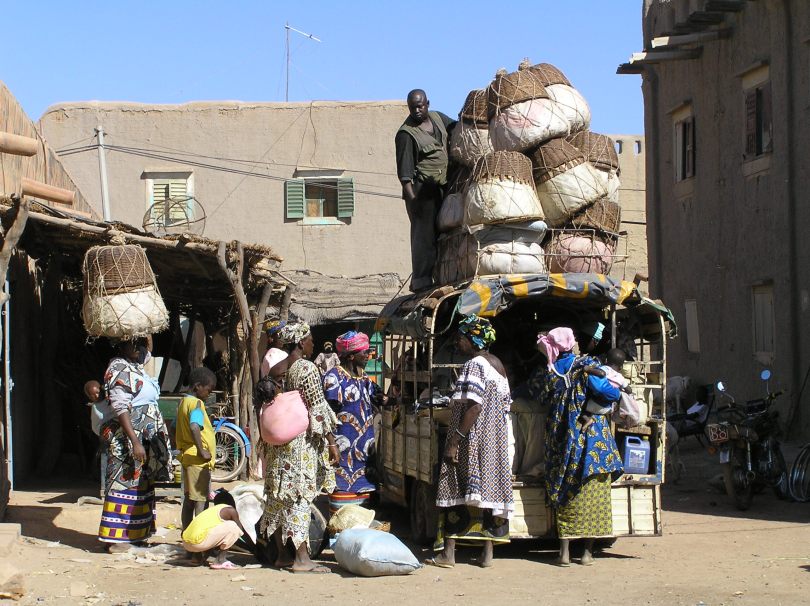
We both enjoyed a nice relaxing sleep during our final night in Mopti, waking up at our leisure without the sounding of any alarm – natural or otherwise – which is always a joy. I took a shower and redressed my healing wounds, spun our final few stems of subtle illicity and packed up. So it was with a relatively late start that we checked out of Ya Pas De Probleme hotel and set off to get ourselves to Djenné. There is no direct bus service so we dragged our growing pile of stuff to the collectif depot and laid out 5000 CFA’s for two seats in the next car heading our way. The collectifs don’t leave on a time schedule, they simply wait until every seat in the vehicle is sold. In this case the magic number was nine, and so far m’lady and I made four. And so we waited.
They actually had a waiting area and I found it fascinating to sit there and watch Malian city life play itself out. (Good thing too, ‘cuz we sat there for a long time.) Local people seemed to use the waiting area as a gathering place. All the seats remained full as the locals circulated in and out of the waiting area, most of them focussed on the blinking television set attached to the back wall while others sauntered through trying to hawk an astounding array of items from baskets that they carried perched on their heads. When a television program called Fils De Dragon with David Carradine came on the place absolutely filled up, and oh how the crowd jabbered back and forth the during commercial breaks!
A boy with a tray of peanuts, a man with an armload of turbans, a lady balancing impossibly large trays of sunglasses, a man walking around selling “fast food” in the form of meat chunks cut between his bare fingers topped with onion and served on torn bits of newspaper, people wearing enormous piles of toys on their head, with stuffed animals dangling comically from huge sombreros packed full of dollar store squirt-guns and Barbie™ knock-off Blandness Girl dolls. Many of the women merchants were adorned with traditional black tattooing on the alms of their hands, the soles of their feet, and in a circle around their mouths. I joined a small crowd who were noisily watching a fierce foosball match and witnessed an innocuous fight between an older man and a younger one, who ran away and quickly disappeared in the crowd.
Oh the action! Oh the dramas! And all this just while waiting for our collectif to fill up.
Hours went by and still we sat and waited. It was truly a fascinating experience, but we were also quite anxious to get to Djenné’s famous Monday market before it shut down at 6pm, so when the passenger count stalled with just one more to go we broke down and paid an extra 2,500 for the final seat. This way we were able to leave immediately, and with only eight passengers.
Our ride was an incredibly beat-up Peugeot, and while it wasn’t the roughest car we’d experienced in Mali, I’m quite convinced that it wouldn’t have passed even the most lax of inspections. There were no door or window handles on the inside and not a single one of the dashboard indicators worked. But the eight of us and our driver squeezed ourselves and our luggage into that ailing midsize automobile in and set off together for Djenné, two-and-a-half hours plus a ferry ride away.
The journey may have been a bit roomier with one less passenger but trust me: it wasn’t at all “roomy”.
Our strategy worked, with the car dropping us in the middle of the Djenné market around 4pm,. However, without a hotel booking on the busiest night in town our first priority was to secure a place to stay. M’lady went off a-looking for a-booking while I stayed put and watched our bags. She initially returned empty-handed but on her second swing through the area she ran into a guide that we had met in the Dogon Valley named Alex and enlisted his help.
We had initially planned on a little splurge for our time in Djenné, with a stay at what we’d heard was a classy place called Hotel Djenné-Djenno. But when we tried to prebook a room we were told the place was full. However, Alex enquired with the place on our behalf and convinced the owner to take a chance (rightly, it turned out) that one of her late arrivals wasn’t going to show. She offered us the room so after thanking Alex up down and sideways he flagged down a couple of motorcycle taxis for us and we raced over there to check in.
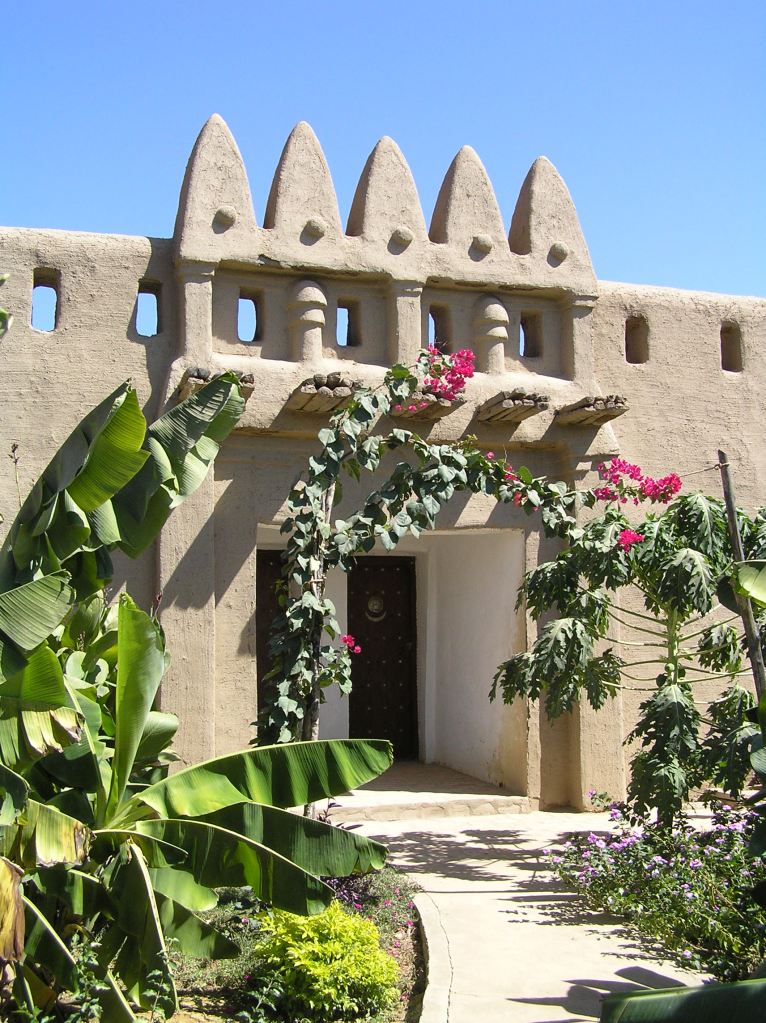
The Djenné-Djenno was like an oasis. It was a fairly large place and just like the mosque that lies at the centre of the city, it is made out of mud. Walking inside the hotel’s old-style compound one is met with lush banana trees and a lounging courtyard that was literally crawling with large, meditative lizards. We were shown to our very lovely whitewashed room complete with a contoured mud ceiling, animal horns built into the walls for hanging our clothes on, and – for the first time on this trip – our very own private bathroom, outfitted with a hot shower no less! M’lady flopped down on the bed and marvelled in a state of bliss while I burned a pinner and we soon headed back to town so we could go through the market before it ended.
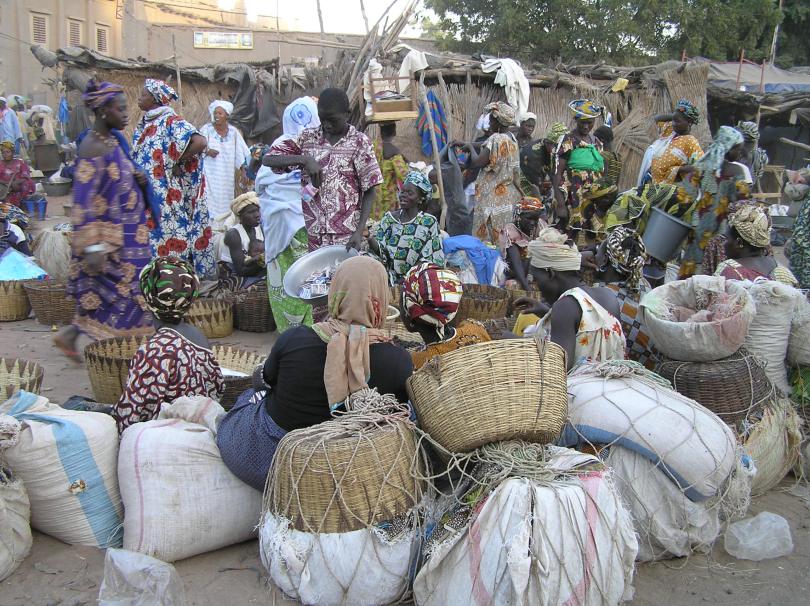
The market sets up every week in front of the Great Mosque of Djenné, a truly grand site/sight which has the distinction of being the world’s largest mud building. Measuring seventy-five metres by eighty-five metres with walls two feet thick and a peak height of eighteen-and-a-half metres, the building is quite something to behold from the outside, which was the only view that we, as non-Muslims, were allowed*.

Though the road to town had been overcome with the dust of so many merchants already on their way home, when we finally got to the market it was still extremely colourful and lively and an absolute feat for the senses. A veritable sea of micro-capitalistic mayhem, it seemed like anything that one could purchase in the country could be purchased at one of the market’s countless stands. With my Alphasmart word processor down for the count I bought myself a notebook in which to keep my memories fresh, but that proved to be our only purchase. Not long after we arrived the market began to completely shut down so we went for a sunset walk around the city.
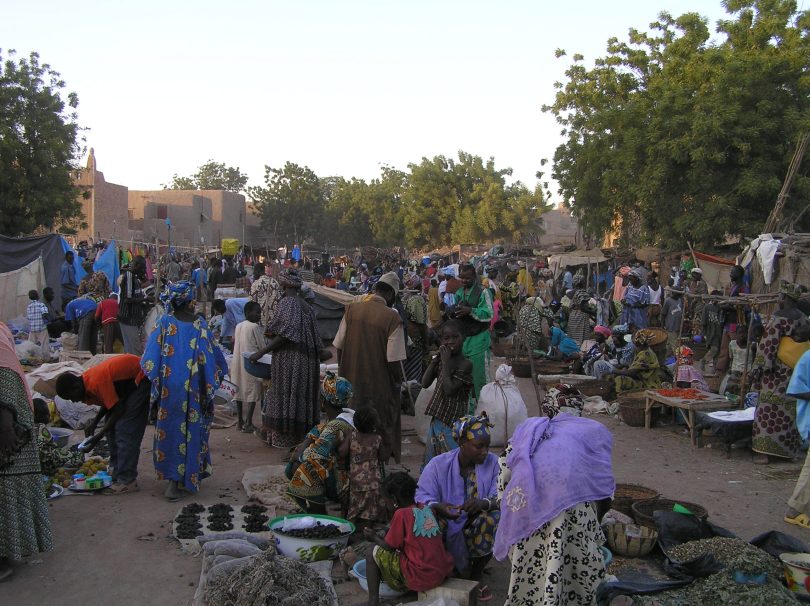
We ended up at Chez Babas, a bar/restaurant we’d heard would be hosting live music that evening. After not eating all day my meal of boiled potatoes alongside two chewy chunks of meat was a big letdown. M’lady chose more wisely and seemed to enjoy her chicken, and when she threw in the towel I ravenously devoured her remaining potatoes, cold as they were.
At 7:30 the band – which consisted of two djembe players and a bass drummer – arrived and started to play. The steady repeated rhythms underlying impossibly counter-rhythmic soloing was reminiscent of the beloved drumming classes I had taken at university from Malian master musician Yaya Diallo, so in addition to being wonderful and soul-affirming the music also held a bit of a nostalgic twinge for me, and I loved it. Occasionally one of the locals got up to dance, and eventually an entire group of young women arrived and took over the dancefloor. They acted like flirty schoolgirls, sticking out their butts and shaking them for all they were worth towards the stage. The musicians in turn reacted to every wiggle, drumming in time to each bounce and trying their best to literally play the girls’ asses off.
Exhausted and maybe a little drunk, about an hour-and-a-half into the show m’lady paid our tab and left, though the music (and dancing) was still going strong. We lumbered along the streets for a kilometre or two until we finally made it back to our oasis, where we immediately flopped onto the comfortable bed and went to sleep.
That’s makes what, five nights of live music in a row?
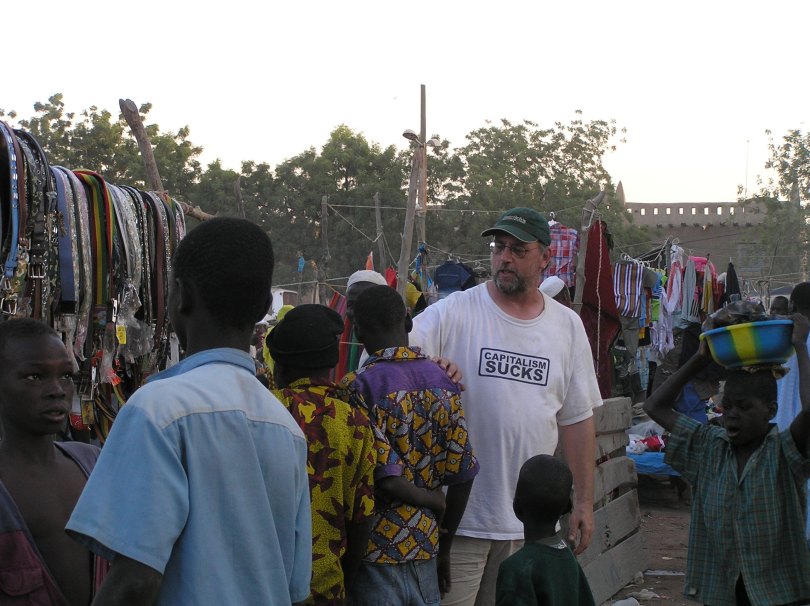
*Which makes it rather strange that the grounds and indeed even the inside of the Great Mosque can be explored using google street view. Perhaps even more incredible is that the grounds (and indeed even the inside) of the Great Mosque of Djenné seems to be the only place in all of Mali that can be explored via google street view. How can that be?
112508 Dit Weah and Djenné-Djenno
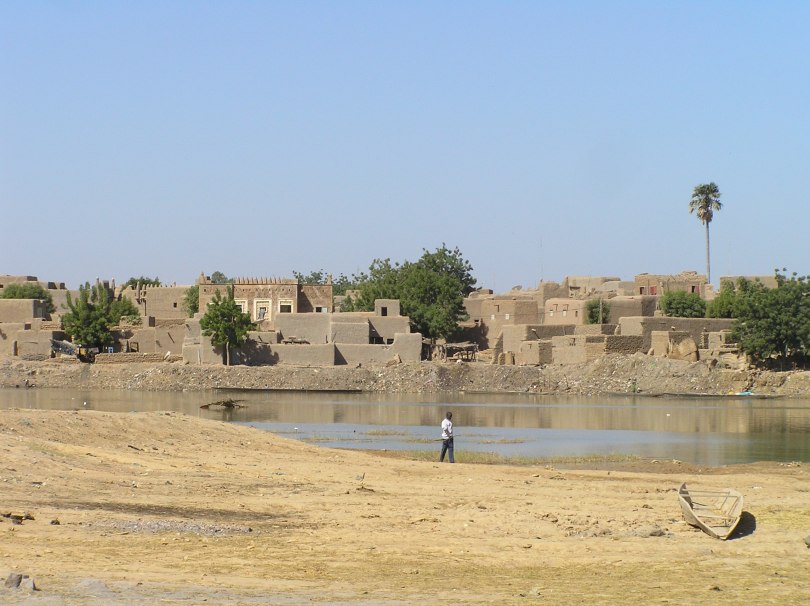
M’lady and I woke up nice and early in our sandy oasis at the Hotel Djenné-Djenno. We were basking in the luxury of a comfortable bed in a well-appointed room and – pardon me if I go on too much about it – most especially our private bathroom.
Just when we thought it couldn’t get any better, we emerged from our room and found a breakfast table elegantly set for us in the beautiful and serene courtyard. We sat down and were immediately served a small marvellous breakfast that included warm, freshly baked bread, butter (a first for us on this trip), peanut butter (another first), and real coffee served in a bodum (you guessed it, another first). As we sipped on our morning brews the European woman who owns the hotel stopped by our table and engaged us in a lovely chat.
After breakfast m’lady relaxed in the room while I hunkered down and furiously wrote a Coles Notes version of everything I could remember from the trip so far into my new notebook. By late morning we tired of laying around so we embarked on a small excursion, walking a kilometre or two to the Djenné-Djenno museum where we learned about a very important archaeological site that had been discovered nearby. We checked out the exhibits and hired a very informative guide who walked us to the Djenné-Djenno site.
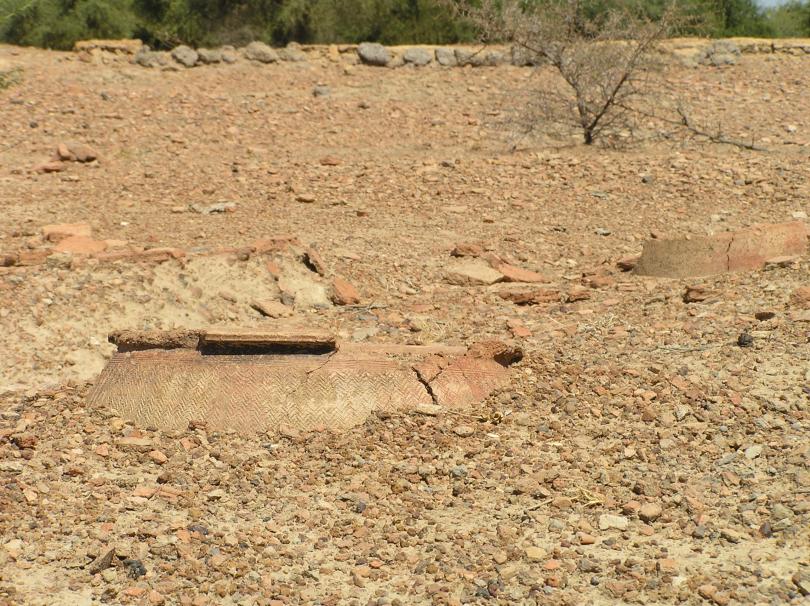
In the 1970’s a pair of western archeologists made a dig on this spot just outside of Djenné and discovered what carbon dating proved was the oldest known settlement in West Africa, countering the then-accepted theory that Arab nomads had first settled the area.
As we walked over the flat, hard-packed fields towards the site I wondered how anyone could have thought to dig in this specific area. Soon the answer was underfoot. To stroll around the Djenné-Djenno site requires one to be constantly trodding upon and around thousands upon thousands of pot shards. I mean they were everywhere, hand-decorated pieces sometimes bigger than your face, just sitting there on the ground, or just as often embedded in the dense earth. Most of these pieces of pottery were about 4,000 years old, and here I was utterly unable to avoid crunching them under my feet with every step.
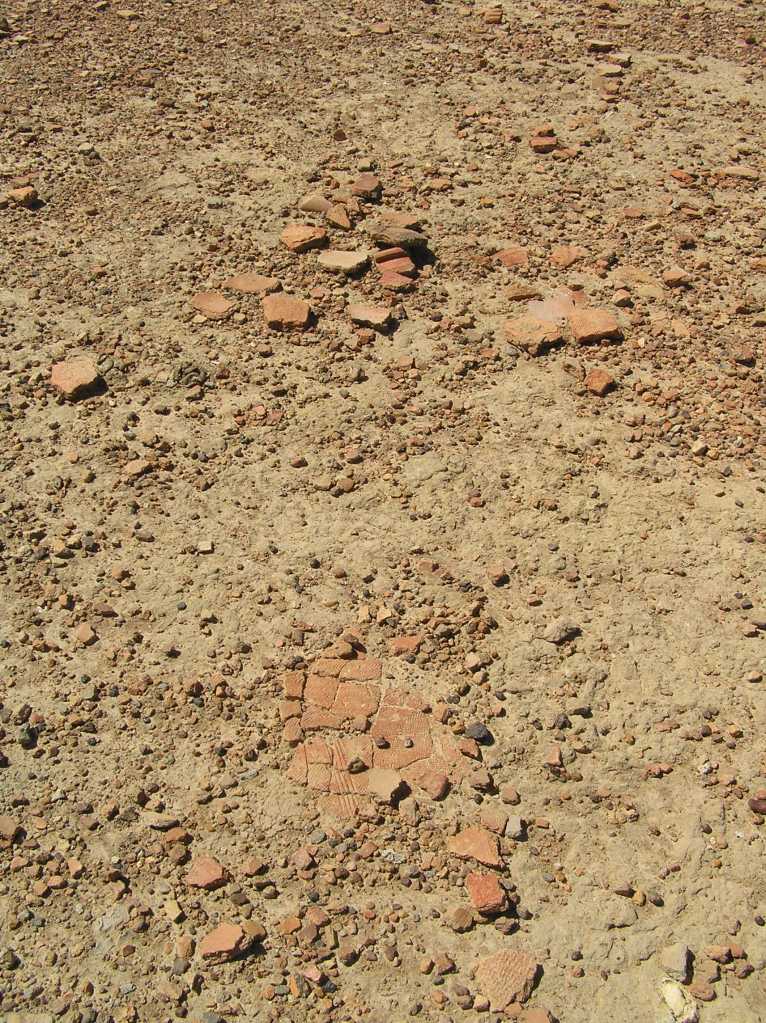
Our guide showed us the original city walls which were several feet thick, along with the remains of a number of dwellings. There were several large clay pots seemingly intact, though they remained buried with just the top few inches sticking up from the dirt. Most of these were coffins, as it was the custom of the people to fold their dead into the fetal position and place them inside clay pots facing west, towards their final sunset. The burial pots were cast with a hole in the bottom that allowed a means of escape for the interred soul as well as a spigot to bleed out the rotting yuckiness of decomposition. One of the pots we saw had bones scattered on top of it which, according to the guide, had been dug up by animals.
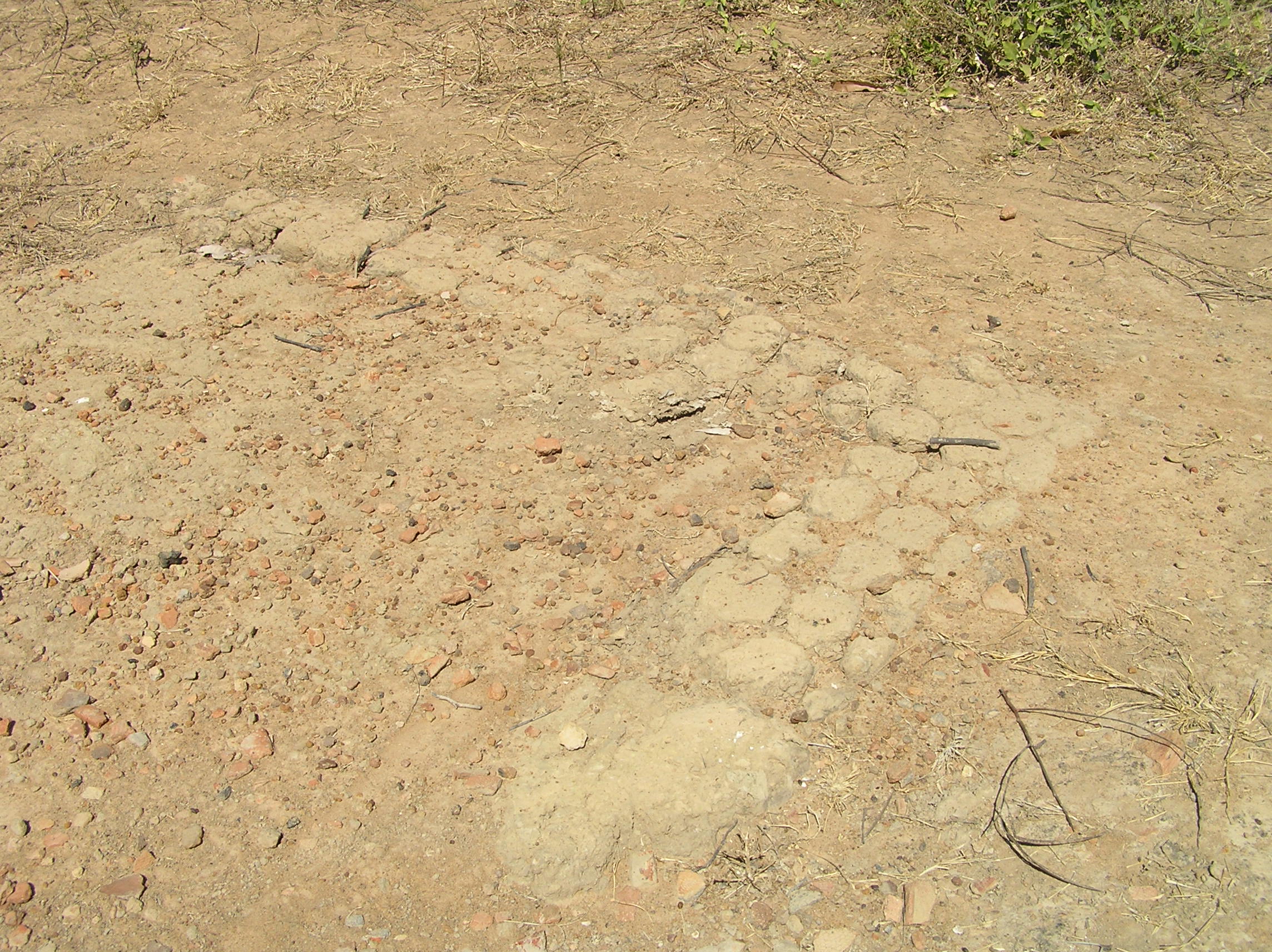
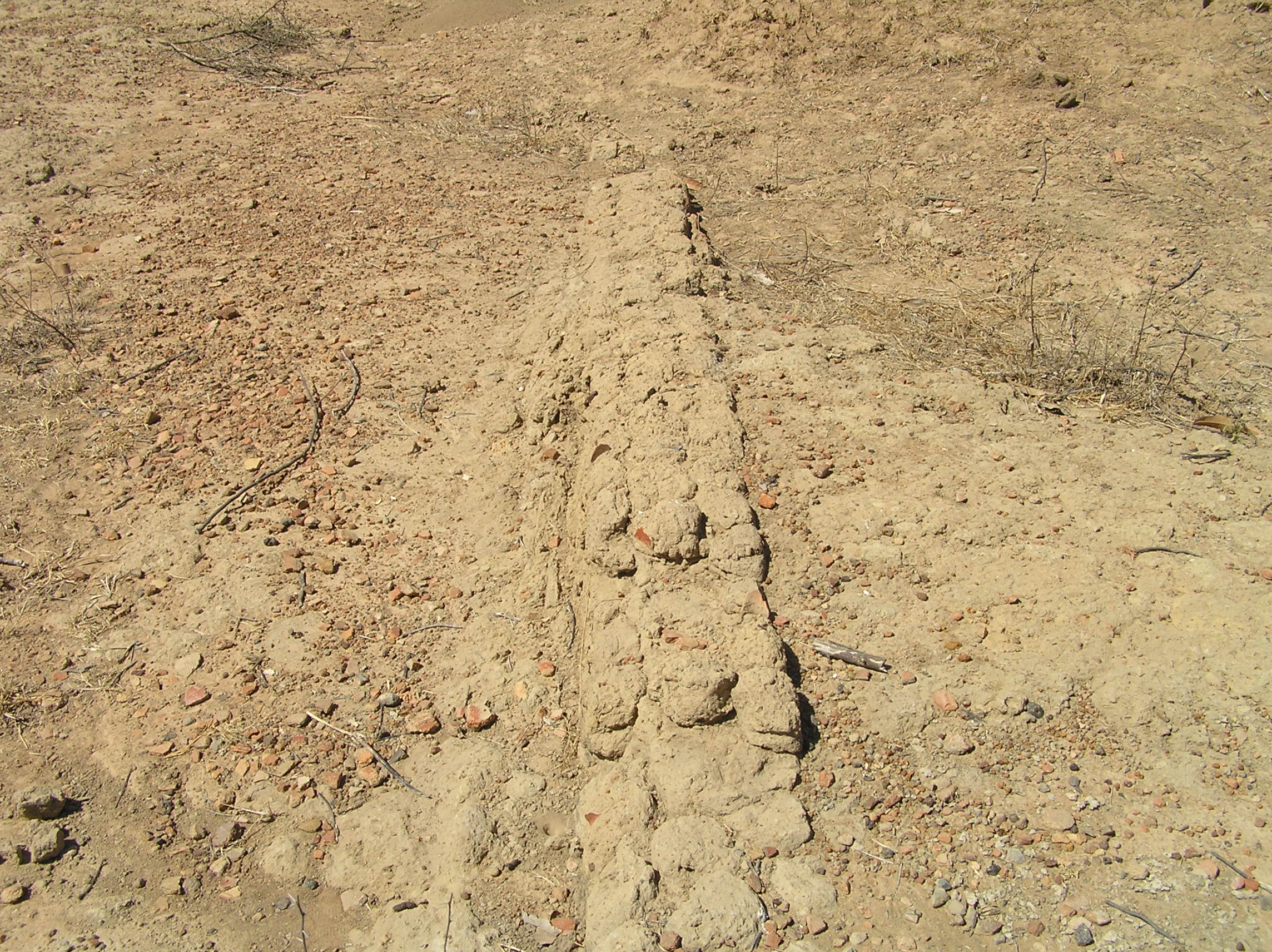
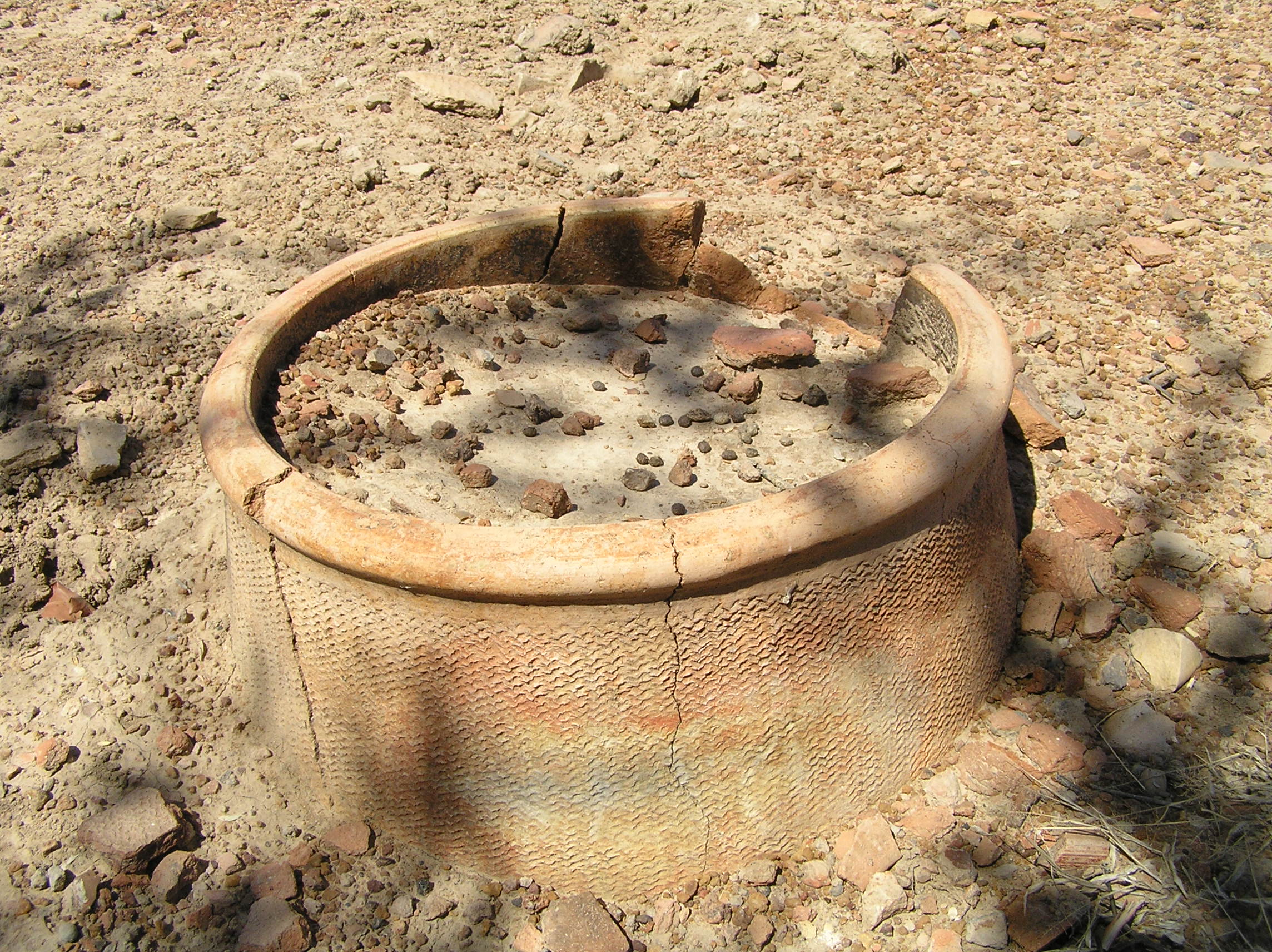
Our tour lasted throughout the sunbaked lunch hour so we were already very hot by the time we started our walk back towards town. Our hotel was along the way so we decided to stop in to chill out until the sun had arced a bit. When we opened our door we were shocked to see that a maid had been in to make up the room. Even at a classy hotel like the Djenné-Djenno I hadn’t dreamed that someone would make up the room. If I had then I certainly would have tidied up a bit before we’d gone out.
When I saw the tightly made bed with fluffed pillows my eyes quickly darted to a desk against the wall where I had spun the absolute end of our airmail bounty into two final gigglesticks, which I left sitting amongst the clutter. Not only had the clutter been uncluttered into a pair of very neat piles, but my two medium coners were lined up pretty-as-you-please in the little clay ashtray, the papers and lighter arranged beside it just so. The sight gave me a quick jolt of paranoia though I wasn’t too worried, reasoning that if there was going to be any trouble then it would have been waiting for me already. But I wasn’t carefree about it either; I’m sure Malian hoosegow would be an interesting experience but I suspect it would eventually grow rather tiresome.
Though we both agreed all was probably quite well I figured it would play best to bail on my plan of saving one for sunset and the last for tomorrow’s sunrise and instead eliminate all the potential evidence straightaway. So it was that I burned my final offerings during our solitary afternoon stroll into the city centre.
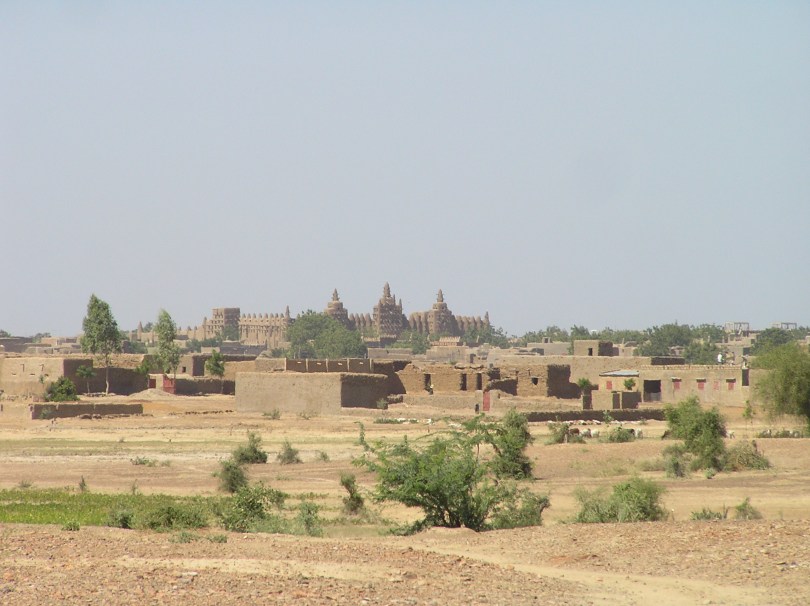
In town we wandered around and checked out the astounding Great Mosque of Djenné once again. We ducked into a restaurant but decided on just a Coke between us, went to a bank and changed a handful of euros into a larger handful of CFAs, we circled past the Post Office several times only to find it closed, closed and closed, and finally we walked back to the hotel.
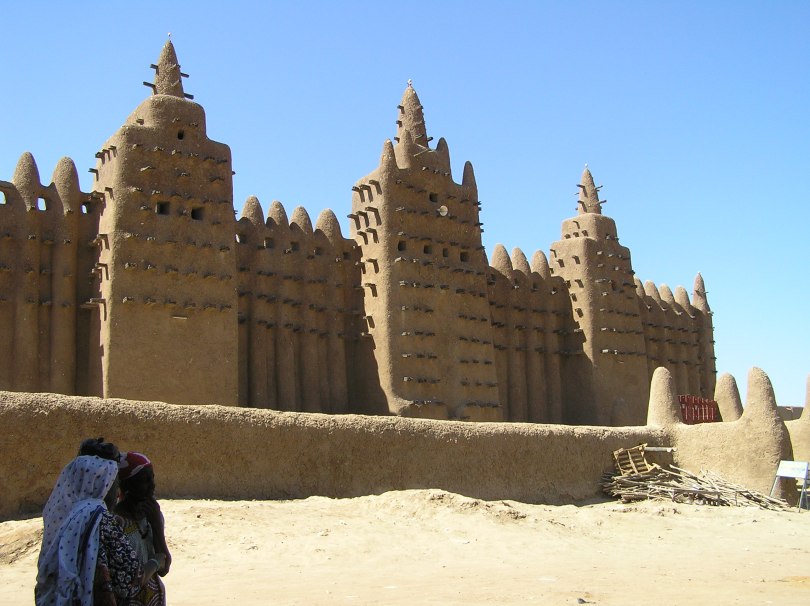
Before embarking on this trip I had asked my boss at the Ottawa Folklore Centre if he might have an old guitar kicking around that he could let me bring to Africa instead of one of my own higher-end instruments. I was concerned about the havoc a harsh desert climate might wreak upon a guitar, not to mention the jostling of countless flights and bus trips. When I suggested that I could donate the instrument to a needy musician at the end of my trip Arthur got up and went to the rental closet . He returned with a smile on his face and a ply-top Segovia acoustic guitar in his hand. “Have a good trip, Todd.” Good man, that Arthur McGregor.
Well, we were now nearing the end of the trip so I had to find myself a needy musician, which I assumed wouldn’t be a difficult task. And it wasn’t.
Over breakfast I had spoken to the owner about the guitar. She told me that they had a guitar there at the hotel and there was a man who sometimes did welding work for the hotel, and he often came by to borrow the guitar and practice. After long days at work he’d ride his scooter to the hotel and sit on the roof for hours, teaching himself how to play popular songs and even writing some of his own. I asked if she would call the fellow – whose name was Dit Weah – and ask him to come over. She did, and he showed up at 6pm.
We took both guitars up to the rooftop and played together for an hour or more as the sun set beautifully into the dusty horizon. Most of the time was spent with him showing me how to play local music, which was awesome. Everything he showed me was monophonic, with not a single chord to be found, just like nearly all the guitar playing I’d seen in Mali. With Dit Weah’s help I discovered one of the keys (pardon the pun) to Malian blues guitar great Ali Farke Touré’s signature sound. It seems he uses E pentatonic minor to solo over songs in the key of A, so relative to the home key he plays R, 2, 4, 5, b7, which totally makes sense. Given that there is no 3rd degree to identify the quality of the key (whether major or minor) the result is a vague tonality, which makes it immensely versatile. Empty and mysterious, like the desert.
Dit Weah was a pretty solid player and we had a good jam. I’d assumed that the owner had told him that I was going to give him the guitar but it seemed that I was wrong. When we were done playing m’lady took a couple of pictures of us with the guitar for the OFC newsletter, but when I tried to hand him all of my picks along with an extra set of strings Dit looked baffled. When I made it clear that the guitar was a gift the man actually screamed. I swear, he could not possibly have been any happier. He thanked me and thanked me, pumping my hand with both of his with a handshake that would make Kreskin blush, a look of wonder and amazement pouring from his eyes.
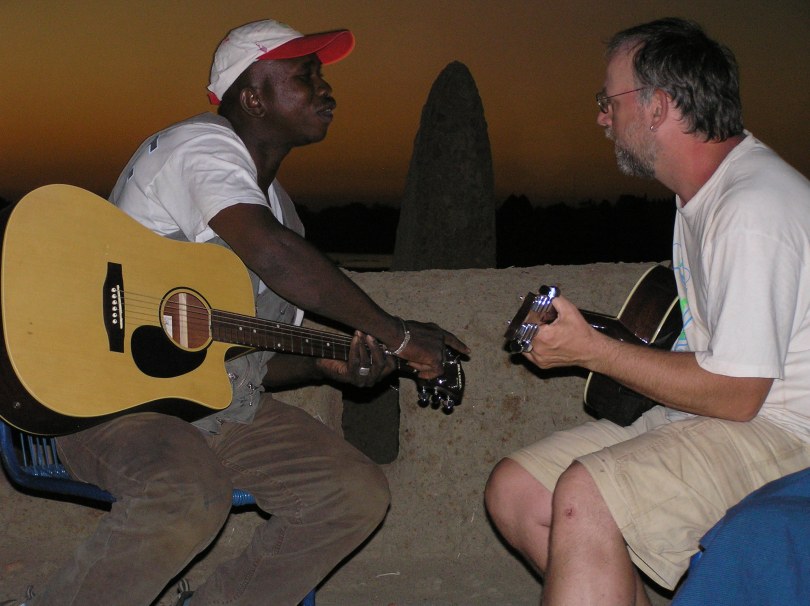
M’lady and I left Weah alone with his new instrument and went downstairs to the courtyard. Though it was already abundantly clear that the guitar had gone to the right person the surety only grew as we heard him playing on and on up there on the roof. When he finally came down he thanked me loudly and profusely once again, promising that the next day everyone in Djenné would know of the gift I had given him. He began as he walked towards the front gate of the Hotel Djenné-Djenno, stopping at the only other occupied table in the courtyard and pointing at me. “That man has just given me this guitar!” he exclaimed. “He GAVE it to me!” Outside, Dit Weah hopped onto his moto with his guitar tucked tightly under his arm and rode home a very happy man.
At 8pm dinner tables draped in white linen emerged from nowhere and were set up in the courtyard, each one adorned with a flickering lantern. It looked positively magical. We had heard that this was a fancy place, but when we saw the meal! Pâté and fresh tomatoes with warm bread to start, perfectly cooked pepper steak and delicious potatoes for a main and there was even fresh in-house yoghurt for dessert, and all of it served with immaculate care beneath a canopy of stars and surrounded by lush tropical trees and scurrying lizards. It was all so good but I still somehow had a difficult time finishing my meal.
After dinner we enjoyed a post-meal cocktail and soon retired to our lovely room for a good night’s rest.
But alas, ’twas not to be.
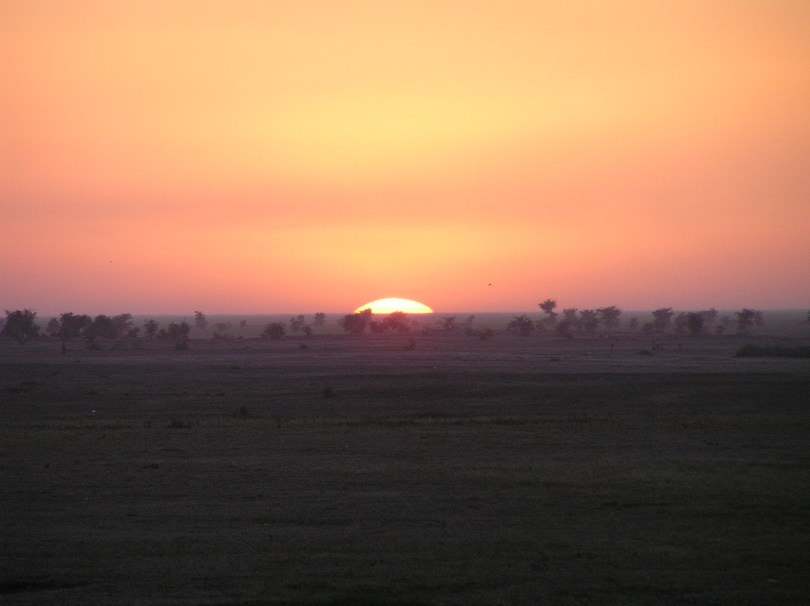
012608 The Long Road Back to Bamako

After making it through the whole trip with nary a hint of illness whatsoever, the previous evening’s fancypants meal had me bounding out of bed at 3:30am, horribly diarrhetic and profusely vomiting in that wonderful private bathroom of ours. I was up three times during the night to similarly expulse and with all the tossing, turning, and moaning in between I managed little to no sleep at all; m’lady didn’t sleep much either. I’m pretty sure it was the duck pâté; I’ve not had pâté since.
So shortly after watching the most beautiful sunrise through our room’s tiny window at 6am m’lady and I got up and around and sat ourselves down in the courtyard for breakfast, which was almost immediately placed before us even at such an early hour. As good as it was, my ill health only allowed me to get down a single banana and two small nibbles of their wonderful freshly baked bread. I felt miserable.
It was with much trepidation but little choice that we faced a long travel day. Directly after breakfast we checked out of the hotel and set out for a dusty walk into town. Along the way I was very concerned about keeping my insides inside and woefully lamenting having rid myself only yesterday of the world’s most effective anti-nauseant.
In Djenné’s town centre we bought collectif tickets to get us to Carrefour, the crossroads that leads to Mopti in one direction and Bamako in the other. Of course the collectif doesn’t depart until it’s full, and we waited a solid three hours before ours left. And I tell you, when a collectif around these parts is full, it’s full. We were nineteen passengers in a Toyota minivan that was just barely being held together with little more than duct tape, baling wire and hope. I had a glad baggie in my pocket in case of vomiting and a silent prayer in my soul in case of diarrhea. I closed my eyes, leaned my head against the tiny opening in the window, and just tried to endure.
Along the way I thought for sure I was gonna turn inside-out. I even whispered to m’lady that I wasn’t going to make it, but I did somehow manage to hold things together. After some time we came to a riverbank where our collectif was forced to join a long line of vehicles waiting for a small ferry, so we had to wait again. My gawd, it was so hard. It was almost 10:30am by the time we made it to Carrefour, where the two of us were dropped off at a barren crossroads with a distinct middle-of-nowhere vibe about it.
At the crossroads our job was not simply to wait, we had to actually had physically flag down any bus we saw that was heading our way, which in this case was Bamako. It’s not like we were at a bus stop or a collectif depot or, well, anything. We were simply two people and their luggage sitting in the hot midday sun on the side of an empty, sandy crossroads in the middle of North Africa, one of them feeling very sick. I mean this place was desolate, and the road proved to have very little traffic of any kind going in any direction.
And so we sat.
We weren’t just waiting for any old bus to come by. We had to hope for a bus that was both going to Bamako and had at least two empty seats available. The first one we managed to flag was heading to Mopti; no good for us. Then came a bus with a sign in the window that read “Bamako” but it must have been full because it just zoomed on past us as we both flailed around on the side of the road like we were doing jumping jacks. it was two hours of Mopti busses and full Bamako busses before we finally hit the jackpot. We climbed aboard the creaky old bus and paid our fare, slumping into our seats exhausted and quiet ecstatic to be on the road to the capitol.
The bus ride from Bamako to Mopti had taken us nine-and-a-half hours, and with Djenné lying two hours closer to Bamako we figured we’d be in for a seven, maybe an eight hour ride. But the bus stopped a lot; if we weren’t pulling over so all the mens could get off to pray we were stopping to pick up or drop off passengers, but mostly the bus stopped so the many roadside merchants could rush the bus screaming and holding up their wares. I tell you, I never have to hear another woman yell, “Benubé! Benubé! Benubé! Benubé! Benubé!” I had no idea what those ladies were selling and I never found out because I wasn’t buying.
I swear it must have hit at least forty degrees in that bus. With no air-conditioning or ventilation on board (there was no bathroom either) the only air movement came from a hatch in the ceiling that was propped half-open. Unfortunately, with every gust of hot air that flitted through that hatch also came a dusting of debris from the ever-changing roof load – mostly bits of hay – so it was of little comfort overall. At one point we ended up stopped on the side of the road for well over an hour while a bunch of things that had been mistakenly unloaded from the roof were repacked and strapped down.
During most of these stops everyone would get off the bus, while I would remain in my seat and suffer through my illness. I felt like hell but at least I was sitting down, and as hot as it was it in the bus it seemed even worse to be out in the searing sun. At one stop m’lady stepped back on the bus to grab her camera, telling me that I should come with her. “You’ve got to see this,” she told me. “Really?” I replied weakly. “Yes, come on!” she insisted, waving me to follow her as she walked back towards the door. With great effort I pulled myself to my feet and shuffled off the bus.
I hadn’t had the wherewithal to wonder why everyone had been sending bales of hay and indeed their luggage up onto the roof instead of utilizing the luggage compartment in the bus’s undercarriage like we had, but I soon found out. It turns out that the storage area underneath the bus was being used exclusively for goats. Yes, live goats. Dozens of them, each one wrapped up in a burlap sack with just their bleating heads poking out. Every goat had its owners name written on one of its horns in Sharpie. A couple of passengers that had reached their stop were searching through the animals looking for their names, picking up and setting aside goats-in-sacks like they were pieces of luggage. It was very odd to watch.

Speaking of which, as m’lady clicked a couple of pictures of this odd sight the other passengers stared at her like she was crazy. I couldn’t understand their language but it was clear to me that they were muttering things to each other like “Why is this woman taking photos of our luggage?” and “Where do they put their travel-goats when they take busses back wherever she comes from?” Hilarious.
Oh, did I imply that the compartment “exclusively” held goats? If so then please accept my apologies, as that’s not entirely the case. For underneath that big pile of smelly livestock was our luggage (and nothing else), including my beloved shoulderbag. From that point onward m’lady would only refer to it as my “goat bag” (and not in a good way), scrunching up her nose every time she saw it. I finally threw it away out of fear that her face might one day get stuck in that position. (“Oh, she’s happy to meet you, her face is just stuck that way…”
In my ginger condition I was afraid to eat any of the mysterious food that was being offered roadside. By late afternoon m’lady and I were both extremely hot and very hungry. I was losing every shred of hope or humour and was fast approaching an extremely downtrodden outlook on my entire situation. As the heat became more and more unbearable I finally sprung for a frozen drink-in-a-bag during one of the merchant rushes simply so m’lady and I could rub on our bodies in order to stave off heatstroke. As the bus lumbered on I stared at the blazing sun outside the window with a grim disposition and silently begged it to just…go…down…
It seemed like time was crawling by at a pace just a bit slower than our impossibly slow bus was traveling, and as the journey stretched on and on m’lady and I became more and more irritated each time the bus stopped for yet another group of roadside merchants. I mean really, if you think you’re probably going to want a banana in a little while couldn’t you just buy one now? Do we really have to stop every half-hour just to see if you’re hungry for benubé yet? I swear I was this close to the end of my rope when we finally pulled into Bamako after a sixteen-hour travel day. I had made it. It had been extremely difficult, but I had made it.
(And I didn’t even have to use that ziplock baggie that I’d brought along in case of an emergency. Nor the silent prayer.)
Though it could have been worse. I could have been riding with the goats.
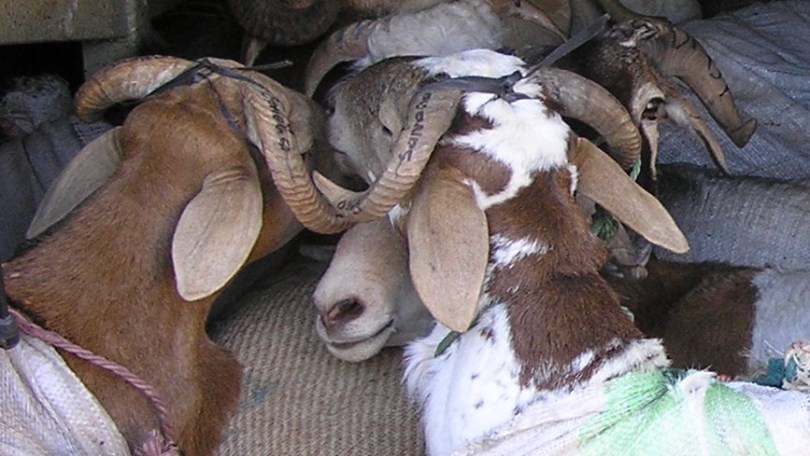
112708 No Problem
Ahhh, what a luxury to have slept in for what I believe was just the third time on this vacation. And here it was our last day in Africa.
When we’d checked out of our Bamako hotel two weeks earlier m’lady and I had taken advantage of their luggage storage service and left a bag of clothes behind; long pants, jackets, and sweaters that we needed for our stopovers in Paris. Inquiring with the proprietor on this morning we discovered that the items we’d left behind had been indiscriminately amalgamated into a large pile of other people’s clothing, and that both my jacket and one of m’lady’s shirts were missing.
“No problem,” insisted the hotel guy as we picked through the laundry-laden table for our things, “no problem.” He seemed baffled at our dismay, repeating over and over again that there was no problem as we sifted through the pile. It was his mantra. We tried to explain why we were upset but he simply didn’t understand, indicating with a wave of his hand that there were plenty of clothes for us to choose from.
“But we don’t want to take someone else’s clothes,” we pleaded. “We don’t want to cause the same problem for them that we are having now.” I swear, the man just stood there blinking his eyes in baffled non-comprehension. “No problem,” he repeated, shrugging and sweeping his arms at the pile. “You take!” Needless to say, we took nothing that wasn’t ours.
Aside from this minor-yet-significant loss, I was also rather concerned about the djembe that I had purchased on our first day in Mali. When I’d paid for the drum (in full) it was with the understanding that it would be waiting for me here at the hotel when we returned. It wasn’t.
I made some phone calls and eventually spoke with Sandy the drum luthier, who tried to assure me that all was well and that the drum would be delivered promptly. I was left with no option but to believe him. With fingers firmly crossed I set out to find a bank machine where I could withdraw some much needed cash on my Visa – a chore that proved surprisingly simple – and then m’lady and I looked around for a place to have lunch.
While we were eating Sandy walked up to our table and handed me the drum. I was so surprised to see him and so happy with the djembe that I didn’t think to ask Sandy how he knew where to find us, so I am left to wonder about it for the rest of my life. He didn’t have the cover with him, for which I had paid an extra 10,000CFA ($23.50), explaining that the seamstress had asked for 20,000 to make the cover. I told him that was more than I was willing to pay and that I’d rather have my 10,000 back. He said that he understood, promising that he’d come to our hotel with the money at 6pm that evening.
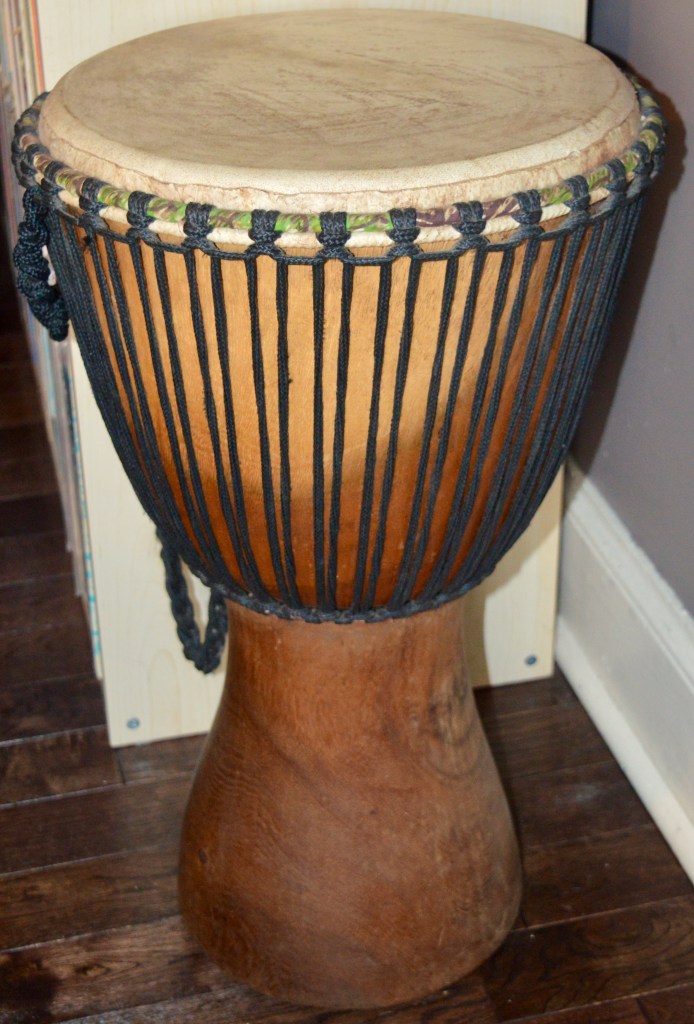
“No problem.” Oh boy.
M’lady and I were both hoping to buy a few souvenirs before leaving the country so we flagged a taxi and went to the market. Even though the ride was fairly long and very cheap, the cabbie was so eager for our return fare that he promised to wait for us even when we told him that we’d be an hour or more. That was fine with him, he parked the car and joined us on our shopping trip.
I’m not sure what kept me busier, the ceaseless bargaining required to obtain any item or the endless barrage of hawks pulling me (and my pockets full of precious CFA’s) in one direction or another hoping their shop would catch my eye. And once you have a bag of purchases in your hand – proving that you’re not “just looking” – the hawks go into overdrive! Even as we tried to return to our taxi we were surrounded by a moving phalanx of merchants attempting to push their wares into our hands and dropping their prices with every step. When we finally got to the car a few of the merchants all but crawled into the cab with us, the rest thrusting products at us through the open windows. Just as we were pulling away I bought a wooden mask for 3,000CFA. The starting price had been 50,000.
Back at the hotel there was no Sandy and no 10,000. I went to find a payphone and ran into the waiter from the place where we’d had lunch (another odd coincidence) and he lent me his cellphone instead. I got in touch with Sandy and he promised he’d meet us at the airport at 9pm. Once again I was left with no option but to trust him. And though it had worked out last time, I didn’t have a very good feeling about this time. I shrugged, showered, packed, paid the hotel bill, and called a cab to get us to the airport.
When we got there m’lady went inside while I waited out front for Sandy. He arrived an hour late with a pile of excuses and no money, suggesting that I should just hurry up and clear security for my flight. He told me that he was there to pick up a couple of arriving tourists and my grinding disappointment at getting rooked out of twenty bucks gave me the idea to wait around and let those tourists know that this guy had cheated me out of money. Sandy read my mind. Eyeing me coldly, he got up and walked over to a nearby security guard. They exchanged a few words, glancing over their shoulders at me the whole while. I took this as my cue to drop the issue and get my ass through security, so I did.
It was a frustrating and seemingly out-of-character final impression of a country that I had enjoyed so immensely, but in comparison to the great time that we’d had in Mali it was a trifle. Not even.
When m’lady and I reunited at the gate we were both astonishingly hungry and disgruntled at having our final few hours in Mali wasted on a minor frustration that robbed us of time to refresh ourselves at the airport bar. Luckily, when we boarded the plane we were surprised to learn that we had both dinner and breakfast to look forward to during our five-hour flight, not to mention a steady supply of free drinks, so we made it okay. Have I mentioned that I love Air France?
And so, after munching on chicken parm with roasted potatoes and swooning about our amazing experience travelling to Africa for the first time we hunkered down for the remainder of the flight eagerly anticipating the upcoming grandiose luxury of Paris.
112808 Paris
Following a relatively luxurious overnight flight that managed to squeeze both a dinner and a petit-déjeuner into less than five hours of airtime, m’lady and I touched down in Paris a little earlier than expected. Our visions of having to wait several hours before being able to check in to our hotel were somewhat alleviated by a remarkably long wait to get through the Charles De Gaulle airport terminal, a rather consistent happenstance that m’lady had warned me to expect. Over an hour waiting to clear customs tried my patience, and when we were suddenly corralled back and forth through the terminal just before we exited the building due to a bag that had been left unattended somewhere my frustration level was in danger of shifting into high gear.
But I maintained. The European leg of our vacation was going to be short and I didn’t have a lot of extra time to waste on petty anger.
When we were finally cleared to enter the airport’s common area we inquired about luggage storage but with the price set at fifteen euros per bag per day we decided to haul my new drum and our grimy goat-smell sack of Dogon blankets to our hotel after all. We took a train to the metro and then took the metro to our hotel, where we managed to arrive a full ninety minutes early for our noon check-in time. We did a good job at killing the time, enjoying a rather hearty continental breakfast at the hotel next door for eight euros apiece before retiring back in our hotel’s lobby and rifling through their free wifi. I believe our sleepy disheveledness in addition to our rank and sticky pile of unsightly luggage inspired the hotel staff to get busy prepping our room; we were checked in by 11:30am.
Using priceline.com we’d booked ourselves into the three-star Novotel La Defence for just $55 a night (prices posted in the room started around 200 euros), Were assigned to a corner room on the 11th floor. As soon as we stepped into the room I threw back the curtains and was shocked to see the Eiffel Tower standing in the distance, just like in the movies. I took m’lady into my arms and we danced ourselves silly at the mind-numbing luxury of our accommodations. Pillows, a comfy bed, no mozzie net, in-room toilet and shower and bath, hot and cold running water that was safe to drink, a coffee maker, fridge, desk, and couch…it was all so glorious. We spun around arm-in-arm until we fell onto the bed, landing with a comfort that tingled.
We both dozed off for about three hours. When we got up we lingered over coffees and continued to swoon over the view. It felt like we had just awoken from our first night in Paris, but in reality is was still mid-afternoon on day one. After some relaxed puttering we lackadaisically headed back to the metro and made our way towards the Tower. Emerging from the metro tunnel we rounded a corner and were smacked to find the most famous landmark in Paris looming large in front of us. The iconic structure truly is a beautiful sight to see, and of course it is incredibly popular with the tourists. We took our places at the end of a very long lineup to buy tickets and waited shivering in the cold, both of us underdressed for the weather.

As a matter of fact I was wearing just a t-shirt beneath a long-sleeved nightshirt to repel the late-November chill – which put the temperature around five degrees – having lost my jacket and sweater in Mali.
The Eiffel Tower ticket booth offers three pricing levels to choose from; we opted for the middle. By the time we ascended the elevator to the second observation tier the sun had gone down and we were confronted with a perfectly romantic night-time view of the City of Love. Or is it the City of Lights? It felt like it must be both as we stood at the railing hugging each other for warmth and gazing quietly over the glittering horizon. It was a moment I had been anticipating since Grade 4. I leaned in and whispered into m’lady’s ear: “Voulez-vous coucher avec moi?”
All the practising had clearly paid off: It worked.
We walked all around our allotted level and enjoyed the amazing views from all sides. Paris really is a beautiful city, perhaps especially at night. Eventually we descended the stairs to explore the first level (here’s a pro tip: if you pay for the first level you are free to walk up the stairs to the second level for no extra charge), which wasn’t quite as picturesque but still plenty nifty. There’s a small post office there – m’lady mailed me a postcard – plus they have a section of glass floor and info panels and other cool things. We considered sharing a snack but budgetary restraints framed by visions of our cozy and warm room back at the Novotel pushed us past the tower restaurant and towards the exit. Back on the sidewalk we shivered through the chill evening, warming up with a purposely slow dinner at a restaurant near the metro.
Our waiter was straight out of the movies, exuding a subtle air of superiority and sporting an accent so perfect it bordered on cliché. I couldn’t resist; I ordered all the French food this proletariat anglophone could think of: onion soup and a side of fries. Plus a beer, of course. M’lady had the same, except we shared the fries. Again: we were on a budget.
The soup arrived burnt, with the croutons toasted black. Now, I love burnt food – I’ve long claimed that carcinogen is my favourite spice – so I loved it. ‘Matter of fact it might have been the best French onion soup I’ve ever had. M’lady, not so much. I let her lean into the fries pretty heavily, which were also quite good.
Warmed from our supper, we swooned arm-in-arm through the rues until we found the hotel. Up in our room we jumped right in bed and quickly went to sleep, capping the first truly relaxing holiday-style day of our trip since our days lazing down the Niger River, which m’lady had been too sick to enjoy.
PS Despite rumours to the contrary, the ladies in France do indeed wear pants.
112908 Fin, et Bonne Nuit
M’lady and I woke up early and easy, wrapped deliciously in the cool comfort of our relatively swank Paris hotel room. Opening the curtains, I could see the top of the distant Eiffel Tower shrouded in mist. I sighed quietly with serene delight and made us coffees. As much as we wanted to linger, we didn’t. With just a single full day in Paris we figured we’d better get on the tourist stuff right away, so we left our suite tout suite and were soon on the metro, headed for the Louvre (via the Arc de triomphe, which was clearly visible from the train).
Still revelling in the comforts of Western society, after we got off the metro we paused at a subterranean kiosk for more coffees and a couple of yummy pastries. We ended up entering the Louvre from the attached indoor food court/mall which robbed us of the splendour of first seeing the iconic museum from the outside. Ah well. We bought our tickets (nine euros each) and made for the entrance.
After getting our tickets punched we walked through a hallway lined with sculptures, first Italian and then Greek. The quality of the work was of course unparalleled, but to my untrained eyes it was impossible to track any improvements made during the 1,500 years that spanned the collections.
As we were leaving the area I noticed a side room that was roped-off due to construction. It was full of statues wrapped in plastic tarps, along with a forklift or two. I don’t know why I found the room so alluring, but I did. I stood and gaped for long, wondrous minutes.
We eventually came upon one of the world’s most renowned sculptures, the Venus de Milo. Again, these untrained eyes failed to discern why this piece is so much famouser than the others we saw. Though it is fun to wonder what mischievous things the missing arms might have been up to.
Due to the magnitude of astounding pieces on display in the magnificent gallery I soon began dismissing heralded works of genius with just the slightest appraisal before quickly continuing past the next iconic work of art, and the next and the next and the next. The same infliction would follow me throughout the Louvre, as all afternoon I would be confronted with wall after inconceivable wall laden with a countless number of mankind’s greatest artistic achievements.
It’s hard to miss the truly big stuff though, as crowds tended to gather around the unmissables. Here were five of Da Vinci’s paintings hanging side-by-side – yes, five of them – including his wonderfully dark and androgynous John The Baptist and the unfortunately unnamed Girl. Right there on the same wall was a third of the surviving paintings by history’s greatest painter (and inventor). I mean: Wow.
And that doesn’t even include the Mona Lisa. That greatest of great masterpieces lives under constant security supervision and crowd adulation in another room altogether. Here was the most famous painting in human history; we decided to give it some time. We stood there long enough to advance to the front row, where we remained for a brief linger. A damn fine piece – no question about that – but again, I’ve no idea why it is so famous. Though I am very glad mine eyes have finally seen it.
Even after drifting through room after room of the world’s greatest art my soul was still prime for stirring. Ducking down a hallway my heart jolted from its cage when I came upon special exhibit featuring a book of snippets and musical motifs hand-written by Igor Stravinsky as he was developing his groundbreaking ballet The Rite Of Spring, one of the most important and revolutionary compositions of the 20th Century. I was all aflutter.
Around the next corner was a nifty little Picasso presentation, also a temporary exhibit. Picasso had done a series based on Delacroix’s Women of Algiers in Their Apartment and the Louvre possessed about fifteen of the pieces, which they had hanging together alongside the Delacroix original. I love Picasso, and I found such modern work a refreshing change from the Louvre’s overwhelmingly classic-leaning collection.
Other memorable highlights from the visit were the coronation crown of Louis XV, which was studded with hundreds of the biggest diamonds you ever did see, plus The Club-Footed Boy by Jusepe de Ribera, The Raft of the Medusa by Théodore Géricault and so many others. Though like I say, more often than not I offered mere seconds of my paltry attention to masterpieces that took great artists years to complete.
And I complain about the life of a musician.
Though the well-adorned walls didn’t leave much room for windows, throughout the afternoon I managed a few peeks at the exterior of the buildings that we were in. Each glimpse outside was another reminder of the stunning architecture of the Louvre, so when we were too tired to explore the museum any further we made a point of exiting through the main courtyard, which was a sight to behold in and of itself. The classic architecture appointed with dozens of sublime statues poised gazing down upon we mortals was offset by the gallery’s iconic contemporary crystal pyramid at its centre. I found the juxtaposition odd – frankly I’ve never been a fan of that modern glass triangle – but what else could one imagine being added to such archetypal French architecture without being, at the least, atavistic?
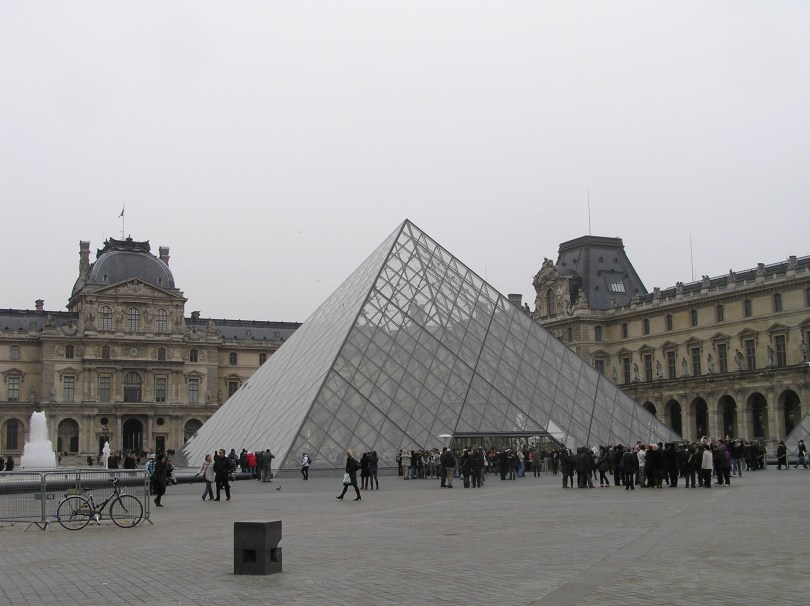
Meandering through several gift shops along Rue de Rivoli, we stopped for a small lunch before continuing our tour de France at the Notre Dame Cathedral. Just walking along random streets in the beautiful city was pleasure enough, but to come across standing works of art like the Notre Dame Cathedral takes the breath away. Like, for real.
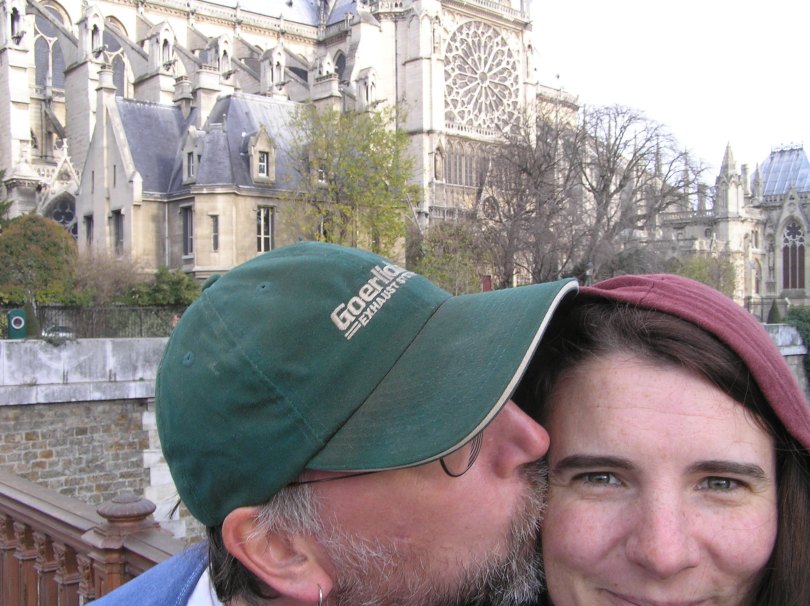
Entrance was free so we took a little tour of the place, and I can report that it was truly majestic (this was more than ten years before a devastating fire collapsed the cathedral’s spire and destroyed the roof). One thing about those Catholics, they sure can commission a piece of architecture! It was a solemn thrill to walk upon the same carved stone floor where people had walked for over eight centuries. It saddened me a bit to be experiencing the Notre Dame Cathedral without having read The Hunchback of Notre Dame, and I’m sure when I do eventually read it I will be kicking myself for not taking more notice of this part of the chapel or that part of the ceiling…or whatever pieces of the building that feature prominently in the novel.
Once we quit the cathedral we wandered across one of the seemingly hundreds of bridges in the city and found the Latin Quarter, which was basically a series of winding cobblestone streets that housed a thousand restaurants separated by the occasional gift shop. We snubbed all the restaurants in favour of a bottle of cheap wine and hit the metro.
Relaxing back at the hotel with the wine and the cozy made it difficult to strike out for another bout of tourism, but as the evening wore on m’lady convinced me that we should do a little more sightseeing. She led us to Montmartre, which was an area that I had been eager to check out.
I could actually feel the history ooze out of the pavement as we walked streets made popular by the bohemian set of the roaring 20’s, past bars and restaurants where notables like Pablo Picasso and Erik Satie surely discussed the merits of acts such as La Petomane whilst sipping on mind-numbing absinthe. We shunned the funicular and instead climbed the steps up to the Sacré-Cœur where we popped inside the smaller but equally grand cathedral for a quick look. Back outside, I bought a couple of beers off a random stranger to enjoy as we checked out the area atop the hill, including an idle perusal through a small popup market.

So, whereas the previous day had begun with a petit petit-déjeuner and ended with a tour of la tour, this evening we’d enjoyed a marche through la marché upon Montemarte.
Ultimately we made our way back to one of those restaurants in the Latin Quarter where we enjoyed a lovely dinner amid the extremely active Friday night revellers that were out in full force. After shunning dessert we escaped the hubbub in favour of our hotel room where we snuggled in for our last night of our wonderful Parisian vacation-in-a-vacation.
* * *
In the morning we woke up early enough to rush out and catch one final museum before hurrying back in time for our 12pm check out time but y’know what? We said au diable avec ça and lounged in bed all morning instead, making do with occasional sigh-inducing glances of the Eiffel Tower outside our window. We’ll be back to Paris someday, no need to pack it all in on one weekend. And frankly, squeezing the Louvre, the Eiffel Tower, Montmartre and the Notre Dame Cathedral (not to mention all the swooning) into a fifty-seven-hour visit, I think we did okay on the sightseeing front.
After checkout we hauled all of our stuff – which was a pretty significant pile – back along the metro and train lines, and after a slight delay on the train (they must have called ahead and found the airport people were too busy to hold us up) we were back at the airport, shopping the duty-free and cringing at the exorbitant costs in the airport cafeteria. Extremely satisfied with our vacation and simultaneously ecstatic to be heading home, we squished into the packed airplane and lofted our way back to Canada. After a brief wait in Montréal the Air France bus delivered us back to the Ottawa terminal where we arrived to a slight snowfall that made everything look just perfect.
In summary, I would highly recommend Mali (and Paris for that matter) to any intrepid traveler*. It’s not Club Med on the beach, but then again it’s not Club Med on the beach either.
*I hasten to highly recommend that you check with the Canadian consulate for travel advisories before you book your ticket. Just days after we returned from this trip al-Qaeda operatives working with Tuareg nomads kidnapped two Canadian diplomats and held them captive for several months, finally releasing them in exchange for $1.1 million in ransom. And that was just the beginning of a long list of sheer nuttiness that has been going on in Mali pretty much ever since. Will I go back? Hopefully eventually.
But not today.
 Todd Man Out