 Posted by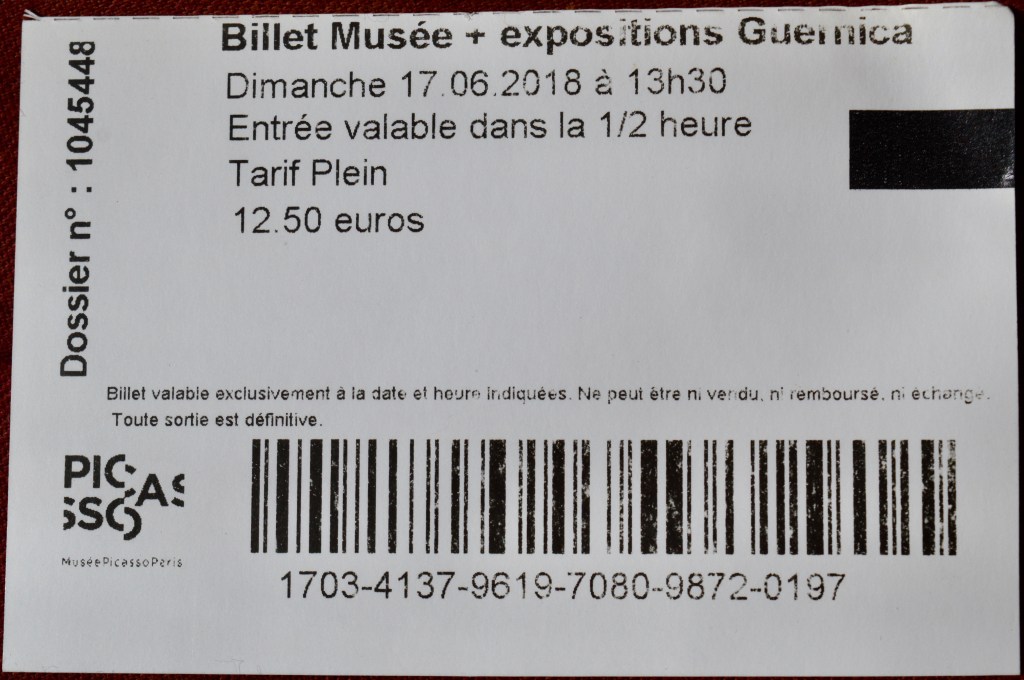
What an amazing joyous pleasure it was to stop over in Paris for a few days on our way home from a arduous, frustrating, and extremely successful instrument drop in Ghana. There’s something about Paris that makes it remarkably alluring; I don’t know what that ‘something’ is but I feel it strongly.
We stayed in the Montmartre district – just across the street from the Moulin Rouge – and spent the days walking hand-in-hand along the winding streets, dining on cheese, wine and baguettes along the Seine, and doing a whole lot of swooning.
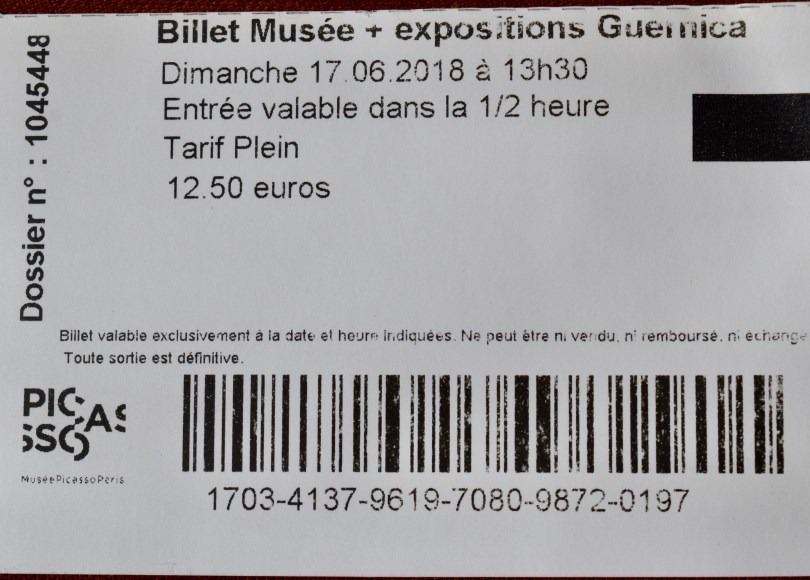
And on June 17th, 2018 we swooned ourselves all the way to the Picasso Museum, almost five kilometres by foot from our hotel (that’s a lot of swooning). The musée was housed in a mansion that dates from the mid-seventeenth century, and while the architecture was certainly impressive, the extensive renovations required to turn a residence into an art gallery – with it’s plain white walls and new hardwood flooring – muted the elegance of the old structure. No matter though, we were here to see the work of the master painter, not the architect.
Unfortunately (for me, though others might have thought otherwise) the museum was presenting a special exhibit on Picasso’s huge political masterpiece Guernica, and nearly every room had been employed in the task of educating patrons on that single piece of art. Which is fine, I suppose, but I had already learned an awful lot about it in high school (Guernica made up the entire cover of our Grade 12 history textbook and as a result Mr. Bowser gave us an extended overview of the work, it’s inspiration, and it’s significance).
A summery of what I learned from Bobby Bowser and what I relearned at the museum that day is presented here, in a cut ’n paste from the world’s leading website dedicated to truth-by-consensus, wikipedia: “The painting was created in response to the bombing of Guernica, a Basque country town in northern Spain, by Nazi Germany and Italian warplanes at the request of the Spanish Nationalists. Upon completion, Guernica was exhibited at the Spanish display at the 1937 World’s Fair in Paris and then at other venues around the world. The touring exhibition was used to raise funds for Spanish war relief. The painting became famous and widely acclaimed, and it helped bring worldwide attention to the Spanish Civil War.”
After exploring room after room of Picasso’s sketches and smaller studies that led up to his massive artistic feat the gallery funnelled it’s patrons into a large room that held a woodcut of the full Guernica along one wall, looking like a photographic negative of the original. And (believe it or don’t) that’s all we got, as Guernica actually hangs on a wall at the Museo Reina Sofia in Madrid, Spain.
The oddest thing to ponder is the fact that Guernica is a straight-up painting (I believe), and not a pressing from a woodcut. Also odd is that the museum had little or no information on queries of this nature.
Like, can you believe they took over a whole museum (okay, three out of five floors) in service of a single piece of art without even having the piece in question as part of the exhibit? Crazy. But still, it was Picasso so it was interesting, and of course a tasty visual treat.
Back on the street m’lady and I immediately went back to our swooning ways and decided to shun any and all museums for the remainder of our stay.
(Every staircase inside the museum had those little bumps embedded into the floor at the top and bottom, which I have always assumed were installed for the benefit of blind people, to let them know that stairs are afoot. I found this very, very odd, given the context. Like, how many blind people go to art galleries?)
 Todd Man Out