 Posted by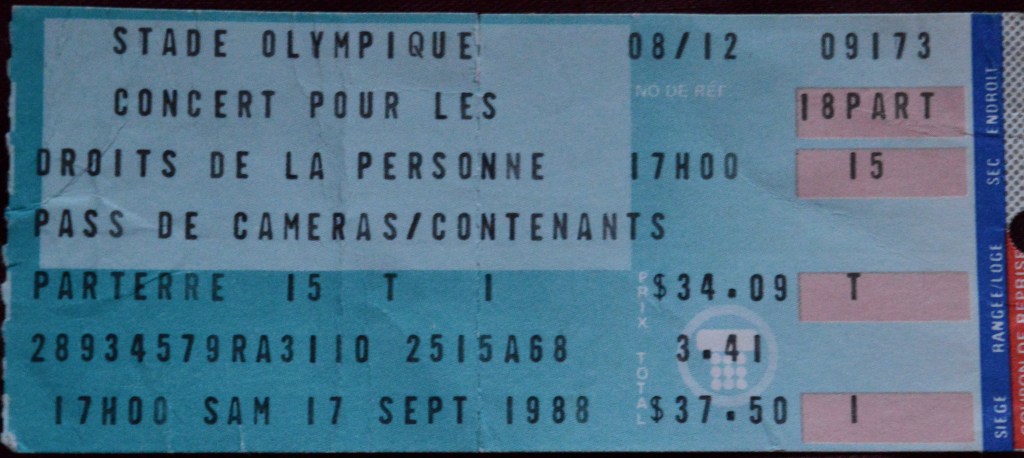
When I went to Montreal in the summer of ’88 with my friend Carlton to see Bob Dylan (and inadvertently the Montreal Jazz Festival) we momentarily joined a bunch of young people that were sitting on a grassy rise that overlooked the jazzfest site. I still recall it exactly: it was the southwest side of Rue Jeanne-Mance and it’s one of the few chunks of earth that has emerged thus far unscathed from the urban/arts concrete development that has risen in the area.
Which is to say the hill is still there.
Anyway, I met a girl that was hanging out with her friends. I told her that we had driven to Montreal from Moncton to see the Bob Dylan concert at the Forum and she responded by telling me about an upcoming concert that I might be interested in returning for. It was something called Amnesty International Human Rights Now! and it would be an all-day affair featuring sets by Sting, Peter Gabriel and several others at the Olympic Stadium.
She was right: I was interested. I gave her my address and she eventually sent me a pair of tickets in the mail. I sent back a crisp $75 bill and that was the end of our relationship.
As the date neared I must have been scrambling to find someone to go with because I ended up taking a guy who lived in the neighbourhood. He was dating a girl I worked with at the local gas station and he had an ugly habit of chewing his fingernails down to bloody stumps. I didn’t know him very well and this trip is one of my only lasting memories of the guy.
We drove up in my Buick Skylark and somehow ended up staying with my buddy Carlton’s cousin who had recently moved out of his parent’s house in Mont Saint-Hilaire to go to McGill. I wasn’t crazy about the guy but he was nice enough to give me the t-shirt he had purchased when we saw Dylan together a few months earlier. I remember him telling me that he thought I’d appreciate it more than he would, which was pretty cool of him.
The night before the concert my companion and I hit the town; it was his first time in Montreal. Neither of us had much money so we didn’t hit the town very hard. I wanted to go to some pub and have a few beers but once my buddy got one look at all the strip bars along Ste. Catherine Street he was adamant. As much as he felt compelled to go into a peeler bar I was equally repugnant on the idea. Finally I begrudgingly agreed to go in for one beer. I kept my end of the deal, had my beer and called for the bill and ended up spending the next hour sitting on the sidewalk outside waiting for my guy to come out of the strip bar.
I went in a few times and told him he was spending all his money, told him we had to save money to eat and he’d probably want a beer at the show tomorrow, but like a pig on stink nothing could keep that man away from those girls.
Not until his pockets were empty that is, at which point he was out on the sidewalk in a flash.
I had squirrelled away $40 from my already-meagre finances to purchase a t-shirt at the concert and he knew it. He spent the rest of the night (the rest of the trip, frankly) begging for me to lend him that money and I spent the whole time saying no and meaning it.
I can’t remember if this was my first encounter with Amnesty International – it probably was – but I do know it was right around this time that I got a bunch of friends and family members to sponsor me when I took up the organization’s 30-Hour Famine challenge and starved myself silly for a day and-a-bit. (I ended my famine with a microwaved prefab sub sandwich from the gas station I worked at. At the time it was probably the greatest tasting food I had ever eaten and to this day I love, love, love me a good gas station-purchased microwaved pre-made submarine sandwich.)
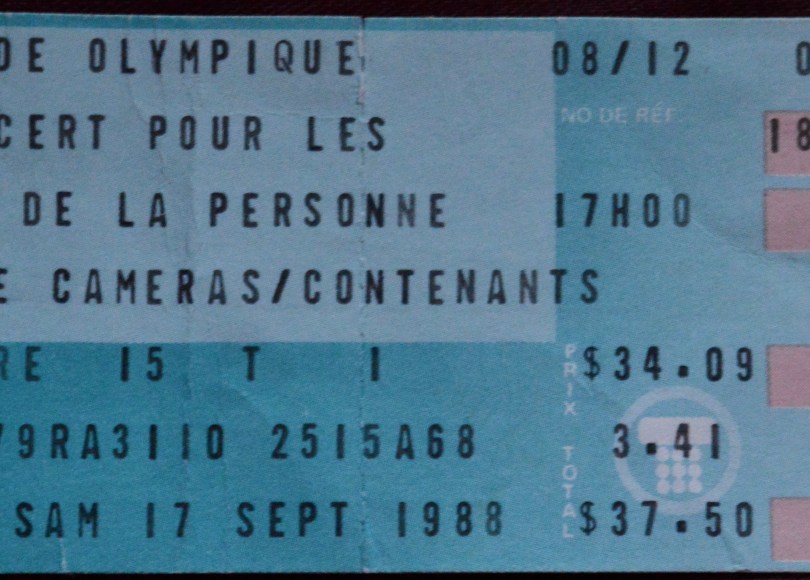
The show was on September 17th, 1988. It was the first time I had ever been inside the Olympic Stadium (though I had ridden the funicular up it’s protruding arm the last time I was in town) and I had never been in a room so large. The massive domed cavity looked like it could hold a small city and I suppose it could have. The attendance at that day’s concert was pretty close to the population of Moncton.
First up was the utterly unknown (to me at least) k.d. lang and a pair of artists very well known to the Quebecois audience (but sadly, not to me): Michel Rivard and Daniel Lavoie (no, not Daniel Lanois). Between sets two large screens played videos and short films promoting Amnesty International and human rights in general.
I spent those first three acts jockeying for position on the floor and listening to my companion whine and lament the result his poor judgement the night before. I was having none of it, I bought an awesome t-shirt for $35 that I still wear and love to this day and put him on ‘ignore’.
Youssou N’Dour was the first of the five featured headliners. I suspect this was my first experience with any sort of African or Afro-beat music – a continent-wide musical encompassing that I have come to universally endear – and I really dug it. However the biggest memory that remains with me from his set is visual rather than musical: N’Dour brought out a dancer who gyrated and flailed her arms about wildly and seemed to fly back and forth across the massive stage like a giant bird. I’m not sure my innocently ignorant aesthetics knew what to do with the sound and spectacle, but it sure caught my attention. N’Dour and his dancer sat in with Peter Gabriel for In Your Eyes too, which was pretty great.
Tracy Chapman followed N’Dour with a solo set that was really impressive. She had only recently hit the airwaves; so recently that I still didn’t have it clear as to whether she was a boy or a girl. No matter, she played a few songs that I had heard before and liked and overall her set was great.
Next up was Peter Gabriel. He was on his So tour and I swear to you I could write an entire book on how much this set meant to me. In (very, very) brief: the man leapt about the stage chased by aircraft landing lights attached to lengthy hydraulic arms mounted on moveable bases, and the whole time he belted out one amazing song after another backed by his remarkable band that was augmented by what I’m guessing must have been an Egyptian orchestra.
As I say, I remember so much about the eighty or so minutes Peter Gabriel was onstage but I’ll cut to the chase: He ended the set with Biko, his anthem about the anti-Apartheid activist who was beaten to death by South African police just eleven years before. At the end of the song Gabriel led the entire crowd in a rousing, lamenting singalong.
You know the ending of the song where he sings that part: “Oh, oh, ooohhhh…la da, la da la da” or whatever it is. Well, once Gabriel had all 60,000 of us singing along with him and raising our arms in unison, his band started leaving the stage. One by one the twenty or so musicians set down their instruments and quietly walked off the stage. Eventually all that was left was Peter Gabriel, a man playing a tama (talking drum), and a city-sized crowd of fans enthralled in the moment.
Then Peter Gabriel walked off the stage. And you know what? We all kept singing, even though the only music left was a simple beat coming from the sole musician remaining on the stage. After a few more runs through the oh-oh-ooohhhh stanza he too left the stage.
And then the most incredible thing happened.
The house lights came up in the huge room and roadies ran onto the stage rushing to strike the gear and set up for the upcoming Sting set. And nobody – I mean not a soul – nobody moved. Not one of us headed for the bathroom or made a run to the beer lines. Every person in that record-breaking crowd stood their ground, 60,000 arms still pumping as one, all of us still singing oh-oh-ooohhhh…la da, la da la da, just as loud as before. In fact, as it dawned on us what was happening, the staggering moment we were all spontaneously taking part in, we got even louder…even stronger.
To this day it stands out as one of the most emotional musical experiences of my life. When it it finally ended I turned to my pal with tears literally streaming down my face. Finding my tongue all I could do was mumble, “Wasn’t that incredible?”
“Yeah,” he said with a goofy voice that instantly turned my stomach. “For that last song I was rubbing up against some girl’s boob the whole time. It was awesome!”
I swear to you, that was the level of maturity and class, the calibre of character and sensitivity I shared this experience with, not a word of a lie.
I was a huge fan of The Police and this was my first time seeing Sting or anyone from the recently disbanded band. Truth be told he was the main reason I was there and I was pumped to see him. Just before Sting went on I was sitting on one of those metal barriers that get set up on GA floors sometimes. You know, the ones with a bunch of bars running up-and-down about four inches apart.
I was balancing myself by wedging my sneakered feet between those upright bars and when I inevitably slipped and fell off the barrier my right foot remained jammed in place. I went down hard, jerking my knee in a way it shouldn’t go with two hundred pounds of downward force. I instantly thought I had broken my right knee. Thankfully youthful flexibility saved the day and by the end of Sting’s relatively benign and somewhat boring set (you’d think that bringing Bruce Springsteen onstage for a set-closing duet on Every Breath You Take would be pretty exciting but really…it wasn’t) the pain had settled into a dull thud.
After buying the t-shirt and a sole beer at the show I had just enough money to pay for gas back to Moncton, so I was in effect broke. I had spent the last half of Sting’s set incessantly kicking a bottle that was annoyingly underfoot. When the houselights came up for the final changeover of the day I reached down and picked up the offending bottle. And lo, as some sort of cosmic reward for enduring this otherwise fantastic trip with such a boor I was delivered a gift from the concert gods in the form of an unopened half-pint of vodka.
I’m guessing I shared this manna with said boor, though he clearly deserved none of it.
Ironically, when that girl on the hill had first told me about this Human Rights Now! concert the headliner was supposed to be Def Leppard. I’ll admit to you that I was severely disappointed when I heard they had been replaced by Bruce Springsteen, who was still busily touring his monstrously successful and equally amazing Born in the USA album. I was a pretty big Def Leppard fan at the time. Springsteen not so much.
Sure I knew the hits off of the USA album but otherwise had no appreciation for the power and legacy of the performer I was about to see. And if you’ve ever seen The Boss and can imagine how astounding he was on that career-solidifying tour you can easily believe how much his set blew me away.
It. Was. Amazing.
This is getting way too long so I’ll skip Springsteen bringing Sting up to help him sing The River and the E Street Band performing Bob Marley’s Get Up, Stand Up featuring Sting, Peter Gabriel, and all of the day’s performers (save ms. lang) and cut to the encore, where Bruce lit up the house lights and closed the show with an endless, riotous version of Twist and Shout. I’ll never forget spinning around in a slow 360 and gaping at 60,000 people all dancing and singing together. It was like a reprise; an encore of our performance together at the close of Peter Gabriel’s set. A dancing, singing community celebration of an unforgettable day shared with thousands upon thousands of like-minded souls. It was a coming together of consciousness and a massive act of shared bliss.
That massive Springsteen Twist and Shout was pure tribal celebration and it produced an enormity of feeling in me that I’ve never felt again.
I also never went on a roadtrip with Daryl again. He can find his own tribe.
 Todd Man Out