 Posted by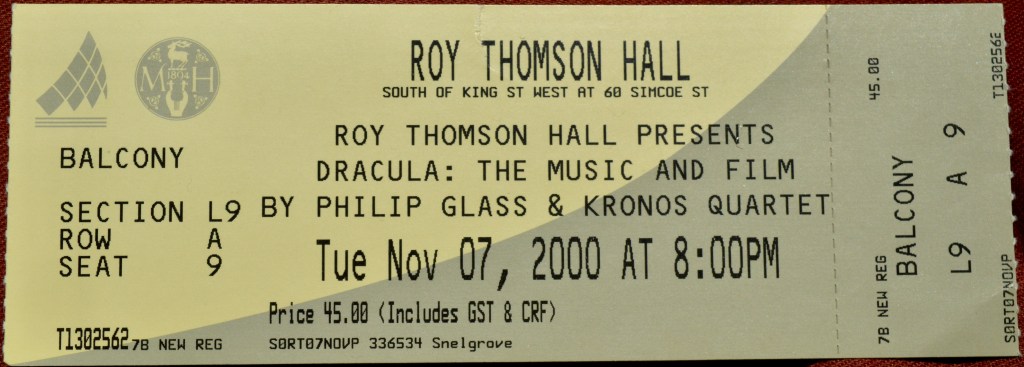
My third year composition class in Carleton University’s music department was tiny, with maybe eight students or so, and it was taught by Professor Patrick Cardy, a guy I really liked but I sure skipped a lot of his classes. Aside from being a very heavy and well-respected Canadian composer the guy was a theoretical genius who could cast lectures of potent mathematics that would alternate between gapingly insightful and utterly baffling. I generally got better marks when I attended his classes sporadically and relied heavily on the textbooks.
(I was even known to sneak up to the music department and slip my weekly theory assignments under his office door while he was giving the lecture I was currently skipping. Gadzooks, how insulting that must have been.)
Carleton’s music department was small and we saw each other a lot, every year. We were always cordial but because I skipped so many of his classes I always suspected that Cardy didn’t like me very much.
So there I was skipping Composition 300 the day Cardy handed out the pieces we would each have to analyze and write a paper on to present to the class. I got word that he had made a big deal of the fact that he was assigning me (in absentia) some big weird modern opera. While other students were getting short etudes and studies to work on for this, one of our big-mark assignments of the term, I got a four-hour monstrosity called Einstein On The Beach by some guy named Philip Glass. Just buying the damn thing on CD cost $90.
So I grudgingly dug in and initially found the “one-one-one-one-two-one-one-one-two” lyrical content pretty ridiculous, though I really liked the mathiness of it, being a big numbers guy myself. I started doing my research while listening to the minimalist epic over and over preparing to present my assignment. I became especially intrigued by Philip Glass’ additive process where he reveals a melody one note at a time, repeating the ever-lengthening figure until the melody is complete and then dropping the melody note-by-note until he’s left just a single pitch to be repeated over and over.
One-one-two-one-two-three-one-two-three-four-one-two-three-four-five-two-three-four-five-three-four-five-four-five-five-five-five…
I loved it and used the concept many times in both school compositions and stuff I would later write with my rock band Bob Loblaw. I came to realize that the whole of Einstein On The Beach was a mathematical wonder laid out in sound and I fell in love with both it and the composer.
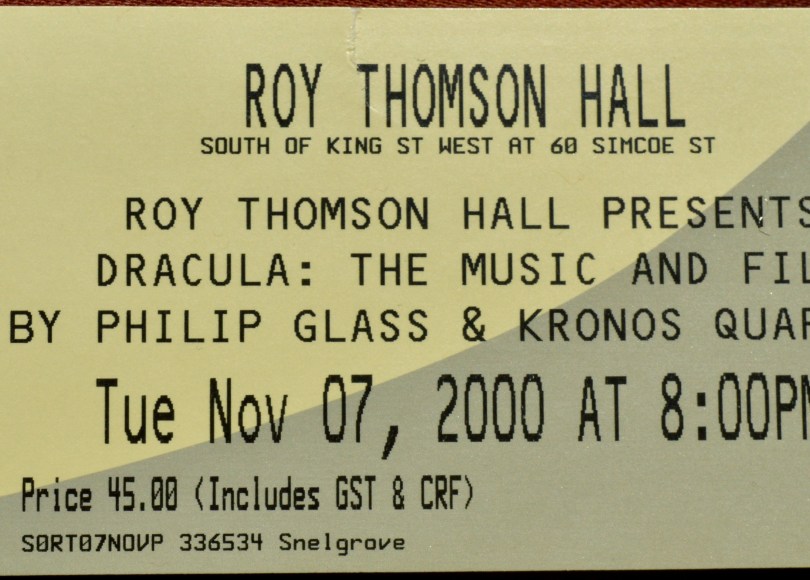
So there was no question I was going to get in my car and drive to Toronto to see Philip Glass at Roy Thompson Hall on November 7th, 2000. He was reimagining the music to Nesferatu, Bram Stoker’s Dracula story with the names and places changed to protect the innocent (and circumvent copyright issues), and he would be performing alongside the highly-regarded Kronos Quartet.
The show was sublime, surreal, sanguine, inspirational and intensely musical, in Glass’ typical overtly-minimalist style, if there can be such a thing in a post-John Cage era. The movie was interesting, I hadn’t seen the B&W German Expressionist film despite it being released almost ninety years previously, and it really helped keep things going for the show. While the music never got boring, with it’s near-droning repetition it might have without a coherent distraction like the film.
The evening was a musical purifier, that’s for sure. Modern Serious Music (for extreme lack of a better term, since the term “20th Century Music” no longer applies) can really get inside my rock and roll soul and smooth out the edges. It’s like a musical meditation of sorts and I sure do appreciate the fact that I learned to appreciate it.
And I unquestionably owe my appreciation of Philip Glass to Patrick Cardy, and my thanks to him for that. In retrospect I am utterly convinced that after two-and-a-half years of teaching me he saw my love of the mathematics that lie at the heart of all music and he specifically hand-selected Einstein On The Beach for my composition assignment knowing full well that it would have a big effect on me. Respect.
I also have him to thank for suggesting I apply for a job at the National Arts Centre, a role that I’ve had the great pleasure of filling for two decades now. And certainly once I had graduated and started teaching a class at Carleton myself I got to know my former prof a bit better and found out that no, he didn’t have it in for me for skipping all those classes when I was an undergrad. Again, respect.
Unfortunately Patrick Cardy died much too young in a bizarre curling accident. No kidding: he was fine, he went curling, he slipped and badly broke his arm, he went into cardiac arrest during surgery and he passed away that very day. It was as sad as it was unusual and unexpected, and our country lost a great composer and a good man that day. Look him up.
 Todd Man Out